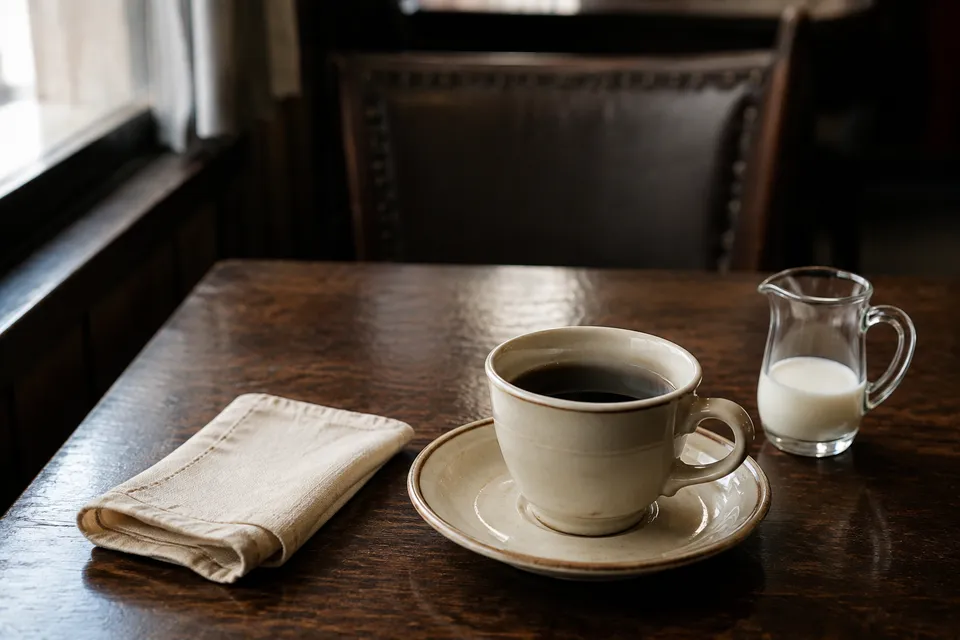
What the seat changes
A useful first distinction is between buying a drink and spending time in a place. At a takeaway counter, the cup follows your journey. In a seated kissaten, the next small part of the journey happens around the cup: choosing something from the menu, waiting for it, tasting it and noticing the room. Neither way is more authentically Japanese. They simply offer different experiences.
Kissaten literally refers to a place for drinking tea, but coffee is central to many of the shops travellers encounter. It is not a guarantee of one interior, one brewing method or one generation of customers. A busy neighbourhood café, a serious coffee counter and a room dedicated to recorded music can all sit under this broad label. A newly opened shop may draw on the same tradition without pretending to be old.
Look at what the room is arranged to support. Seats facing speakers suggest a different visit from large tables set for meals. Cups behind a counter may invite a conversation about coffee, but only if the person serving has time. Try ordering first and observing second. The people beside you are using a café, not performing everyday Japan for visitors.
Sources: JNTO: kissaten culture
Imported coffee, a local routine
Japan’s coffee culture did not begin as an isolated invention. The All Japan Coffee Association’s chronology records the opening of Kahiichakan in Tokyo in 1888. That is a useful historical landmark, not the date when everyone in Japan began drinking coffee. Tea continued alongside coffee, and shops developed in different cities and circumstances.
A more intimate example comes from Kyoto. Inoda began its coffee wholesale business in 1940 and opened its first coffee shop in 1947. Keeping those dates separate matters: the story starts with imported beans as a commodity, then becomes a place where people could gather. The company’s own history describes coffee attracting local businesspeople and cultural figures in the postwar years.
On a visit, the connection to other countries is right there in a blend of beans. The beans, the equipment and the idea of a café can travel; the way a particular shop roasts, serves and welcomes customers develops locally. This is a helpful way to understand Japanese culture beyond a choice between “traditional” and “foreign”. Something can come from elsewhere and still become part of a neighbourhood’s ordinary morning.
Try a small comparison rather than a ranking: have the house blend at one shop, then at another on a different day. Was it lighter, more bitter, rounder with milk, or served in a different-sized cup? Those are observations you can make without knowing professional tasting vocabulary. A flavour you enjoy is a good starting point for asking what the shop does differently.
Sources: All Japan Coffee Association: history / Inoda Coffee: company history
Six moments behind the café menu
Selected milestones, not a single origin story. Imported ideas, local businesses and new equipment reached the coffee table by different routes.
- 1888
A Tokyo coffee-house landmark
Kahiichakan opens, as recorded in the AJCA chronology.
- 1902
A soda fountain in Ginza
Shiseido’s pharmacy brings in an American-inspired idea.
- 1926
Lion is established
The café’s history connects its coffee to a London bakery.
- 1947
Inoda opens its café
The coffee wholesaler adds a place for people to gather.
Sources: Inoda Coffee: company history
- 1948
HARIO makes coffee siphons
Laboratory-glass expertise reaches the coffee counter.
- 1950s
Morning-service accounts in Ichinomiya
Several local accounts survive; the first shop is not established.
Why does breakfast arrive with a drink?
In a morning-service café, the drink can be the starting point of breakfast. A basic service may include toast and a small accompaniment; a larger plate may cost extra. This is different from assuming that every breakfast-looking picture is included. Read the time window, the qualifying drink and the price beside the food before you order.
Ichinomiya, north of Nagoya, offers a particularly revealing local story. Its morning association links the custom to the textile trade in the early postwar growth years: coffee shops served people involved in the industry and added food such as boiled eggs and peanuts. Food alongside a drink makes sense as a welcome for people who come back during their working lives.
The same association’s investigation is refreshingly cautious about an exact birthplace. It records several accounts and does not establish a single uncontested first shop. We should keep that uncertainty. The textile connection helps explain one regional setting; it does not prove that every morning service in Japan descended from one plate.
For a visitor, this turns an ordinary breakfast into a way of getting to know a region. Choose a café that fits the morning you have: a simple toast beside your drink before a museum, or a separately priced sandwich before a longer rail journey. On another day, try a shop with a different accompaniment and notice what changes. The small choices make each morning feel a little different; check what is included each time.
Sources: Ichinomiya Morning: local background / Ichinomiya Morning: competing origin accounts
A familiar dish, with a different destination
Bread, pasta and custard may already be familiar before you reach Japan. That familiarity is useful: it lets you notice the changes. Thick, softly resilient toast gives butter somewhere to melt. Sweet bean paste brings a flavour associated with Japanese sweets onto bread. An egg sandwich may emphasise a warm omelette rather than chopped egg. None needs to be judged against a single foreign “original” to be enjoyed.
Napolitan is an especially good example. A typical café version uses a sweet-tangy ketchup sauce; it is not a promise of a dish you would order in Naples. Hotel New Grand in Yokohama gives its own postwar account: chef Shigetada Irie developed a spaghetti dish after encounters with American servicemen’s ketchup pasta. The hotel’s version uses a tomato-based sauce including fresh and canned tomatoes and tomato paste. Calling every napolitan “the hotel’s ketchup recipe” would miss that distinction.
The name can travel in another direction, too. Shiseido Parlour traces its beginnings to a 1902 soda fountain inspired by American drugstores. A glass of soda and ice cream in Japan therefore has a wider family than its retro appearance might suggest. It belongs to a story of shops borrowing an idea, changing its setting and giving people a reason to return.
These are specific business histories, not proof of a single origin for every café dish. They are worth knowing because they give a meal an extra dimension: the next time a menu looks partly familiar, ask what has changed in texture, portion, sweetness or occasion. That is often where the local story becomes visible.
Sources: Nagoya tourism: ogura toast / Hotel New Grand: its signature dishes / Shiseido Parlour: soda-fountain history
When music is the reason for the room
A café can give people access to more than coffee. A room arranged for listening brings recordings, sound equipment and an audience together. Instead of choosing another track while doing something else, the listener shares the selection and the time it takes to unfold. That is a different use of a café from meeting friends over lunch, and a rewarding one even without specialist music knowledge.
Meikyoku Kissa Lion in Shibuya is a concrete example focused on classical music. Its own history records its founding in 1926, destruction in the 1945 air raids and rebuilding in 1950 to a similar design. It also traces its coffee preparation to a bakery in London. The European-looking room and the music are therefore connected to a history of exchange and rebuilding, not simply a decorative “retro” theme.
Its published requests make the listening experience possible: phones on silent, calls outside, no photography or video, and no loud conversation. Notice the last distinction: the official request is not a universal ban on all speech. Order quietly and follow the staff’s guidance. Do not visit with the expectation of photographing the interior or bringing in a snack.
A useful first visit is to listen for one thing: an instrument entering, a theme returning, or a change from a full ensemble to a single line. No need to recognise the piece. If a title is displayed, save its name afterwards and listen again at home. A souvenir can be a recording discovered over a cup of coffee, rather than an object carried in a suitcase.
Sources: Meikyoku Kissa Lion: history (Japanese) / Meikyoku Kissa Lion: visitor requests (Japanese)
How to enjoy the house coffee
A house blend is a useful first order because it gives the shop a chance to introduce its own balance. Darker roasting and a rounded, bitter profile are common associations with classic kissaten, but they are not a test every shop must pass. Ask for the flavour you prefer. There is no obligation to drink a bitter coffee black to show respect.
Brewing equipment can help explain what you see. In pour-over, water passes through ground coffee held in a filter. A cloth filter is often called nel drip, from flannel. A siphon uses heated water moving between glass chambers before the brewed coffee returns through a filter. These methods can be interesting to watch, but equipment alone does not tell you how sweet, strong or good the finished cup will be.
Inoda describes cloth-filter brewing and its original blends; it also says staff now ask about sugar and milk preferences when taking an order. Konparu describes a distinctive iced-coffee service: concentrated hot coffee comes with an ice-filled glass for the guest to pour into. These are two named examples, not rules for every Kyoto or Nagoya café. At a shop with an unfamiliar setup, asking for a demonstration is better than guessing with hot liquid.
If you avoid caffeine, ask before committing to a seat or a set. Decaffeinated coffee is not guaranteed, and tea, cocoa or a coffee dessert may also contain caffeine. If you avoid milk or other ingredients, a request for a different taste is not enough: explain the dietary requirement or allergy separately so staff can check the actual product.
Sources: Inoda Coffee: brewing and blends / Inoda Coffee: milk and sugar preferences / Konparu: menu and iced-coffee method
The laboratory on the coffee counter
A coffee siphon can look like a small laboratory on the counter. There is a reason for that resemblance beyond visual theatre: Japanese manufacturer HARIO began with laboratory glassware in 1921 and moved into coffee siphons in 1948. Its UK history also places the earlier development of siphon brewing in Europe and its later popularity in the United States. Japan became part of that travelling story; it did not invent the whole method.
Watch from your seat as water moves between the chambers, coffee meets water and the liquid is filtered back. The visible equipment makes work that usually happens inside a machine easier to notice. The person brewing still has choices to make about coffee, grind, water and timing. Glassware alone cannot promise a particular flavour, and the apparatus is hot: it is something to observe, not reach across the counter to handle.
A paper-filter pour-over offers another kind of observation. Water is poured through the coffee bed; with cloth-filter brewing, the filter material changes but careful pouring still matters. These are useful differences to recognise, not a ladder from ordinary to superior. Ask which coffee the shop recommends with its method and choose a flavour that suits you.
This connection can continue at home without buying a collection of equipment. Write down the coffee name, whether milk or sugar was added, and what you liked. If you do buy beans, ask for a grind matched to the brewer you already own. A name alone is not a recipe: copying a shop’s cup size with different beans and equipment will not necessarily reproduce its coffee.
Sources: HARIO: from laboratory glass to coffee equipment / HARIO: the history of the siphon / Inoda Coffee: brewing and blends
A familiar order is a kind of local knowledge
A visitor often meets a café through its most photogenic object: a pudding, a green soda or an old chair. For someone returning each week, the attraction may be knowing the portion, the coffee or the way a morning fits around work. Look at what the menu makes easy to repeat. A familiar order can save a decision on a busy morning; a favourite table can make a short break feel like coming back to somewhere you know.
A choice between toast, a sandwich and a sweet lets the same shop fit different parts of a day. A drink paired with a small breakfast has a different role from an afternoon dessert plate. That helps explain why apparently unrelated foods sit together on one menu: the room serves occasions as well as dishes. The people sharing it may be taking quite different breaks.
There is room for a traveller in that rhythm. Choose something that genuinely appeals, put away a bulky bag, and let the order become a pause in the day. If the shop is quiet and the staff have time, a short question about the house coffee can open a conversation. A modest exchange about a familiar item can be more memorable than a list of facts recited at the counter.
Before leaving, choose one detail you would recognise next time: the toast cut into easy pieces, the shape of the cup, a menu word you can now read. Say thank you and settle the bill as directed. The next café will be different, but you will arrive with a little more confidence and a better question to ask.
Make the visit fit your day
Leave breathing room around a sit-down visit. A café can be a lovely pause on a rainy day, but a queue is not a reliable buffer before a train. If you have only twenty minutes, a takeaway counter or a bakery may fit better. For a relaxed first visit, our planning suggestion is about forty-five minutes once seated, with extra time for a queue. This is not a promised service time.
At the entrance, check the posted menu, smoking policy and any ordering or time-limit notice. A small independent shop may use cash, and an upstairs room may have steps without a lift. If step-free access, a wheelchair-accessible toilet, a pram space or a child seat is essential, confirm with the actual branch beforehand. Old furniture in a photograph tells you nothing reliable about access.
Wait for a staff member to seat you if the arrangement is unclear. Keep bags and umbrellas out of the aisle. Order according to the shop’s policy; do not assume that one adult drink covers a whole group, or that children follow the same rule. When it is busy, a quick menu question is easier to answer than a long discussion about the shop’s history.
Ask before photographing the room, especially other customers or someone working behind the counter. A music-focused café may ask for quiet listening; a neighbourhood lunch café may be lively. There is no need to imitate a solemn ritual in either. Read the signs and respond to the actual place. If it does not suit you, choose another café without treating either one as more or less Japanese.
Sources: JNTO: kissaten culture
Five places to connect the story to a visit
These are editorial starting points, not a ranking or a guarantee of availability. Pick the right branch and check its current official information; the generated images in this feature do not depict these shops.
Meikyoku Kissa Lion · Tokyo
Make listening the purpose of a Shibuya afternoon. Its classical music and history connect this café to a different way of spending time with coffee.
Read the current visitor requests: no photos or video, no loud conversation and no outside food. Confirm the hours and any access needs directly; this is not a morning-service suggestion.
Official shop informationCity guide →Inoda Coffee · Kyoto
Try a house blend, then look at the route from imported-coffee wholesaling to a full-service café. The brand’s history makes that transition tangible.
Choose the branch before planning your walk; menus, breakfast service and access differ. The founding year of the wholesale business is not the opening year of the café.
Official shop informationCity guide →Konparu · Nagoya
An iced coffee that starts hot, or a substantial shrimp-cutlet sandwich, makes this a chance to notice a shop’s own way of serving familiar things.
The signature sandwich is not automatically part of a morning set. Check the branch menu, seasonal service notices and ingredients, especially shrimp, egg, bread and sauces.
Official shop informationCity guide →Smart Coffee · Kyoto
Its official café menu lists egg sandwiches, hotcakes and house-made pudding. It is a useful place to compare a simple sweet or sandwich with the coffee beside it.
Choose a café item from the current menu rather than assuming the lunch menu, set price or availability is identical throughout the day.
Official shop informationCity guide →Hotel New Grand · Yokohama
The hotel café is a contrasting setting for reading about napolitan and purin à la mode. It puts the international connections of Japanese café food into a named place.
Plan it as a hotel dining visit, not a low-cost neighbourhood breakfast. Confirm the restaurant, current prices and service conditions directly.
Official shop informationCity guide →Turn the story into a small part of your day
Choose one occasion that fits your trip. These are suggested ways to spend time, not fixed tours or guaranteed service times. Allow separately for travel and queues, and confirm the shop’s hours, access and ingredients before visiting.
Nagoya or Ichinomiya
Breakfast with a local story
About 45 minutes once seated
- Find a café whose current morning-service hours fit your day; account for the journey and any queue separately.
- Check the drink, included food and optional extras. If available, choose toast with a bean-paste accompaniment to connect breakfast to the menu story.
- Notice the portion and serving style. Before leaving, decide whether you would choose the same combination tomorrow.
If plans change: Past the cut-off? Ask about the regular menu, or choose a nearby bakery rather than relying on a morning offer that has ended.
Read the detail before you go →Sources: Ichinomiya Morning: local background / Nagoya tourism: ogura toast
Kyoto
A coffee and one careful comparison
About an hour once seated
- Choose one shop, not a race around several: Inoda for its coffee history or Smart Coffee for a sandwich or sweet on its current menu.
- Order a drink and one dish that suit your appetite and dietary requirements. Compare a first sip with a sip after a bite.
- Note the item name and one thing you liked. Continue to the surrounding streets with a detail to remember, rather than another compulsory café stop.
If plans change: A long queue? Keep the walk and change the café, leaving enough time for your next train or reservation.
Read the detail before you go →Sources: Inoda Coffee: company history / Smart Coffee: current café menu
Shibuya, Tokyo
An afternoon spent listening
Leave time for a relaxed drink
- For Lion, read the current shop information and visitor requests before you set out. This is an afternoon listening visit, not a breakfast plan.
- Silence the phone, put the camera away and order quietly. Let the room’s music set the pace.
- Remember one moment in the music. Outside afterwards, make a note of a displayed piece title if you want to hear it again.
If plans change: Need a conversation, a child-friendly meal or a work call? Pick a café designed for that use instead; a listening room may not fit the moment.
Read the detail before you go →Sources: Meikyoku Kissa Lion: shop information (Japanese) / Meikyoku Kissa Lion: visitor requests (Japanese)
Food allergies: confirm with the actual shop
These dish descriptions are not allergen lists. Tell staff the specific food you must avoid before ordering. Check every component, including bread, spreads, sauces, drinks and garnishes, and ask about shared utensils, toasters, pans and scoops. If staff cannot confirm, do not assume the dish is suitable.
Sources: Consumer Affairs Agency: food allergies when eating out / Komeda: allergy information and limitations
Before you open the door
Is morning service always free?
No. A basic accompaniment may be included with a qualifying drink during the stated hours; larger sets and side dishes may cost extra. Check the actual shop’s menu and total before ordering.
Can I visit without speaking Japanese?
You can often order by pointing to the menu and using a short phrase, but an English menu or English-speaking staff is not guaranteed. If you have an allergy, do not rely on pointing alone: show the specific allergen and confirm ingredients and cross-contact with staff.
Does “jun-kissa” mean smoke-free or allergy-safe?
No. The name does not certify either. Check the actual shop’s smoking policy, ingredients, preparation and access requirements separately.
Keep exploring from this cup
Sources & review notes
Source facts and article quality reviewed on · Next planned review: .
Historical claims follow the named organisations’ accounts; origin disputes are kept visible. The scenes and tasting suggestions are editorial guidance, not reports of an on-site visit. Menus, prices, availability and access can change. English and Japanese were checked with AI-assisted editorial review, not a human native-speaker review.
Open the official reference list
- Consumer Affairs Agency: food allergies when eating out
- Komeda: allergy information and limitations
- All Japan Coffee Association: history
- Shiseido Parlour: soda-fountain history
- Meikyoku Kissa Lion: history (Japanese)
- Inoda Coffee: company history
- HARIO: from laboratory glass to coffee equipment
- Ichinomiya Morning: competing origin accounts
- Ichinomiya Morning: local background
- Nagoya tourism: ogura toast
- Smart Coffee: current café menu
- Meikyoku Kissa Lion: shop information (Japanese)
- Meikyoku Kissa Lion: visitor requests (Japanese)
- JNTO: kissaten culture
- Hotel New Grand: its signature dishes
- Inoda Coffee: brewing and blends
- Inoda Coffee: milk and sugar preferences
- Konparu: menu and iced-coffee method
- HARIO: the history of the siphon