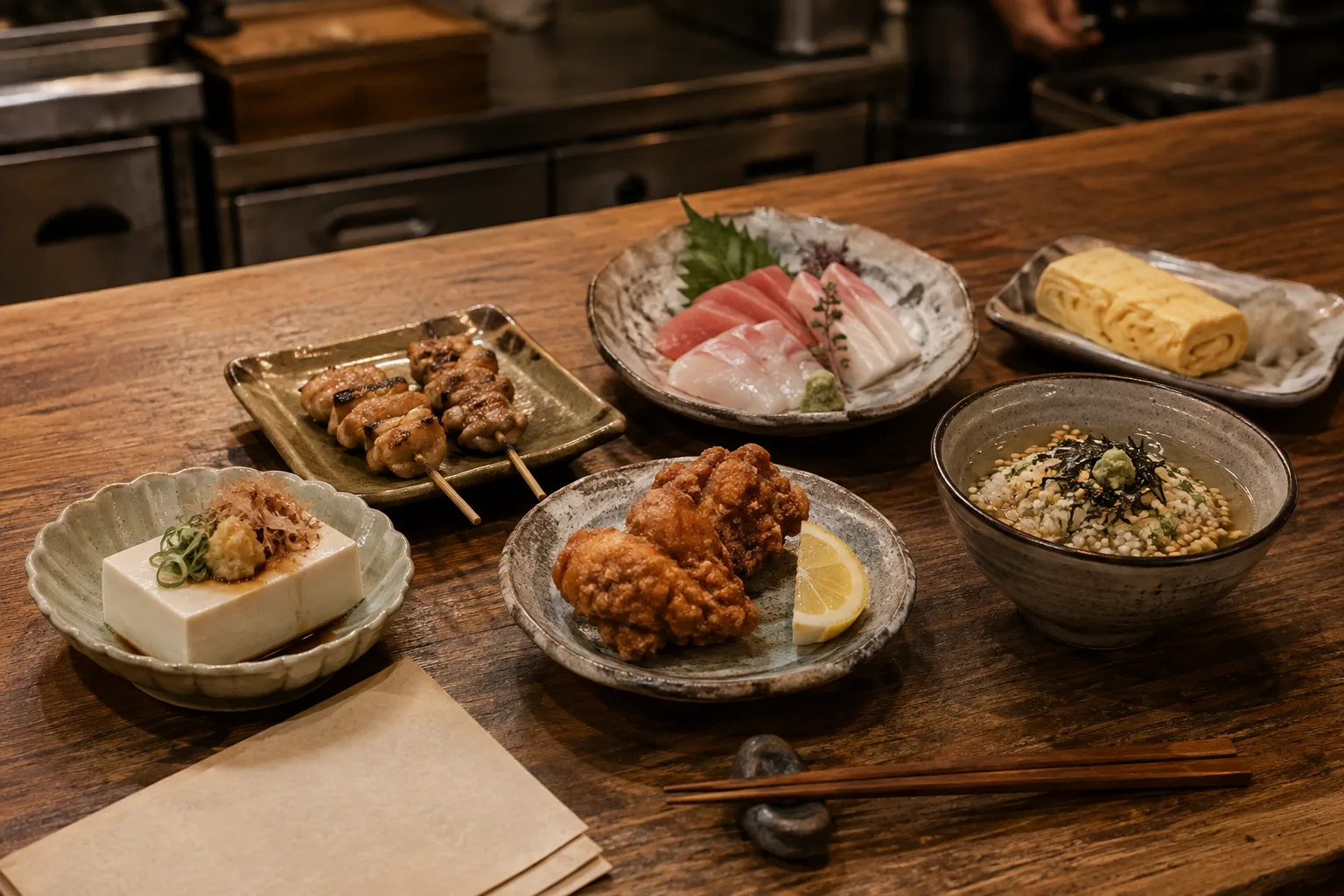
Build a table by cooking method, not by translation alone
The 36 cards are a field dictionary, not a promise that a shop serves every dish. Begin with one quick item, add one cooked centrepiece, then pause. Open only the family you need.
Six ways to make three dishes feel connected
These are tasting routes, not set menus. Use them to change temperature and technique without filling the table; then substitute for appetite, dietary needs and the actual shop.
A gentle first table
Chilled tomato → dashi omelette → grilled rice ball
Move from cool and clean to soft and savoury, then finish with toasted rice.
Compare cool food with char
Chilled tofu → yakitori → ochazuke
The quiet tofu makes salt, tare and smoke easier to notice before a soft finish.
Read seafood at three temperatures
Sashimi → grilled fish → vinegar-dressed octopus and seaweed
Raw, hot and chilled-acidic preparations show that “fish” is not one texture.
A cooked-food route
Seasoned cucumber → karaage → shared hot pot
Keep raw seafood outside the plan while changing temperature and texture.
A plant-forward conversation
Chilled tofu → miso-glazed aubergine → fries
These names sound plant-led, but dashi, toppings, butter and shared oil still need direct confirmation.
A shared winter table
Pickles → shared hot pot → rice cooked in the broth
One broth links the main dish and finish; confirm every ingredient before the pot begins.
Use the season as a question, not a guarantee
Climate, region and purchasing change the plate. A broad seasonal clue becomes useful only after the shop says what arrived today.
New greens, shoots and shellfish
Ask which spring vegetable or shellfish is today’s recommendation. Availability and safe preparation belong to the actual shop.
Cool vegetables and bright acidity
Cucumber and tomato can cool the sequence; ask what fish arrived today instead of assuming one national season.
Mushrooms and grilled fish
Look for a handwritten mushroom or fish special, then ask the species, region and preparation.
Root vegetables, leafy greens and hot pot
A seasonal nabe can bring several ingredients into one broth. Confirm the complete pot and the final zosui before ordering.
Sources: MAFF: Japan’s four seasons and ingredients / MAFF: Our Regional Cuisines
Twelve words that reveal quantity, choice and price
Translate the word, then use its action to close the remaining gap. A label such as homemade or salt does not disclose a full recipe.
Start without filling the table
Cold or simply prepared dishes often arrive first. “Quick” describes service rhythm, not an allergen-safe category.
枝豆
edamameEdamame
Green, lightly salty and easy to share. Pods are not usually eaten.
What to notice when it arrives
Notice whether the beans are warm or chilled and how strongly the pods are salted.
冷奴
hiyayakkoChilled tofu
Cool tofu with changing toppings such as ginger, spring onion or bonito flakes.
What to notice when it arrives
Compare the tofu’s firmness with the sharp, smoky or salty toppings.
たたききゅうり
tataki kyūriSeasoned cucumber
Crisp cucumber dressed to order or in advance; flavour varies widely.
What to notice when it arrives
Crushed edges hold dressing differently from a clean knife cut.
ポテトサラダ
poteto saradaPotato salad
Creamy or chunky, sometimes with egg, ham, mustard or pickles.
What to notice when it arrives
Look for a smooth mash or distinct potato pieces, then identify the house additions.
漬物盛り合わせ
tsukemono moriawasePickle selection
Salty, sour or lightly sweet vegetables in several textures.
What to notice when it arrives
Compare salt, acidity, sweetness and crunch; not every pickle is fermented.
冷やしトマト
hiyashi tomatoChilled tomato
A clean pause between seasoned dishes; condiments may come alongside.
What to notice when it arrives
Temperature, ripeness and the condiment beside it decide whether this feels like a pause or a seasoned dish.
Follow the sound of the grill
Salt or tare sauce can change the same ingredient. Ask about the item, sauce and shared grill separately.
焼き鳥
yakitoriChicken skewers
Different cuts make fat, spring and char easier to compare.
What to notice when it arrives
Try to notice fat, spring and char before deciding whether salt or tare leads the flavour.
つくね
tsukuneMinced-meat skewer
Soft minced meat shaped around a skewer, sometimes served with egg yolk.
What to notice when it arrives
A coarse or fine mince changes the bite; egg yolk or sauce changes the finish.
焼き魚
yakizakanaGrilled fish
The fish and season change the fat, skin and bone structure.
What to notice when it arrives
Read crisp skin, moist flesh, bones and salt as separate parts of the plate.
ししゃも
shishamoGrilled shishamo
Small whole fish with a dry, savoury body; roe may be present.
What to notice when it arrives
Notice the whole-fish texture and ask which species and whether roe is present.
いか焼き
ika yakiGrilled squid
Springy rings or a scored body with smoke and sauce.
What to notice when it arrives
Scoring, thickness and heat change chewiness before the sauce is added.
なす田楽
nasu dengakuMiso-glazed aubergine
Soft aubergine under a sweet-savoury miso glaze.
What to notice when it arrives
The centre should be read separately from the toasted, sweet-savoury glaze.
Compare batter, coating and heat
Shared oil can connect foods that look unrelated. A visible coating is not a complete ingredient list.
鶏の唐揚げ
tori no karaageChicken karaage
Juicy chicken with a seasoned, craggy coating.
What to notice when it arrives
Compare the jagged coating with the moisture and seasoning inside the chicken.
手羽先
tebasakiChicken wings
Skin, bone and a sweet, peppery or salty finish depending on the shop.
What to notice when it arrives
Bones slow the bite; notice whether pepper, glaze or crisp skin remains last.
コロッケ
korokkeCroquette
A crisp breadcrumb shell around potato, meat, cream or another filling.
What to notice when it arrives
The breadcrumb shell hides a filling that may be potato, meat, cream or a mixture.
串カツ
kushikatsuFried skewers
One coating connects vegetables, meat, seafood and cheese.
What to notice when it arrives
Compare each centre under one shared coating; the skewer shape does not reveal the filling.
天ぷら盛り合わせ
tempura moriawaseTempura selection
A light or substantial batter around whatever is in season.
What to notice when it arrives
Notice how the batter protects a root, leaf, prawn or fish without making their textures identical.
フライドポテト
furaido potetoFrench fries
A familiar reset, but seasoning can be distinctly local or house-made.
What to notice when it arrives
A familiar potato can become unfamiliar through seasoning powder, butter or dipping sauce.
Read raw, seared and cured as different
Names describe preparation, not individual medical suitability. Ask what the actual plate contains and how it was handled.
刺身盛り合わせ
sashimi moriawaseSashimi selection
Several raw seafood textures on one plate; the selection changes.
What to notice when it arrives
Compare species, cut thickness and texture before reaching for soy sauce.
たたき
tatakiSeared or chopped preparation
The word can mean surface-seared fish or a finely chopped mixture, depending on the ingredient.
What to notice when it arrives
First establish whether the word means surface-seared or finely chopped here.
しめ鯖
shime sabaCured mackerel
Mackerel firmed and sharpened with salt and vinegar; not necessarily cooked.
What to notice when it arrives
Salt and vinegar firm the fish and sharpen the flavour without necessarily cooking it.
たことわかめの酢の物
tako to wakame no sunomonoOctopus and seaweed in vinegar
Chewy octopus, cool seaweed and a sweet-sour dressing.
What to notice when it arrives
Sweetness, acidity, seaweed and octopus create several kinds of resistance in one small dish.
なめろう
namerōChopped fish with miso
Fish chopped with miso and aromatics into a soft, savoury mound.
What to notice when it arrives
Look for the current fish, mince texture, miso depth and fresh aromatics.
海鮮サラダ
kaisen saradaSeafood salad
Leaves and chilled seafood tied together by dressing.
What to notice when it arrives
Identify the seafood and dressing before treating the leaves as the main identity.
Let one warm dish anchor the meal
Dashi, miso and simmering liquid may carry fish, meat, soy or wheat even when solids are not visible.
だし巻き卵
dashimaki tamagoDashi omelette
Tender rolled egg whose moisture and flavour come from dashi.
What to notice when it arrives
Moisture inside the egg reveals how dashi changes both texture and flavour.
肉じゃが
nikujagaMeat and potato stew
Potato, meat and onion absorb a sweet-savoury simmering liquid.
What to notice when it arrives
Compare potato edges, absorbed broth and the cut of meat; home and shop styles vary.
もつ煮込み
motsu nikomiOffal stew
Long-simmered offal with miso or soy, often rich and warming.
What to notice when it arrives
Ask which offal is used, then notice how long cooking changes firmness and aroma.
揚げ出し豆腐
agedashi dōfuFried tofu in dashi
A thin fried surface gives way to soft tofu in warm broth.
What to notice when it arrives
The pleasure lies between a thin fried surface, soft tofu and broth absorbed at the edge.
餃子
gyōzaGyoza dumplings
Crisp or soft wrappers around seasoned meat or vegetables.
What to notice when it arrives
Wrapper thickness, browned surface and filling texture reveal the shop’s balance.
鍋
nabeShared hot pot
Ingredients change as they cook in one shared broth; the final soup may become zosui.
What to notice when it arrives
Taste how one broth changes as ingredients enter; every later bowl carries the earlier pot.
Choose how the table ends
Shime is the final rice or noodle dish, not a required course. Order only if the group still wants it.
お茶漬け
ochazukeRice with tea or dashi
A small bowl of rice softened by tea or savoury stock.
What to notice when it arrives
Decide whether tea or dashi leads, then notice what the topping contributes.
焼きおにぎり
yaki onigiriGrilled rice ball
Toasted rice and soy or miso aroma, crisp outside and soft within.
What to notice when it arrives
Compare the crisp, seasoned surface with the soft centre of the same rice.
雑炊
zōsuiRice cooked in broth
Rice simmered until it carries the flavour of broth and earlier ingredients.
What to notice when it arrives
The rice records the broth and every ingredient previously cooked in the pot.
焼きそば
yakisobaFried noodles
Sauced noodles with cabbage, meat or seafood; toppings vary.
What to notice when it arrives
Sauce, noodle softness and contact with the hotplate decide more than the name alone.
焼きうどん
yaki udonFried udon
Thick noodles fried with vegetables and a soy or sauce seasoning.
What to notice when it arrives
Notice noodle chew, browned edges and whether soy sauce, sauce or dashi leads.
アイスクリーム
aisu kurīmuIce cream
A cold, simple finish after salty and grilled dishes.
What to notice when it arrives
A cold finish may carry a house flavour, topping or shared-scoop condition worth checking.
Eighteen dishes that open a larger story
Every card now includes a compact observation. These eighteen longer notes connect familiar names with texture, technique, region and risk without pretending there is one national recipe.
Edamame is a pause, not a filler
The pods slow the hand just enough for the table to read the menu. Their value is practical: they can arrive while cooked dishes begin, and they divide easily without deciding a precise portion.
Soy is still the ingredient. Salt, seasonings and shared handling vary, so familiarity must not be mistaken for an allergen guarantee.
Return to the dish card ↑Yakitori is a comparison of cuts and seasoning
A mixed skewer order can make one chicken feel like several foods: springy thigh, rich skin, soft liver or a minced tsukune. Names and available cuts differ, so ask rather than treating one diagram as universal.
Shio means salt; tare is a glazed sauce that commonly brings soy and wheat. The same grill can also carry other meats or seafood.
Return to the dish card ↑Karaage and zangi lead into regional language
Karaage usually starts with seasoned pieces and a flour or starch coating, but the marinade, coating and cut are house decisions. Crispness alone cannot tell you the recipe.
MAFF describes zangi as Hokkaido fried chicken seasoned with soy sauce, ginger, garlic and more, while noting local and household variation. Ask what the name means at this shop instead of declaring one permanent border between zangi and karaage.
Sources: MAFF: Zangi in Hokkaido
Return to the dish card ↑A sashimi selection changes with the day
“Assorted sashimi” describes a format, not a fixed list. Species, cut, garnish, condiments and availability can change with purchasing. Ask what is on today’s plate before using a remembered translation.
Raw or partially raw food requires individual health judgement. This guide cannot determine who should eat it; follow medical advice and the actual shop’s handling information.
Sources: Food Safety Commission of Japan
Return to the dish card ↑Dashi changes an omelette from the inside
Dashimaki carries stock inside the rolled egg, creating moisture and a savoury finish that cannot be seen in a photograph. The balance can feel sweet, salty or gently fish-led depending on region and shop.
The word “egg” does not complete the ingredient check. Dashi may include bonito or other fish; seasoning may include soy and wheat, and the pan or utensils may be shared.
Sources: JNTO: Japanese Food Etiquette Guide
Return to the dish card ↑Ochazuke can close the table without ceremony
Rice with tea or stock offers a warm, soft finish after grilled or fried dishes. Toppings may carry salmon, seaweed, pickles, sesame, wasabi or another house choice.
Shime names the final part of a meal; it is not an obligation. Skip it when the table is full or the last train is close. “Tea” in the English name must not be taken as proof that the bowl has no fish dashi.
Sources: JNTO: Japanese Food Etiquette Guide
Return to the dish card ↑Hiyayakko lets texture do most of the work
Cold tofu appears simple because the kitchen does not hide its softness behind heat or batter. Ginger, spring onion, bonito flakes and soy sauce can turn the same pale block aromatic, sharp, smoky and salty in a few bites.
Tofu means soy, and the toppings matter just as much for a dietary check. Ask about bonito flakes, dashi-based sauce and shared utensils; requesting “no topping” does not answer how the sauce was made.
Sources: JNTO: Japanese Food Etiquette Guide
Return to the dish card ↑A pickle selection is a small map, not one recipe
A selection may move from crisp cucumber to soft aubergine, sharp radish or leaves with deeper savoury notes. Salt, rice bran, miso, vinegar and other methods can lead to different textures; not every item called tsukemono should be assumed to use the same fermentation process.
“Assorted” is the important word. Ask what is on today’s plate and what each item was seasoned with, especially when soy, wheat, alcohol-derived seasonings or cross-contact matter.
Sources: MAFF: Local favourites across Japan
Return to the dish card ↑Nasu dengaku balances soft flesh and toasted miso
Aubergine absorbs heat and fat until the flesh becomes almost spoon-soft, while the miso glaze darkens at the surface. The appeal is the contrast: sweet-savoury paste, a faintly toasted edge and moisture underneath.
The glaze is a house recipe. Miso means soy, but it may also include mirin, sake, sugar, dashi or other seasonings. Ask about the glaze and shared grill instead of treating the vegetable name as a plant-based guarantee.
Sources: JNTO: Vegetarian and Vegan Guide
Return to the dish card ↑Tempura is a conversation between batter, oil and season
A light shell preserves a different centre in each piece: firm root, tender leaf, springy prawn or flaky fish. A selection can therefore read like a short tour of the kitchen’s ingredients, but the contents and their season change.
The batter commonly raises wheat and egg questions, and the fryer may be shared with seafood or other foods. Ask about every piece, the batter and the oil; removing the coating after frying does not remove earlier contact.
Sources: MAFF: Japan’s four seasons and ingredients / JNTO: Japanese Food Etiquette Guide
Return to the dish card ↑Nabe turns the whole table into one cooking system
A hot pot is not merely a large dish placed in the middle. Broth, vegetables, tofu, meat or seafood change together as diners add, cook and remove ingredients. Later bites can taste deeper because the broth has collected what came before.
That shared broth also joins every ingredient and utensil. Decide dietary boundaries before cooking begins, ask what forms the stock and sauces, and do not expect one person to isolate a safe portion after the pot has been shared.
Sources: Consumer Affairs Agency: Food allergy information / JNTO: Vegetarian and Vegan Guide
Return to the dish card ↑Yaki onigiri changes rice through its surface
Grilling turns the outside dry, fragrant and crisp while the centre stays soft. Soy sauce or miso can caramelise at the edges, so the pleasure comes from two textures made from one portion of rice.
The brown surface does not reveal one universal seasoning. Ask whether the glaze contains soy, wheat, butter, stock or another ingredient, and whether the grill is shared with meat or seafood.
Sources: JNTO: Japanese Food Etiquette Guide
Return to the dish card ↑Potato salad is where a familiar name stops being predictable
The name sounds universal, yet one bowl can be a smooth mash and another can leave warm-edged pieces of potato. Cucumber, carrot, onion, ham, egg, mustard, pickles or black pepper may move it toward a side dish, snack or house signature. Compare texture before comparing seasoning.
Its familiarity creates the risk. Potato does not reveal mayonnaise, egg, dairy, meat, mustard or the utensils used to prepare it. Ask what this shop adds; a plain colour and chilled service are not a complete ingredient statement.
Sources: JNTO: Izakaya Dining Guide / Consumer Affairs Agency: Food allergy information
Return to the dish card ↑Tsukune shows how a skewer can be engineered from texture
Unlike a visible cut of chicken, tsukune begins by mincing and binding. A coarse mince can keep a springy bite; a finer mixture can feel soft and even. Shape, grilling and a glossy tare then turn that mixture into a skewer with its own rhythm.
The hidden structure matters for dietary checks. Meat, egg, breadcrumbs, starch, aromatics and seasoning may all sit inside before tare or an egg yolk is added outside. Ask about the mixture itself, the sauce and the shared grill as three separate questions.
Sources: JNTO: Japanese Food Etiquette Guide / Consumer Affairs Agency: Food allergy information
Return to the dish card ↑Korokke makes adaptation visible beneath one breadcrumb shell
The Japanese word korokke developed from the language of the European croquette, but the everyday dish has taken on many local forms. Potato and minced meat are common, while cream, seafood, pumpkin and regional ingredients can occupy the same familiar oval. The useful history is adaptation, not a search for one untouched original.
A breadcrumb shell makes different fillings look alike. Ask what is inside each piece and whether the batter, egg, dairy and frying oil are shared. Breaking one open reveals texture only after it has reached the table; it cannot replace a safety check before ordering.
Sources: National Diet Library: A history of eating out / MAFF: Tokyo food culture and the growth of urban dining / Consumer Affairs Agency: Food allergy information
Return to the dish card ↑Shime saba is cured, but that word does not mean cooked
Salt draws moisture and vinegar sharpens and firms the surface, changing raw mackerel without necessarily applying heat. The result can feel dense, bright and oily at once. Time, cut and seasoning belong to the shop, so one plate may be gentler or firmer than another.
The English word “cured” can be misread as fully cooked or medically risk-free. It means a preservation or seasoning process, not a universal safety result. Anyone who must avoid raw or partially raw fish should ask the shop and follow individual medical advice rather than relying on vinegar.
Sources: Food Safety Commission of Japan
Return to the dish card ↑Nikujaga carries home-style variation into a public room
Potato, onion and meat absorb a sweet-savoury simmering liquid, but the balance is not fixed. The meat, vegetables, amount of broth and point at which the pot rests can differ by region, household and shop. At an izakaya, that variation makes a domestic-sounding name into a comparison between kitchens.
Soft potato does not reveal the stock. Ask which meat is used and whether the simmering liquid contains fish stock, soy, wheat or alcohol-derived seasoning. A dish described as home-style is a story about mood or method, not an allergen label.
Sources: MAFF: Diversity of WASHOKU / Consumer Affairs Agency: Food allergy information
Return to the dish card ↑Yakisoba became ordinary by changing with the hotplate
Despite the word soba, izakaya yakisoba commonly uses wheat noodles rather than buckwheat noodles. Sauce, cabbage, meat or seafood, pickled ginger and powdered seaweed can build a strong final dish, while a hotplate adds browned edges and steam. The name is stable enough to recognise but not precise enough to predict the recipe.
This is why word-by-word translation can fail twice: “soba” may suggest buckwheat, and “fried noodles” may hide wheat, seafood or a shared hotplate. Confirm the noodles, sauce, toppings and cooking surface. The familiar brown sauce is not a complete ingredient list.
Sources: JNTO: Izakaya Dining Guide / Consumer Affairs Agency: Food allergy information
Return to the dish card ↑Follow one dish into another Local Japan guide
Sources, boundaries & next review
Sources and editorial quality reviewed · Next planned review
Menus, prices, opening hours, table charges, smoking conditions and access can change. Dish descriptions and scenes are editorial guidance, not reports of an on-site visit. Generated imagery is illustrative. English and Japanese received four-pass AI-assisted editorial review—meaning, naturalness, travel usability, and consistency/safety—not human native-speaker review.
Open the official and public reference list
- JNTO: Izakaya Dining Guide
- JNTO: Japanese Customs and Etiquette
- JNTO: Japanese Food Etiquette Guide
- JNTO: Japan on a Budget
- JNTO: Vegetarian and Vegan Guide
- Consumer Affairs Agency: Food allergy information
- Consumer Affairs Agency: Food Allergy Communication Sheet
- MHLW: Rules on second-hand smoke
- National Tax Agency: Alcohol and the age of 20
- MAFF: Our Regional Cuisines
- MAFF: Zangi in Hokkaido
- MAFF: Local favourites across Japan
- MAFF: Japan’s four seasons and ingredients
- MAFF: Diversity of WASHOKU
- MAFF: WASHOKU guidebook—tableware and counter culture
- MAFF: Tokyo food culture and the growth of urban dining
- National Diet Library: A history of eating out
- GO TOKYO: A guide to yokocho alleyways
- Food Safety Commission of Japan