21 PIECES · 12 REGIONS · ONE STEAMING POT
Japan does not become one inside the pot.
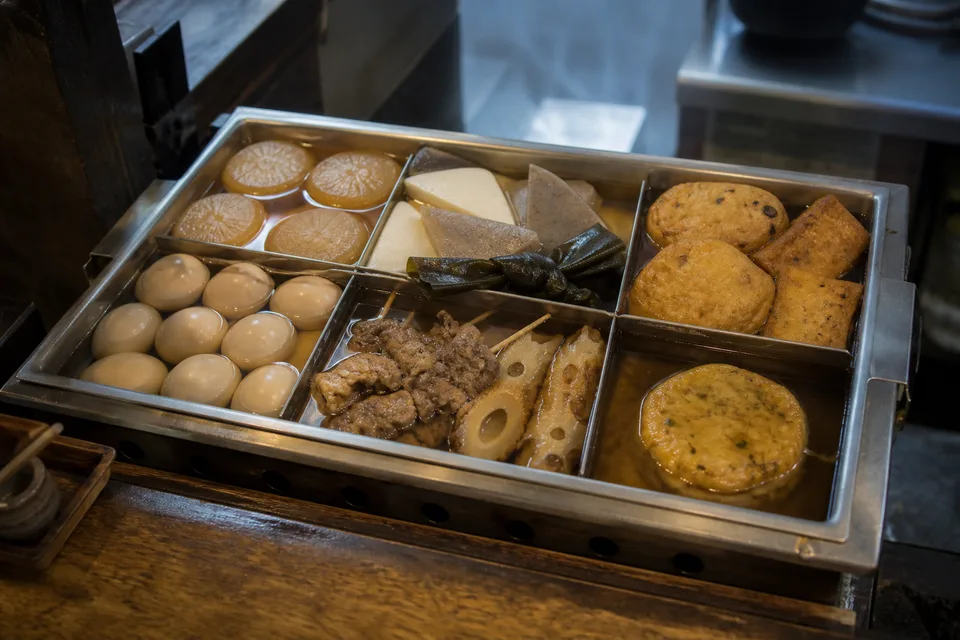
Quiet stock inside daikon; fish transformed into springy cakes; Tokyo wheat dough called chikuwabu; Aomori ginger-miso, Shizuoka’s dark pot and Okinawan pork feet. Under the single name oden, place, home life, preservation and craft rise with the steam. Read it before Japan as a cultural story—or at the counter to choose your first five pieces.
- 21
- ingredient profiles
- 12
- regional readings
- 0
- fixed rankings
YOUR FIRST FIVE · NO EXPERTISE REQUIRED
Begin with daikon. Taste how one pot changes.
Do not chase every famous piece at once. Let daikon reveal the stock; use egg for contrast, chikuwa for fish craft, atsuage for tofu and—around Tokyo—chikuwabu for wheat. This is not a correct order. It is a small course comparing how materials meet one broth. Replace the fifth piece with a local signature wherever you travel.
- 01大Daikon大根 · だいこん · daikon
A calm first piece. Cut it with chopsticks and taste the centre before adding mustard.
- 02卵Boiled egg玉子 · たまご · tamago
Split it over a small amount of broth so the yolk does not feel dry.
- 03輪Chikuwaちくわ · ちくわ · chikuwa
A useful first fish cake: mild enough to compare directly with hanpen or satsuma-age.
- 04豆Atsuage厚揚げ · あつあげ · atsuage
Break one corner and spoon broth over the centre.
- 05麩Chikuwabuちくわぶ · ちくわぶ · chikuwabu
Choose it to understand Tokyo oden; compare directly with chikuwa so the name never confuses you again.
DASHI · TANE · CONDIMENT
Read oden in three layers.
The dish name cannot reveal the recipe. Separate the stock, the pieces called tane and the final condiment, and the same daikon begins to explain why Aomori, Tokyo, Nagoya and Himeji taste different. This structure also prevents colour, visible pieces or a machine translation from becoming a dietary decision.
- 01汁
Dashi and seasoning
Kombu, bonito, fish, chicken, beef, pork or blended stock can carry soy sauce, salt, mirin, sugar or miso. Pale colour does not mean vegetarian, allergen-free or low-salt.
- 02種
Tane: the ingredients
Root vegetables, eggs, tofu, konnyaku, fish cakes, starches and meat absorb or release flavour at different speeds. Tane means the oden pieces—not only seafood.
- 03添
Condiments and finishing sauces
Mustard is common, but ginger-miso, ginger-soy, sweet red miso, green-onion sauce, yuzu kosho, seaweed powder and dashi powder can redefine the final bite.
THE 21-PIECE ENCYCLOPEDIA
Choose by what each piece does in the pot.
Filter by gentle, fish, chew, richness or region. The choice stays on this device and is not sent to Analytics. “Looks plant-led” is only a shortlist for checking stock and production—never a dietary or allergen guarantee.
Showing 21 piecesBROTH ABSORBERS & QUIET FOUNDATIONS
Broth absorbers & quiet foundations
Begin here to read the pot itself: what went into the ingredient, and what the ingredient gives back.
5 piecesDaikon
大根 · だいこん · daikon- What it is
- A thick cross-section of Japanese white radish, slowly cooked until the centre accepts broth.
- Texture
- Tender, juicy layers with a clean bite
- What it does in the pot
- Its pale flesh is the clearest reading of the stock: kombu, fish, soy, meat or sweetness become easier to notice.
- How to approach it
- A calm first piece. Cut it with chopsticks and taste the centre before adding mustard.
Official context used
Boiled egg
玉子 · たまご · tamago- What it is
- A peeled boiled egg simmered in the pot; colour deepens where broth reaches the surface.
- Texture
- Firm white, crumbly-creamy yolk
- What it does in the pot
- The white carries broth; the yolk softens and thickens it in your mouth.
- How to approach it
- Split it over a small amount of broth so the yolk does not feel dry.
Official context used
Konnyaku
こんにゃく · こんにゃく · konnyaku- What it is
- A firm gel made from konjac yam, often cut into a triangle and scored so seasoning can reach it.
- Texture
- Springy, squeaky and almost calorie-light in feel
- What it does in the pot
- It absorbs less like a sponge than daikon; surface cuts and long simmering carry the flavour.
- How to approach it
- Choose it for texture between softer pieces; chew carefully rather than swallowing quickly.
Official context used
Shirataki noodles
しらたき · しらたき · shirataki- What it is
- Thin konnyaku strands, often tied into a bundle so they can be lifted from the pot.
- Texture
- Slippery, springy strands
- What it does in the pot
- The many surfaces catch broth while the strands remain distinctly springy.
- How to approach it
- Let excess broth drain over the dish; the bundle can be hotter inside than it looks.
Official context used
Kombu knot
結び昆布 · むすびこんぶ · musubi kombu- What it is
- Edible kelp tied into a knot; it may be both an ingredient and part of the stock story.
- Texture
- Silky surface with a fibrous bite
- What it does in the pot
- It gives glutamate-rich depth and takes on soy, fish or meat flavours from the same pot.
- How to approach it
- Eat the knot in small bites if it is firm; texture varies with cooking time.
Official context used
FISH-CAKE CRAFT
Fish-cake craft
Grinding, shaping, steaming, boiling, frying and grilling turn fish paste into very different textures.
6 piecesChikuwa
ちくわ · ちくわ · chikuwa- What it is
- Fish paste shaped around a rod and cooked, leaving the familiar centre hole.
- Texture
- Bouncy tube with a lightly grilled surface
- What it does in the pot
- The hollow shape and porous paste carry broth quickly without losing bounce.
- How to approach it
- A useful first fish cake: mild enough to compare directly with hanpen or satsuma-age.
Official context used
Hanpen
はんぺん · はんぺん · hanpen- What it is
- A pale steamed or boiled fish-paste cake whose aerated structure makes it unusually light.
- Texture
- Pillowy, airy and delicate
- What it does in the pot
- It swells and drinks broth near the surface, then releases it with almost no resistance.
- How to approach it
- Eat soon after serving; long soaking can change its shape and softness.
Official context used
Satsuma-age / fried fish cake
さつま揚げ · さつまあげ · satsuma-age- What it is
- Seasoned fish paste shaped and fried; regional names and additions such as vegetables differ.
- Texture
- Springy centre, savoury fried edge
- What it does in the pot
- Oil and fish richness enter the stock while the cake absorbs seasoning back.
- How to approach it
- Choose after a pale piece to notice what frying adds to the same broth.
Official context used
Tsumire
つみれ · つみれ · tsumire- What it is
- Fish paste dropped or shaped into a ball, often retaining more of the fish’s aroma than a smooth cake.
- Texture
- Tender, coarse or springy depending on the fish
- What it does in the pot
- It can season the surrounding broth as much as it absorbs it.
- How to approach it
- Ask which fish is used if aroma, sustainability or dietary limits matter to you.
Official context used
Gobo-ten
ごぼう天 · ごぼうてん · gobo-ten- What it is
- Burdock root wrapped in fish paste and fried; the word ten here refers to a fried fish-cake form.
- Texture
- Bouncy fish cake around a crisp-fibrous centre
- What it does in the pot
- Earthy burdock, fried richness and fish stock meet in one bite.
- How to approach it
- Cut across it to get burdock and fish cake together.
Official context used
Black hanpen
黒はんぺん · くろはんぺん · kuro hanpen- What it is
- A grey, thin fish cake associated with Shizuoka, commonly made from whole small oily fish rather than the white hanpen formula.
- Texture
- Dense, grainy and fish-forward
- What it does in the pot
- It reinforces the pot with a direct fish flavour instead of disappearing into it.
- How to approach it
- In Shizuoka, try it with the local dashi powder or seaweed finish if the shop provides it.
Official context used
TOFU, WHEAT & RICE TEXTURES
Tofu, wheat & rice textures
These pieces show how oden makes soft, porous, chewy and melting textures share one broth.
5 piecesAtsuage
厚揚げ · あつあげ · atsuage- What it is
- A thick block of tofu fried on the outside while remaining tofu-like within.
- Texture
- Fried crust around a soft tofu centre
- What it does in the pot
- The crust catches broth and oil; the centre keeps a mild soybean sweetness.
- How to approach it
- Break one corner and spoon broth over the centre.
Official context used
Ganmodoki
がんもどき · がんもどき · ganmodoki- What it is
- A fried tofu fritter that may mix in vegetables, seaweed, seeds or other small ingredients.
- Texture
- Porous, tender and full of broth
- What it does in the pot
- Its holes make it one of the pot’s strongest broth carriers.
- How to approach it
- Pierce or cut it over the dish; trapped broth can be very hot.
Official context used
Chikuwabu
ちくわぶ · ちくわぶ · chikuwabu- What it is
- A ridged tube of wheat dough associated especially with Tokyo and the Kanto area; despite its name, it is not chikuwa fish cake.
- Texture
- Dense, chewy wheat dough
- What it does in the pot
- It gradually drinks broth into a dumpling-like interior.
- How to approach it
- Choose it to understand Tokyo oden; compare directly with chikuwa so the name never confuses you again.
Official context used
Mochi kinchaku
餅巾着 · もちきんちゃく · mochi kinchaku- What it is
- A small fried-tofu pouch tied around mochi rice cake; fillings and ties can vary.
- Texture
- Silky fried-tofu pouch with a sticky rice-cake centre
- What it does in the pot
- The pouch absorbs stock while the mochi softens and thickens inside.
- How to approach it
- Open carefully, let steam escape and take small bites; hot mochi can stretch.
Official context used
Potato
じゃがいも · じゃがいも · jagaimo- What it is
- A peeled potato simmered whole or in large pieces; variety and timing determine whether it holds together.
- Texture
- Floury or waxy, sometimes beginning to crumble
- What it does in the pot
- Starch softens the broth around each bite while the centre takes on seasoning slowly.
- How to approach it
- Lift gently. If it is breaking, use the dish rather than squeezing with chopsticks.
Official context used
MEAT, SEAFOOD & REGIONAL SIGNATURES
Meat, seafood & regional signatures
Not every pot carries these pieces. When they appear, they often reveal where you are—or whose home recipe shaped the pot.
5 piecesBeef tendon
牛すじ · ぎゅうすじ · gyu-suji- What it is
- Beef connective tissue cooked until it softens, often threaded on a skewer in western Japan and Shizuoka.
- Texture
- Gelatinous, yielding and deeply savoury
- What it does in the pot
- It gives fat and meat depth to the pot as it absorbs soy and stock.
- How to approach it
- Choose after daikon to see how one pot changes when meat enters the comparison.
Official context used
Octopus
たこ · たこ · tako- What it is
- A tentacle or cut piece simmered in the pot, especially visible in some Kansai and coastal styles.
- Texture
- Firm, springy and increasingly tender with cooking
- What it does in the pot
- It brings a marine sweetness and can tint or deepen the surrounding broth.
- How to approach it
- Cut across the fibres and chew slowly; size and tenderness vary greatly.
Official context used
Rolled cabbage
ロールキャベツ · ろーるきゃべつ · roll cabbage- What it is
- Cabbage wrapped around a minced filling; meat blend and seasoning are shop-specific.
- Texture
- Soft cabbage around a juicy filling
- What it does in the pot
- The leaves absorb dashi while the filling releases meat and vegetable juices.
- How to approach it
- Cut it in the dish so the filling stays together and the heat can escape.
Official context used
Gyoza-maki
餃子巻 · ぎょうざまき · gyoza-maki- What it is
- A Fukuoka-associated fish-cake roll with a gyoza-style filling inside.
- Texture
- Bouncy fish cake around a seasoned dumpling filling
- What it does in the pot
- Fish paste, meat filling and broth create several layers in one cross-section.
- How to approach it
- Slice it to see both layers; do not expect a pan-fried dumpling skin.
Official context used
Tebichi / pork feet
てびち · てびち · tebichi- What it is
- Okinawan pork feet cooked until tender and served as a defining local oden ingredient.
- Texture
- Gelatinous skin and soft meat around bone
- What it does in the pot
- Pork richness and collagen make the pot feel unlike a clear Kanto shorthand.
- How to approach it
- Use the dish for bones and eat slowly; this is a meal-like piece, not a quick first bite.
Official context used
No pieces match this view. Return to all pieces.
TWELVE POTS · NO SINGLE NATIONAL RECIPE
From north to south, more than ingredients change.
Stock, soy, miso, condiments, fish cakes, venue and even the name change. These cards are not definitions for every shop. They extract representative clues from MAFF and other official material so you can notice difference where you actually eat.
Aomori
Common oden pieces + sweet miso sharpened with grated ginger; local additions can include whelk or bamboo shoots.
- Why it stays with you
- The condiment is not decoration: heat and sweetness answer Aomori winter in the final bite.
- One move there
- Ask whether ginger-miso is served on the side or already applied, then try one piece both ways.
Open regional evidence
Tokyo & Kanto
Bonito-led, soy-coloured broth; chikuwabu, hanpen and fish cakes are strong local clues.
- Why it stays with you
- Chikuwabu makes wheat dough—not fish—the surprising memory in a classic city pot.
- One move there
- Compare chikuwa and chikuwabu in the same order; similar names reveal opposite textures.
Open regional evidence
Shizuoka
Dark soy broth commonly deepened with beef tendon; skewered pieces, black hanpen, seaweed and dashi powder.
- Why it stays with you
- A dark bowl, powdered finish and skewers make colour, aroma and hand movement part of the identity.
- One move there
- Begin with black hanpen and daikon; use powder lightly first because it changes salt and aroma.
Open regional evidence
Nagoya & Aichi
Pieces simmered in or finished with sweet, dark bean miso such as local red-miso styles.
- Why it stays with you
- The same daikon can move from translucent broth reader to a dark, fermented centrepiece.
- One move there
- Ask whether this is miso-ni or oden with miso sauce; the amount and intensity differ.
Open regional evidence
Iida, Nagano
Oden served with a chopped green-onion soy sauce, a local finishing habit rather than a different pot alone.
- Why it stays with you
- A fresh, sharp sauce turns slow-simmered food lively at the table.
- One move there
- Taste before and after the sauce; check the raw green-onion intensity if you are sensitive to it.
Open regional evidence
Osaka & Kansai
Paler kombu-and-bonito-style broth; beef tendon and octopus are familiar additions. Kanto-daki can be used as a name.
- Why it stays with you
- The name Kanto-daki preserves a story of a dish arriving, adapting and becoming local.
- One move there
- Do not read pale colour as weak flavour. Try broth, daikon and beef tendon as a sequence.
Open regional evidence
Himeji, Hyogo
Oden eaten with ginger-soy sauce; the base pot itself can vary by household or shop.
- Why it stays with you
- One pour makes the local identity visible without requiring a completely separate ingredient list.
- One move there
- Add ginger-soy to part of one piece, not the whole plate, so the original broth remains comparable.
Open regional evidence
Toyama & Kanazawa
Kurumabu wheat gluten, red-and-white akamaki fish cake and seafood can appear in cold-region pots.
- Why it stays with you
- Large rings and bright spirals make local preserved foods visible before the first bite.
- One move there
- Ask what the colourful spiral contains; appearance alone does not distinguish wheat from fish paste.
Open regional evidence
Takamatsu, Kagawa
Some udon shops offer oden with two condiments, commonly mustard-miso and sweet miso.
- Why it stays with you
- Oden becomes the food that fills the wait before udon—and a two-sauce tasting in its own right.
- One move there
- Check how pieces are counted before taking them; self-service systems differ by shop.
Open regional evidence
Fukuoka & Nagasaki
Chicken-led or flying-fish stock, local sweet soy, yuzu kosho and distinctive fish cakes such as gyoza-maki.
- Why it stays with you
- A fish-cake centre can hold a dumpling filling, while the condiment adds citrus heat instead of mustard sharpness.
- One move there
- Try gyoza-maki or a local kamaboko, then ask before using yuzu kosho—it can be intense.
Open regional evidence
Kagoshima
Pork-led depth and barley-miso influence can move oden toward a fuller, sweeter southern profile.
- Why it stays with you
- Pork and fermented barley shift the idea of oden away from one clear Tokyo pot.
- One move there
- Ask whether pork is in the stock as well as among the visible pieces.
Open regional evidence
Okinawa
Bonito-led broth with tebichi pork feet, sausage and greens in a substantial local form.
- Why it stays with you
- A pot with bones, pork skin and leafy vegetables feels closer to a complete meal than a light snack.
- One move there
- Order tebichi as the centrepiece, then add a broth-absorbing piece to compare.
Open regional evidence
FOUR DOORS INTO THE SAME POT
Where you eat changes the pace of the experience.
Some nights invite a second round at a specialist; others call for a labelled pack from a supermarket. Never assume a convenience-store counter pot is always present. Current venue and official information win.
Oden specialist
Best for comparing broth, ingredient timing and a second round. Ask whether the menu is per piece, plate or course, and check reservation and cover-charge conditions.
Izakaya or yatai
Oden sits beside drinks and small plates. Ordering may be handwritten, verbal or by tablet; outdoor stalls and current operation can be seasonal or weather-dependent.
Convenience store or supermarket
A practical entry with labels and take-home packs. Counter pots are not universal and availability changes by chain, branch, season and time; follow the current package and storage instructions.
Home or accommodation kitchen
A slow pot becomes a shared meal. Use a packaged stock or a clearly documented recipe, follow fish-cake and food-storage directions, and keep dietary needs separate before ingredients share the broth.
LOOK · ASK · THREE PIECES · SECOND ROUND
Six calm moves at the pot.
Oden does not require one complete order. Read readiness, sell-outs, condiments and the venue’s unit, then choose only what you can eat while warm.
- 01
Read the unit
Look for one piece, three-piece plate, chef’s selection or course. A written number can be a quantity, not a set name.
- 02
Protect one gentle start
Daikon gives you the broth; egg gives contrast. Add one fish cake, one tofu or starch piece and one local signature.
- 03
Ask what is ready today
Oden is timing-sensitive. A sold-out piece or one not yet ready is normal; let the pot, not a checklist, decide the substitution.
- 04
Taste before the condiment
Try the broth and one cut surface before mustard, miso, ginger-soy or yuzu kosho. Then add one condiment to part of the piece.
- 05
Order the second round with purpose
Repeat what you loved or choose the opposite texture. Do not over-order pieces that cool faster than you can eat them.
- 06
Leave bones and skewers visible
Use the provided dish for bones, skewers, ties and mustard packets. Ask before returning anything to a shared pot.
FROM GRILLED DENGAKU TO A SHARED POT
Imagine oden before the simmered pot.
A leading line of development reaches back to tofu dengaku, skewers and miso. The simmered form spread in the modern era and accepted local stocks and ingredients wherever it moved. Instead of forcing one first shop, follow how the name of a grilled form survived inside a simmered pot. That flexibility is the cultural story.
Dengaku gives the name a likely root
MAFF describes oden as developing from tofu dengaku. Origin stories are useful when held as a line of development, not a single proven birthday.
Skewers, grilling and miso
In the Edo period, skewered ingredients grilled and eaten with miso helped shape the earlier form associated with the word.
The simmered pot spreads
The stock-simmered form spread in the modern era. As it moved, Kansai could call it Kanto-daki while adapting stock and ingredients locally.
Home pot, specialist craft and retail food coexist
Oden now appears at home, in specialist shops, izakaya, stalls and packaged retail. None is the single authentic endpoint; each solves time, service and place differently.
A HOME POT IS A TIMING MAP
At home, not everything enters at once.
This is one planning pattern, not a national recipe. Follow the directions on your stock, fish cakes and prepared foods, together with the recipe you actually use.
- 01Separate dietary needs before the pot
Shared stock cannot be separated later. Plan serious allergies, vegetarian needs or religious restrictions before cooking, including utensils and pots.
- 02Name every stock and seasoning
Do not stop at kombu. Read fish, meat, soy sauce, mirin, miso and packaged seasonings one by one.
- 03Begin with pieces that need time
Prepare daikon, konnyaku and egg as your recipe directs, then let them take on flavour gently.
- 04Add fish cakes and delicate pieces later
Follow package directions for preparation and heating. Add hanpen, mochi pouches or potato with their shape and texture in mind.
- 05Serve small; do not return food
Serve small portions and check the heat. Never return a tasted piece to a shared pot. Handle leftovers promptly according to the foods used and local safety guidance.
THE VISIBLE PIECE IS NOT THE RECIPE
Even if daikon suits you, the pot may not.
Fish, shellfish, molluscs, wheat, egg, soy, milk, beef, pork, chicken, sesame, yam or alcohol may enter through stock, soy sauce, miso, fish cakes, binders, dumpling filling or condiments. Ladles, tongs, knives, boards, pots and frying oil may be shared. Never make a safety decision from a photograph, colour, name, machine translation or this article alone.
Show or say this
初めてです。大根と玉子と、おすすめの練り物を一つください。
It is my first time. May I have daikon, egg and one fish cake you recommend?これは一個の値段ですか? 盛り合わせですか?
Is this price for one piece or for an assortment?このおでんのだしには、魚、肉、醤油、酒を使っていますか?
Does this oden stock contain fish, meat, soy sauce or alcohol?薬味は何を合わせるのがおすすめですか?
Which condiment do you recommend with this?このおでんの、だし、つゆ、練り物、具、薬味に使う原材料と、共用器具による混入を確認したいです。
I need to check every ingredient in the stock, broth, fish cakes, pieces and condiments, and possible cross-contact from shared equipment.SIX QUESTIONS BEFORE THE FIRST BITE
Untangle six small questions at the pot.
Is oden always a winter food?
It is strongly associated with cooler weather, but specialist shops may serve it year-round and packaged or home forms vary. Check the venue rather than assuming seasonal availability.
Is pale oden broth vegetarian?
Not necessarily. Clear or pale broth may contain bonito, other fish, chicken, beef, pork, soy sauce or mirin. Ask about the complete stock and shared pot.
What is the difference between chikuwa and chikuwabu?
Chikuwa is a fish-paste tube with a springy bite. Chikuwabu is dense wheat dough, especially associated with Tokyo and Kanto oden.
Do I have to use mustard?
No. Mustard is common, but condiments change by region and shop. Taste the stock first, then add a small amount if you want it.
Can I pick pieces directly from the pot?
Only when the shop clearly uses self-service and provides the method. Otherwise order from staff or the menu; never reach into a shared pot without instruction.
Is every fish cake made from the same fish?
No. Fish species, whole-fish use, binders, seasoning and cooking method differ. Read the current label or ask the maker or shop when the exact fish or allergen matters.
OFFICIAL EVIDENCE · CLEAR LIMITS
Go deep on culture; stay modest about today.
Sources and facts checked 2026-09-01. This guide compares representative forms; it does not compress every home and shop into one definition. Price, stock, ingredients, broth, condiments, opening and season vary by venue and product.
AI language quality review completed; no human native-speaker review was performed.
- MAFF: Tokyo Oden
- MAFF: Oden across Japan
- MAFF: Regional oden cultures
- JNTO: Aomori cuisine and ginger-miso oden
- MAFF: Shizuoka Oden
- MAFF: Himeji Oden
- JNTO: Winter hot-pot culture
- Consumer Affairs Agency: Food allergy labelling
- Consumer Affairs Agency: Allergen information in dining and prepared food
- MAFF: Fish-cake history, methods and regional craft
- MAFF: Regional oden ingredients and condiments
- MAFF: Food-safety guidance for simmered dishes
- Consumer Affairs Agency: Preventing choking on mochi
- National Diet Library reference: Oden history and historical records