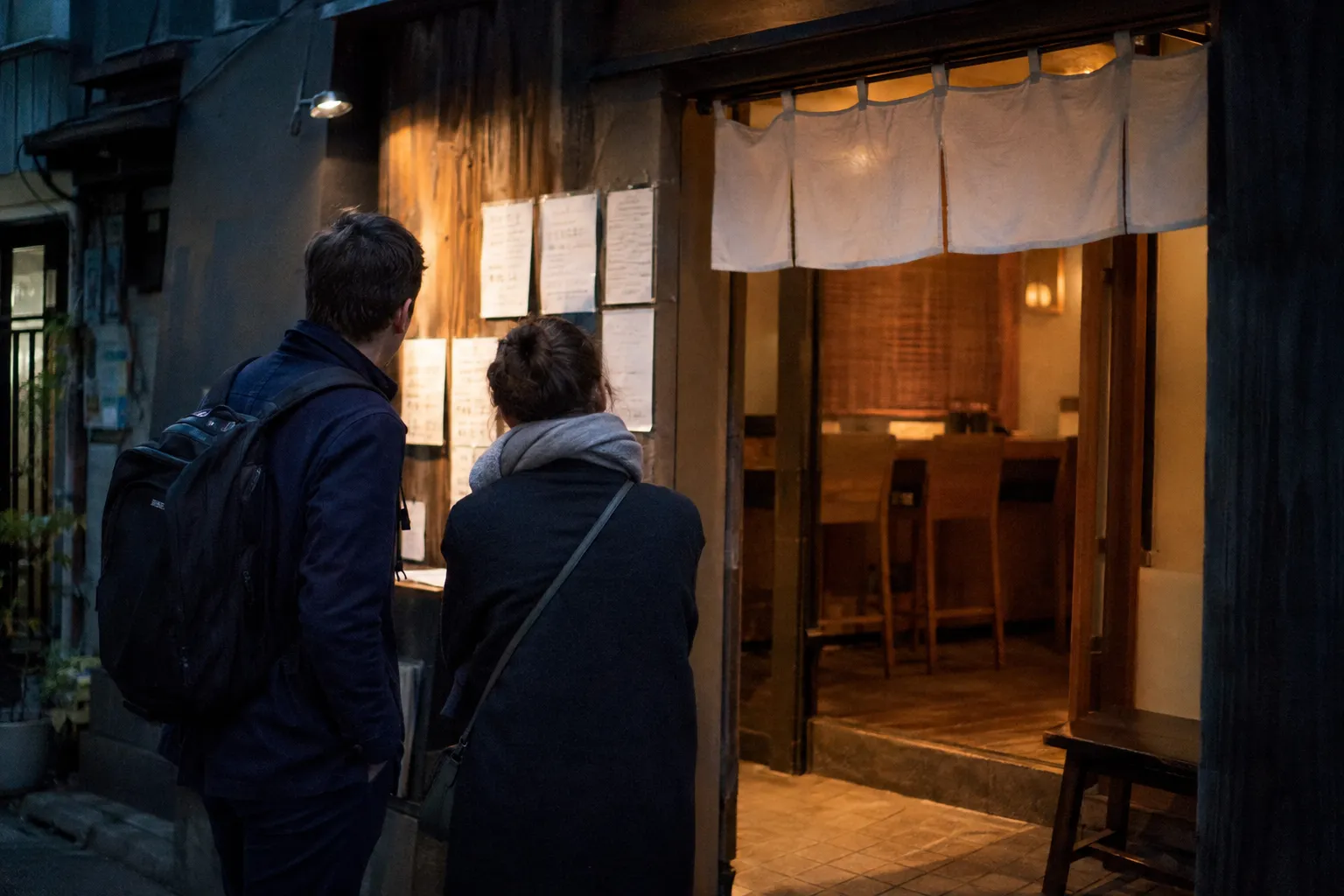
Give the doorway one useful minute
A review score cannot answer tonight’s seat, menu, smoke or route. Read these six signals in order. If one is essential and unclear, ask before entering.
Open now
Can you enter today without a booking, and is a seat actually available?
Speciality
Is the kitchen built around fish, skewers, stews or another focus?
Price pattern
Can you read the range, table charge and any time limit?
Ordering
Will you speak, write, press a call button or use a tablet?
The room
Does it fit the group, luggage, child, noise, smoke and step needs?
Route home
After any wait, can everyone still return safely?
Six rooms hiding behind the same word
These are decision patterns, not permanent categories. A venue can belong to several, and the actual conditions come first.
Small neighbourhood counter
Works when: A solo or two-person meal when you can ask a few questions and wait for the cook’s pace.
Check: Seats, conversation, payment and dietary capacity can be limited. A small room is not proof of greater authenticity.
Station-area chain
Works when: A group that benefits from photographs, a tablet, clearer plan terms or more seats.
Check: The interface still may not list every ingredient, and a multilingual screen does not certify allergy safety.
One-speciality izakaya
Works when: Travellers who want to compare cuts, seasons or techniques around yakitori, seafood, oden or another focus.
Check: A focused menu can make substitution harder. Ask about stock, sauces and shared equipment before relying on the speciality.
Tiny yokocho venue
Works when: One or two adults who are comfortable with close seats and a short, changeable menu.
Check: Large groups, luggage, wheelchairs, smoke-sensitive guests and children may need another room. Ask before making the lane the destination.
Tachinomi standing bar
Works when: A short stop for someone who can stand comfortably and understands the current ordering and payment system.
Check: There may be nowhere to sit or place luggage. Do not treat standing service as an accessible or family default.
Group or private-room venue
Works when: A family or group that needs a quieter boundary, room to coordinate dishes or a reservable seat.
Check: Private does not mean step-free, smoke-free or quiet. Check floor seating, steps, partitions, time limits and the toilet route.
Sources: JNTO: Izakaya Dining Guide / GO TOKYO: A guide to yokocho alleyways
Ten small signs that can change the whole evening
The same wording can be implemented differently. Use the translation to find the question, then confirm the shop’s meaning.
Today’s recommendations
Ask what changed today and the price before ordering.
A speciality the shop wants to be known for
Use it as a clue, not proof that it fits every taste or diet.
Starter or table-charge wording
Ask whether it applies and the amount per person.
One item required per person
Check whether drinks count and whether children are included.
A two-hour seating or plan limit
Ask when the clock starts and when last order occurs.
Last order
Treat it as the final order deadline, not closing time.
Cash only
Check before sitting if cash is limited; payment methods can change.
All seats non-smoking / smoking room available
Ask about the actual air route when smoke avoidance is essential.
No seat is currently available
Ask about the wait only if the route home still works.
Reservation only
Do not assume walk-in entry; choose another shop if no booking is possible.
Sources: JNTO: Izakaya Dining Guide / JNTO: Japanese Customs and Etiquette / MHLW: Rules on second-hand smoke
Choose from the person who has the least room for error
The best room is the one the whole group can use. Start with the condition that cannot be negotiated, then compare food and atmosphere.
Solo
Look beyond the presence of a counter: ask whether the order size and conversation level fit you.
No alcohol
Ask whether food can lead the meal and whether a one-drink condition applies.
With a child
Check time, seating, smoke, sound and kitchen pace, not only an age rule.
Avoiding steps
Ask about the whole route: entrance, seat, payment point and toilet.
Food allergy
Choose by whether the kitchen can confirm ingredients and shared equipment, not by a multilingual menu alone.
Avoiding smoke
Beyond a sign, ask whether smoke can travel from a room or neighbouring area.
A quiet meal
Do not rely on the word “private”; ask about walls, doors, group bookings and music.
Late arrival
Check food and drink last orders and the route home, not only whether the door is open.
Six questions to show before taking the seat
Ask only what matters to the group. These buttons record the use of this article’s phrase tool, not the question selected.
Ask for a walk-in table
予約していません。二人、入れますか?
Yoyaku shite imasen. Futari, hairemasu ka?
We do not have a reservation. Can two people come in?
Check smoke conditions
全席禁煙ですか?
Zenseki kin-en desu ka?
Are all seats non-smoking?
Check the full route
入口から席とトイレまで、段差はありますか?
Iriguchi kara seki to toire made, dansa wa arimasu ka?
Are there steps from the entrance to the seat and toilet?
Ask about children
子どもと一緒に利用できますか?
Kodomo to issho ni riyō dekimasu ka?
May we dine here with a child?
Check payment
クレジットカードは使えますか?
Kurejitto kādo wa tsukaemasu ka?
Can I pay by credit card?
Keep food at the centre
料理を中心に注文しても大丈夫ですか?
Ryōri o chūshin ni chūmon shite mo daijōbu desu ka?
Is it okay to order mainly food?
Choosing another door can save the evening
Full or reservation only
It describes tonight’s capacity, not a judgement about the traveller.
Dietary safety cannot be confirmed
A clear reason to choose elsewhere is better than an uncertain “probably fine.”
Luggage, wheelchair or stroller cannot fit
It is a spatial limit. Passing the entrance does not solve the seat and toilet route.
The room serves a different evening
A standing bar, loud group room and quiet counter are different uses, not a quality ranking.
Save two or three candidates in the same area. A backup is especially useful for a small room, dietary restriction, wheelchair route, child or late arrival.
Sources, boundaries & next review
Sources and editorial quality reviewed · Next planned review
Menus, prices, opening hours, table charges, smoking conditions and access can change. Dish descriptions and scenes are editorial guidance, not reports of an on-site visit. Generated imagery is illustrative. English and Japanese received four-pass AI-assisted editorial review—meaning, naturalness, travel usability, and consistency/safety—not human native-speaker review.