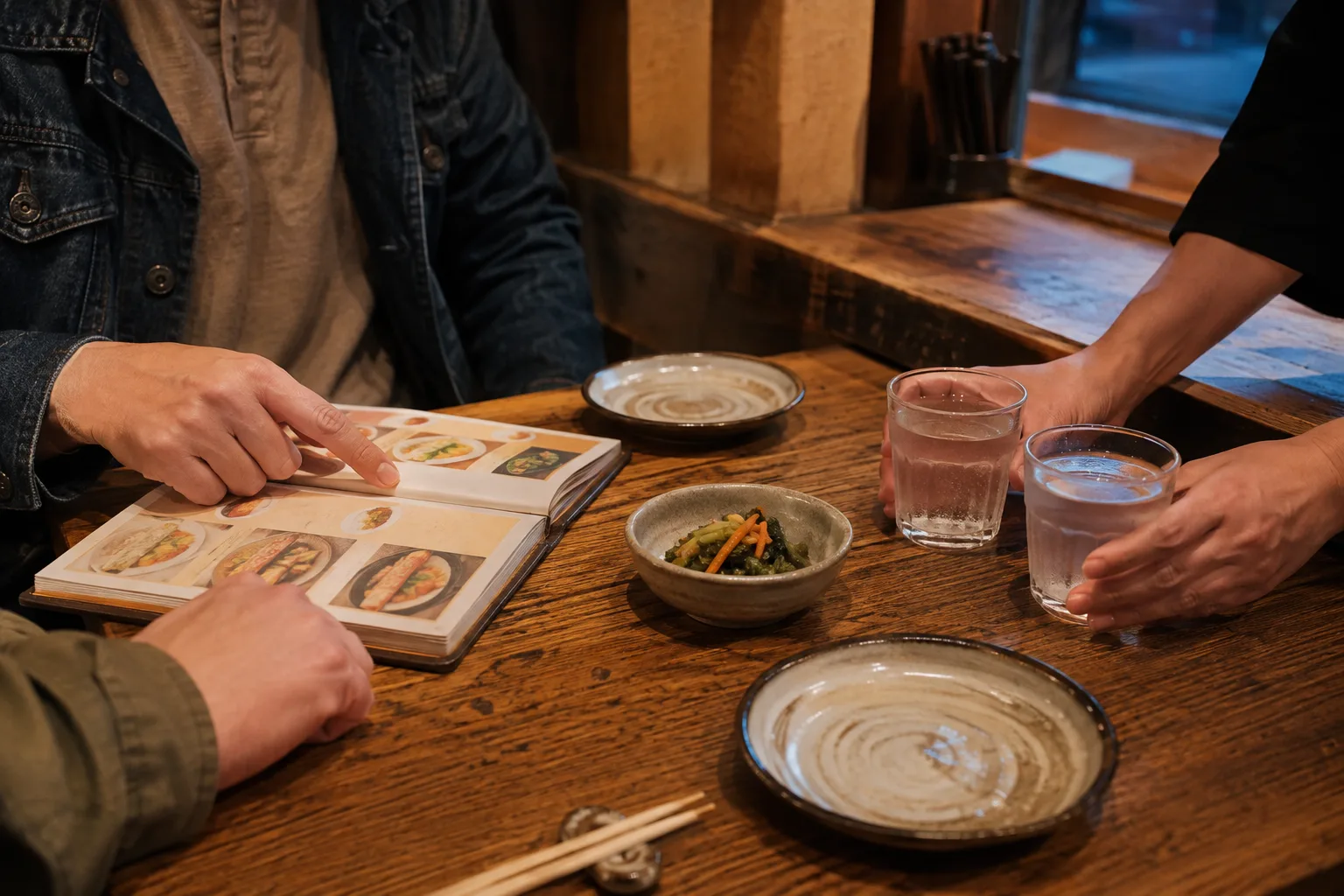
Six calm decisions from door to bill
Read the door before entering
Check today’s opening hours, whether the venue suits every person in the group and any smoking sign. A narrow curtain is not evidence of an inaccessible entrance; the full route, seat and toilet still need a direct check.
Ask about the charge before settling in
An izakaya may have a table charge, sometimes represented by a small otōshi dish. It is not universal. Ask the amount per person, tax and any late-night charge instead of treating the dish as either a free gift or a scam.
Make the first round small
Start with water or another drink, one quick plate and one cooked dish. This buys time to read portions and the kitchen pace. Choosing a non-alcoholic drink is a valid way to dine; check any stated one-drink or course condition.
Order the second round from what you learned
If the first plates were larger or faster than expected, pause. If everyone is still hungry, add one different cooking method rather than repeating the whole order. This reduces waste and keeps the table readable.
Hear “last order” as a deadline, not a command
Last order marks the final chance to add items before closing; it does not require another drink or shime. Confirm outstanding dishes, choose a final bowl only if wanted and ask for the bill.
Sources: JNTO: Izakaya Dining Guide / JNTO: Japanese Customs and Etiquette / JNTO: Japanese Food Etiquette Guide / MHLW: Rules on second-hand smoke / National Tax Agency: Alcohol and the age of 20
A first-round pattern for one, two, or a small group
These are starting patterns, not fixed portions or price promises. Appetite, dish size and the actual venue always decide the next order.
One person
Begin with a drink and one quick plate, then one cooked dish if needed. Decide on a final bowl only after checking appetite and the route home.
Two people
Begin with drinks, one quick plate and one cooked centrepiece. After seeing its size, add one dish made by a different technique.
Three or four
Share every dietary restriction first. Start with one or two quick plates, then about two centrepieces with different temperatures or techniques.
Close the four-part confirmation loop
A picture solves identification, but not quantity. This short loop catches the most expensive misunderstanding before it becomes a table full of food.
Point
Point to the dish name, photograph or number.
Name the unit
Confirm whether it means one plate, one skewer or one portion.
Hear the repeat-back
Listen for the dish and quantity when staff repeat the order.
Read the record
If there is a tablet or order history, check it once after sending.
Eight moments when the next decision matters
Find the scene that matches the table. Each card separates what happened, what to do next and why the distinction matters.
A small dish arrives before you order
Do this: Ask whether it is otōshi, the per-person charge and every ingredient before eating it.
Why: The dish may represent how the bill begins, but the system and recipe vary by shop.
The menu says 時価 or “market price”
Do this: Ask today’s price and whether it is for one piece, one plate or one portion before ordering.
Why: Translating the ingredient does not reveal the current price or unit.
An assorted plate differs from the photograph
Do this: Ask what is on today’s plate; do not infer species or allergens from the example image.
Why: Moriawase describes a selection, so purchasing can change its contents.
The first cooked dish is larger than expected
Do this: Pause the next order and check which dishes have already been sent to the kitchen.
Why: Cancelling may no longer be possible, and another round can crowd the table or create waste.
Staff cannot confirm an allergy question
Do this: Do not eat the dish. Choose a different dish only if its ingredients and cross-contact can be confirmed, or leave.
Why: A friendly guess, translation app or removed topping is not evidence of safety.
Staff announce last order
Do this: Check outstanding dishes, the route home and appetite before adding anything.
Why: It is a deadline for additions, not an instruction to order a final drink or bowl.
One line on the bill is unfamiliar
Do this: Point to that line and ask what it represents before discussing the total.
Why: Food, drinks, table charge, tax and stated time-based charges are different questions.
Your preferred payment method is not accepted
Do this: Use an accepted method if possible; otherwise ask calmly before leaving the counter or table.
Why: A logo seen online or at the entrance may not describe the terminal working tonight.
Read the bill as four possible layers
This is a reading aid, not a claim that every layer appears. Prices and policies belong to the actual venue.
Your totalAsk about an unfamiliar line before paying
Sources: JNTO: Japanese Customs and Etiquette / JNTO: Japan on a Budget
Before choosing an all-you-can-eat or drink plan
Time
When do the plan, finish and last order begin?
Scope
Which drinks or dishes are included?
Whole-group terms
Must every person choose the plan?
Extras
What is excluded, extended or charged if left?
Pace
All-you-can-drink is not a target. Eat, drink water and never pressure anyone to consume more.
Six Japanese phrases for the difficult moments
Copy or show the sentence. The buttons record only that this article’s phrase tool was used; they do not record which allergy or preference you selected.
Ask before taking the seat
席料やお通しは、一人いくらですか?
Sekiryō ya otōshi wa, hitori ikura desu ka?
How much is the table charge or otōshi per person?
Order without alcohol
お酒を飲まなくても、利用できますか?
Osake o nomanakute mo, riyō dekimasu ka?
May we dine here without ordering alcohol?
Check a dish size
これは、二人で分けるくらいの量ですか?
Kore wa, futari de wakeru kurai no ryō desu ka?
Is this about enough for two people to share?
Begin an allergy check
食物アレルギーがあります。原材料と共用の調理器具を確認できますか?
Shokumotsu arerugī ga arimasu. Genzairyō to kyōyō no chōri kigu o kakunin dekimasu ka?
I have a food allergy. Can you check the ingredients and shared cooking equipment?
Check an outstanding order
まだ来ていない料理は、何ですか?
Mada kite inai ryōri wa, nan desu ka?
Which dishes have not arrived yet?
Ask for the bill
お会計をお願いします。
Okaikei o onegai shimasu.
The bill, please.
Recover without turning one problem into the whole night
The menu is unreadable
Do not translate everything. Ask one category, portion and ingredient question at a time.
A dish is much larger
Stop adding food and check what is still outstanding.
An order has not arrived
Point to the order record or slip and ask which dishes remain.
The total is unexpected
Before disputing the total, ask about one unfamiliar line at a time.
Sources, boundaries & next review
Sources and editorial quality reviewed · Next planned review
Menus, prices, opening hours, table charges, smoking conditions and access can change. Dish descriptions and scenes are editorial guidance, not reports of an on-site visit. Generated imagery is illustrative. English and Japanese received four-pass AI-assisted editorial review—meaning, naturalness, travel usability, and consistency/safety—not human native-speaker review.
Open the official and public reference list
- JNTO: Izakaya Dining Guide
- JNTO: Japanese Customs and Etiquette
- JNTO: Japanese Food Etiquette Guide
- JNTO: Japan on a Budget
- JNTO: Vegetarian and Vegan Guide
- Consumer Affairs Agency: Food allergy information
- Consumer Affairs Agency: Food Allergy Communication Sheet
- MHLW: Rules on second-hand smoke
- National Tax Agency: Alcohol and the age of 20