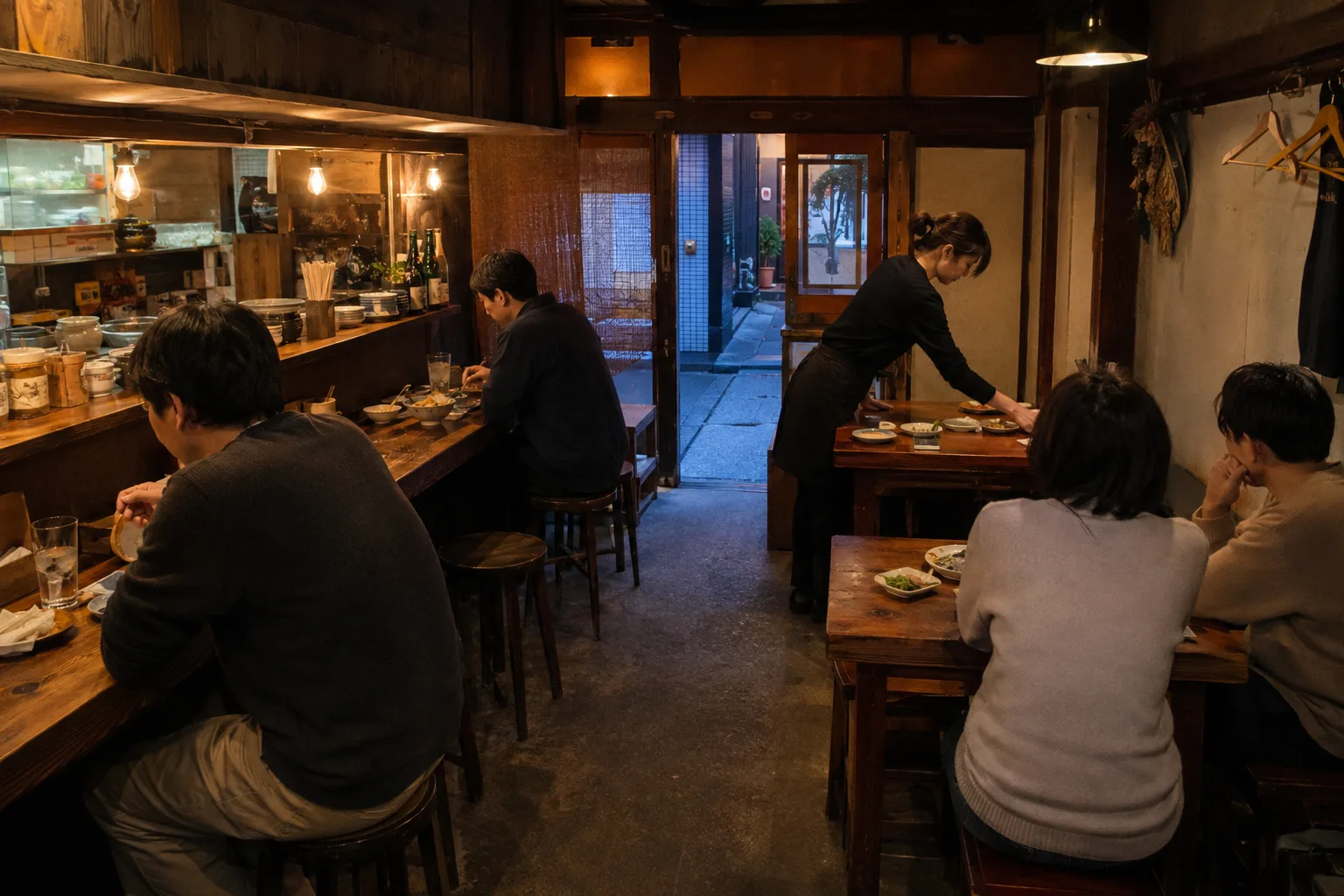
One word, four very different ways to sit
This is a decision map, not a classification of every venue. A chair, step, partition, smoke route or toilet can matter more than the label on the door.
Counter
Often easier solo; seat width and conversation vary
Table for two
Easy to share small plates; check luggage and neighbouring space
Group table
Orders coordinate well; share every dietary need first
Private room / floor seating
Ask about quiet, shoes and steps instead of assuming
The menu carries more than one period of Japan
This is a context line, not a single family tree for every izakaya. Public dining, imported dishes, postwar alleys and current ordering systems developed through different local histories.
- Edo period01
Urban eating moves into public streets and rooms
Food stands and restaurants helped sushi, tempura and soba grow in an expanding city. This is context for urban dining, not a claim that every modern izakaya descends from one shop.
- Meiji to Taisho02
Foreign dishes enter ordinary menus
Western-style restaurants and cookbooks helped croquettes, cutlets and omelettes move into restaurant and home cooking. Their presence beside dashi is part of the history, not a break from it.
- Early postwar decades03
Small alleys gather compact businesses
Some well-known Tokyo yokocho took shape in the early postwar decades. Their histories are local; “old-looking alley” is not one nationwide category.
- Today04
Handwriting, call buttons and tablets coexist
A changing special may be handwritten while the standard menu sits on a tablet. Technology changes the ordering surface, not the need to confirm ingredients, portions and house terms.
Sources: National Diet Library: A history of eating out / MAFF: Tokyo food culture and the growth of urban dining / GO TOKYO: A guide to yokocho alleyways
Watch one table become an evening
First small plate
Learn the shop’s portions and pace without rushing
Grill / fryer
When hot food arrives, do not immediately fill the next round
Second round
Use what the table enjoyed to choose one different technique
Bill / route home
Check the last practical train and outstanding dishes before last order
Four details that turn looking into understanding
Observe the system before inventing a story about the people. These prompts keep attention on pace, writing, sharing and the route home.
What arrives before the cooked food?
The first dish reveals the kitchen’s pace and how the bill begins.
What was written today?
A changed fish, vegetable or price can show where the menu is alive.
What does the table share?
Notice which dishes stay central and which choices remain individual.
How does the evening end?
The bill, shoes, luggage and route home are part of the room’s design.
One name covers very different rooms
Izakaya is useful as a category, but weak as a promise. It may describe a small counter where one cook knows every regular, a multi-floor chain with tablet ordering, a seafood room near a harbour or a restaurant built around skewers. Food, sound, seating, smoke rules, price structure and the role of alcohol all change. The sign tells you the broad type of evening, not whether this particular room fits your group.
The word is often translated as Japanese pub or gastropub. That comparison helps with informality and drinks, while tapas helps explain small shared plates. Neither is exact. Some diners eat a complete dinner, some stop after one plate, and some do not drink alcohol. Begin with the visible menu and the people you are travelling with, rather than trying to perform a supposedly correct national ritual.
This flexibility explains why two neighbouring izakaya can feel unrelated. Read the speciality written outside, the prices, the number of seats and the current house rules. A room that suits four colleagues after work may not suit a tired child, a wheelchair route, a smoke-sensitive guest or a solo traveller who wants a quiet meal. Choosing another door is part of travelling well.
Sources: JNTO: Izakaya Dining Guide / JNTO: Japanese Customs and Etiquette
The room belongs to a longer history of eating out
A modern izakaya should not be projected unchanged into the Edo period. What the historical record does show is a growing urban culture of eating outside the home. In Edo, food stands and restaurants helped sushi, tempura and soba develop as food for a dense city. Public dining created places where preparation, payment and time were organised beyond one household.
The menu continued to absorb new routes. From the Meiji period, Western-style restaurants and later household cookbooks helped croquettes, cutlets and omelettes enter everyday cooking. That is why a croquette can sit beside sashimi and dashi omelette without being an interruption to the story. The mixed menu records adoption, adaptation and repetition across generations.
There is no need to turn one dinner into a museum reenactment. The useful historical question is smaller: which part of this table comes from an older urban technique, which part travelled from somewhere else, and what did this shop change? A handwritten special, a frying method or one regional name can answer more than a broad claim that the whole room is “traditional.”
Sources: National Diet Library: A history of eating out / MAFF: Tokyo food culture and the growth of urban dining
Small plates turn dinner into a sequence
At many izakaya, the whole meal does not arrive as one set. A quick cold dish buys time for grilled or fried food, then another order follows what the table actually enjoyed. The useful unit is not a fixed course but a round: order, receive, share, look again. That rhythm can make a long menu manageable because you need only decide the next one or two dishes.
A torizara, the small plate beside each diner, makes the shared structure visible. Moving a bite from the central plate creates a pause to notice portion, temperature and who has not tried it. Serving chopsticks or a spoon may be provided; use them when they are. The final piece belongs to the conversation before it belongs to one person. These habits are coordination tools, not a test of whether a visitor knows enough manners.
Ordering slowly also protects appetite and budget. A photograph can make six small plates look like six personal portions, while the real table may already be crowded. Let the first order teach you the size and kitchen pace. If a dish disappoints, the evening is not ruined; the next round can change texture, temperature or seasoning. A flexible meal leaves room for curiosity without demanding waste.
Sources: JNTO: Izakaya Dining Guide / JNTO: Japanese Food Etiquette Guide
After work is one story, not the only story
The after-work group is a familiar izakaya scene. Shared food lets people stay longer than one drink and speak across roles that structure the working day. Yet it would be a mistake to make every table a lesson about Japanese companies. Friends meet, couples eat, sports groups gather, travellers compare the day and solo diners take a counter seat. The room holds several relationships at once.
For a visitor, that means observation should stop before invention. Matching jackets do not prove that everyone works for the same employer; a loud toast does not explain an entire national attitude to hierarchy. Notice instead how the room makes group time possible: movable tables, shared plates, call buttons, a menu with several price levels and a kitchen that sends dishes in waves.
The visitor does not have to copy pouring rituals or wait for a dramatic kanpai. Follow the people at your own table. Nobody should be pressured to drink, and anyone under 20 may not consume alcohol in Japan. Water, tea and alcohol-free drinks can carry the same meal. What matters is consent, clear ordering and getting everyone home safely.
Sources: JNTO: Izakaya Dining Guide / JNTO: Japanese Customs and Etiquette
The menu is a map of techniques, not one cuisine
An izakaya menu can place raw fish, a rolled omelette, a Western-style croquette and noodles on adjacent lines. That is not careless mixing. The room is organised around choosing several appetites rather than presenting one formal cuisine. Raw, grilled, simmered, fried, dressed and pickled become more useful reading categories than “traditional” and “modern.”
Look at one ingredient moving through those techniques. Tofu may arrive cold with toppings, fried in dashi or simmered beside meat. Chicken can be grilled as a skewer, minced into tsukune or fried as karaage. The comparison teaches what heat, cutting, broth and coating do. It also prevents a common allergy error: dishes that begin with the same ingredient can pick up completely different sauces, stocks and shared-equipment risks.
Foreign influence is already inside the ordinary menu. Croquettes, potato salad and fried noodles live beside dashi and pickles without needing to be less Japanese. Food culture changes through households, ports, factories, restaurants and convenience. A useful question is not “Is this authentic?” but “How did this shop make this dish part of its table?”
Sources: JNTO: Japanese Food Etiquette Guide / MAFF: Our Regional Cuisines
Small plates change what the table can notice
A row of small dishes is not simply a large meal divided into decorative parts. Different depths, rims and materials hold sauce, broth, crisp food and chilled food differently. MAFF’s guide to washoku places tableware beside ingredients and technique because the vessel helps frame colour, season and portion. An izakaya uses that vocabulary informally: a narrow plate for skewers, a deep bowl for simmered food, a small dish for pickles and individual torizara for sharing.
The gaps between vessels matter as much as the vessels. One empty patch lets the next hot plate land safely; a small torizara lets a diner take only one bite; a central platter shows what remains for the group. This is why ordering six dishes at once can flatten the experience. It removes the room in which temperature, timing and another person’s appetite become visible.
Do not turn the tableware into a rulebook. A plastic basket, plain white plate or mass-produced bowl can serve the meal well, while a handmade-looking vessel proves nothing about age or quality. Notice what the shape allows: whether broth is shared, whether a skewer has space, whether the final piece is visible and whether staff can clear a route for the next dish.
Sources: MAFF: WASHOKU guidebook—tableware and counter culture / MAFF: Japan’s four seasons and ingredients / JNTO: Japanese Food Etiquette Guide
The counter makes kitchen timing visible
At a counter, the distance between order and cooking becomes short enough to watch. A cook turns skewers, a chilled dish leaves first, a pan is cleared for the next order and an empty plate signals that the diner may be ready. The counter is not automatically more intimate or more traditional. Its useful difference is visibility: sequence, storage and the limit of one small kitchen can be easier to read.
That visibility does not grant permission to document everything. Hands, faces, order slips and conversations belong to people at work and at dinner. Ask before photographing, keep a phone away from the serving edge and let staff move hot dishes without reaching around luggage. Watching becomes respectful when it does not add another task to a compact room.
A solo diner can use the counter without performing expertise. Start with one dish, read how the shop communicates and ask one precise question when needed. Silence may be welcome; conversation may emerge; neither is a test of belonging. The most considerate signal is practical: keep the place clear, respond when an order is repeated and say thank you when a dish arrives.
Sources: MAFF: WASHOKU guidebook—tableware and counter culture / JNTO: Izakaya Dining Guide / JNTO: Japanese Customs and Etiquette
A night without alcohol can still have the full rhythm
Alcohol is visible in the category’s name and imagery, but it is not the only way to organise the table. Tea, water and alcohol-free drinks can sit beside the same sequence of chilled, grilled, fried and final dishes. The practical question is the shop’s ordering condition: whether each person must order a drink or item, and which choices satisfy that condition. Ask before sitting rather than apologising after the order begins.
Removing alcohol can make other parts of the meal easier to notice. Roasted tea can echo char on a skewer; cold water can reset the palate after a fried dish; a tart alcohol-free drink can sharpen rich food. These are tasting suggestions, not universal pairings. Sugar, caffeine, fruit, additives and allergens may still matter, so a drink also needs an ingredient check when relevant.
Nobody should be pressed to explain why they are not drinking. Health, religion, recovery, pregnancy, medication, age, driving and simple preference are different private reasons. People under 20 may not drink alcohol in Japan, and any driver must follow the law. A good shared night is measured by whether everyone can choose clearly, eat comfortably and return safely, not by how closely the table matches an alcohol-centred image.
Sources: JNTO: Izakaya Dining Guide / JNTO: Japanese Customs and Etiquette / National Tax Agency: Alcohol and the age of 20
A menu can hold several speeds at once
The printed menu often carries the dishes a kitchen can repeat. A handwritten board may carry today’s fish, a short supply of vegetables or a price that changed with purchasing. A tablet may organise the standard menu while paper on the wall records the part that moved. Read the surfaces as different editing speeds, not as a contest between old and new.
This changes how a traveller should translate. Machine translation is useful for a stable dish name, but a handwritten line may hide a species, cooking method, quantity or market price. Photograph only with permission, then confirm one line with the shop. Ask what the ingredient is, how it is cooked and how much it costs before turning “today’s recommendation” into an order.
Season is also local and practical rather than decorative. MAFF documents how vegetables, fish and regional dishes change with climate and place, but a national calendar cannot prove what one kitchen bought. The question at the table is “What arrived today?” That answer connects the broad idea of seasonality to an actual supplier, harbour, farm or market without inventing a story the shop did not tell.
Sources: JNTO: Izakaya Dining Guide / MAFF: Japan’s four seasons and ingredients / MAFF: Our Regional Cuisines
A regional name is an invitation to verify
Regional dishes can turn an ordinary evening into a reason to notice place. Hokkaido zangi, Kochi katsuo no tataki and Okinawa goya champuru point toward different products, climates and histories. MAFF documents those foods through regional committees and recipes, while also noting that recipes vary by area and household. A name on an izakaya menu is therefore an invitation to ask, not proof that one plate represents an entire prefecture.
Zangi offers a clear example. MAFF describes Hokkaido-style fried chicken marinated with soy sauce, ginger, garlic and other seasonings, while noting that sauce and method vary. On a menu, ask what makes this shop’s zangi different from karaage. The answer may be seasoning, local usage or simply the name the cook learned. The useful comparison stays with the plate instead of declaring one national definition.
Travel changes the question again. A regional dish served in Tokyo can still carry a cook’s memory, a supplier or a chain’s concept, but it is not the same as visiting the producing region. Save the name, then look for it closer to its home if the journey goes there. The izakaya becomes a first clue in a longer geography of eating.
Sources: MAFF: Our Regional Cuisines / MAFF: Zangi in Hokkaido / MAFF: Local favourites across Japan
A narrow alley is someone else’s working room
Yokocho is often translated as an alleyway of tiny bars and eateries. In well-known Tokyo examples, compact rooms, counters and standing bars developed close to busy stations and work districts. The narrow scale can make several doors visible in one short walk. It can also make group size, luggage, smoke, steps and noise more consequential than they are in a larger building.
Calling the lane “hidden” or “authentic” can make ordinary work look like scenery arranged for a visitor. Staff are cooking in a small space, regulars may be using their usual seats and neighbours still share the street. Ask before photographing people or interiors, keep bags out of the passage and accept that a room may be full, reserved or unable to meet a dietary need. Another door is not a failed experience.
The most interesting observation may be how little space carries a complete service: storage above the counter, a handwritten menu, one grill, a place for coats and a route for finished plates. That design explains the menu more reliably than nostalgia does. A small kitchen may specialise because every centimetre has a job, not because it is performing an older version of Japan.
Sources: GO TOKYO: A guide to yokocho alleyways / JNTO: Japanese Customs and Etiquette
The bill and the last train are part of the meal
An enjoyable table can hide time. Last order, closing time and the last practical route to the hotel are different deadlines. Check transport before the second round, especially outside large city centres. If the final train would require a difficult transfer or long walk, end the meal earlier. The best last dish is not worth losing a safe route home.
Read the bill by components: food, drinks, table charge, tax and any clearly stated time-based charge. Japan does not generally use tipping, but that does not make every displayed menu price the final total. Ask before ordering if a plan has a minimum, fixed duration or cancellation condition. If something looks wrong, point to one line and ask calmly; do not solve an unfamiliar bill by guessing at the whole total.
Air quality belongs in the decision before the meal. Indoor smoking is prohibited in principle, but designated rooms and transitional rules for some existing small restaurants mean conditions still vary. A sign is useful, yet smoke may travel between areas. A guest who needs to avoid smoke should ask the actual venue and choose another room if the answer is unclear. Accessibility, noise and toilets deserve the same whole-route check.
Sources: JNTO: Japanese Customs and Etiquette / JNTO: Japan on a Budget / MHLW: Rules on second-hand smoke
Three regional names worth carrying onward
Availability is not guaranteed, and one shop’s plate does not represent a whole region. Save the name and compare it closer to its home if your route continues there.
Hokkaido
Zangi
Seasoned fried chicken; ask how this shop distinguishes its name and method from karaage.
Kochi
Katsuo no tataki
Bonito seared at the surface; compare local aromatics, salt and sauce.
Okinawa
Goya champuru
A stir-fry built around bitter melon; check the tofu, meat, egg and seasoning used.
Sources: MAFF: Our Regional Cuisines / MAFF: Zangi in Hokkaido / MAFF: Local favourites across Japan
Questions to settle before the first order
Do I have to drink alcohol?
Not as a general rule. Many izakaya offer tea and alcohol-free drinks, but each venue can set ordering conditions. Ask before sitting down if the menu is unclear.
Is otōshi always compulsory and always the same price?
No. Table-charge systems differ. Ask whether an otōshi or seating charge applies, the price per person and what happens when dietary restrictions make the dish unsuitable.
Can children enter?
It depends on the venue, time, seating and smoking conditions. People under 20 cannot enter a smoking room and may not drink alcohol. Confirm the actual shop before travelling there.
Can the menu prove a dish is allergy-safe?
No. Restaurant meals may not provide the same packaged-food label, and sauces, dashi and shared equipment can add hidden exposure. Tell staff the exact food to avoid and do not eat when safety cannot be confirmed.
Do we need to finish with rice or noodles?
No. Shime is a useful menu idea, not a compulsory course. Order it only when the table still wants more food and there is enough time before leaving.
Sources, boundaries & next review
Sources and editorial quality reviewed · Next planned review
Menus, prices, opening hours, table charges, smoking conditions and access can change. Dish descriptions and scenes are editorial guidance, not reports of an on-site visit. Generated imagery is illustrative. English and Japanese received four-pass AI-assisted editorial review—meaning, naturalness, travel usability, and consistency/safety—not human native-speaker review.
Open the official and public reference list
- JNTO: Izakaya Dining Guide
- JNTO: Japanese Customs and Etiquette
- JNTO: Japanese Food Etiquette Guide
- JNTO: Japan on a Budget
- JNTO: Vegetarian and Vegan Guide
- Consumer Affairs Agency: Food allergy information
- Consumer Affairs Agency: Food Allergy Communication Sheet
- MHLW: Rules on second-hand smoke
- National Tax Agency: Alcohol and the age of 20
- MAFF: Our Regional Cuisines
- MAFF: Zangi in Hokkaido
- MAFF: Local favourites across Japan
- MAFF: Japan’s four seasons and ingredients
- MAFF: Diversity of WASHOKU
- MAFF: WASHOKU guidebook—tableware and counter culture
- MAFF: Tokyo food culture and the growth of urban dining
- National Diet Library: A history of eating out
- GO TOKYO: A guide to yokocho alleyways
- Food Safety Commission of Japan