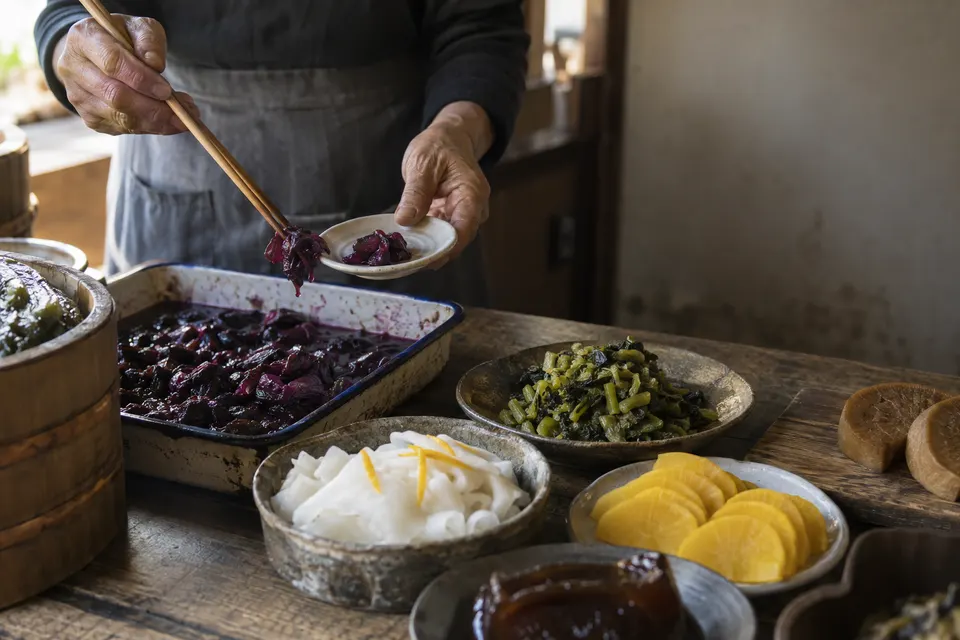
A COUNTRY KEPT IN SMALL DISHES
A small slice can hold a way through winter.
Tsukemono is not decoration beside rice. Salt draws out a crop’s water; bran remains after milling; lees remain after brewing; smoke moves indoors when snow blocks outdoor drying. Ways to keep food become flavour and memory of place. Do not chase completion—compare three different kinds of time.
- 21
- pickles to try
- 9
- ways to transform
- 6
- windows on place
30 SECONDS AT THE COUNTER
At the counter now? Keep only three things.
- 01
Begin with only three
Choose small portions in different directions: sweet senmaizuke, tart shibazuke and smoky iburigakko.
- 02
Do not assume fermentation
Acidity can come from lactic fermentation or vinegar. Let the current label and maker explain the product.
- 03
One daikon slice can have a full recipe
Check pickling liquid, dashi, soy sauce, miso, sake lees and shared utensils when they matter to you.
PRESERVATION BECOMES APPETITE
A preservation method became the taste that asks for one more bite of rice.
Official records point to salted gourd on Nara-period wooden tablets and several vinegar, hishio and sake-lees methods in the Heian-period Engishiki. Long history does not mean an unchanged product. Refrigeration, packaging, sweetness, colour and distribution have shifted; one name can now cover slow traditional work and modern quick seasoning.
THE SMALL DISH IS PART OF THE FORM
Pickles are not empty space on the tray.
MAFF describes a basic form of washoku as rice, soup, dishes and pickles, or kōnomono. Not every modern meal follows that form. It is a useful doorway, however: the small dish is not a reduced main course but a separate relationship between rice and the rest of the meal.
- 01飯
Beside plain rice
Salt, acid, aroma and crunch become clearer against rice. The pickle does not need to be large: one small bite can redraw the next mouthful.
At the table: Taste rice alone, then rice with one piece. Notice the change rather than searching for a correct pairing. - 02間
Between stronger flavours
Gari between sushi, rakkyo beside curry and a crisp pickle after fried food all create a pause. The role is not to erase the previous dish, but to make the next contrast legible.
At the table: Use one small bite as punctuation. Adding too much can turn the accent into the dominant flavour. - 03旬
A trace of season on the tray
A winter root, summer shiso or autumn leaf may reach the table after drying, salting or fermentation. The date of eating and the season of making are related, but they are not identical.
At the table: Ask what was made or harvested in season instead of assuming every item on today’s shelf is freshly seasonal. - 04技
An ingredient that returns to cooking
Older nozawana can fill oyaki; takana enters rice and noodles; chopped pickles season a dish as well as accompany it. Preservation can become a cooking ingredient with acidity, salt and texture already built in.
At the table: When a menu names a pickle inside a dish, expect its seasoning to travel through the whole dish—not remain in one removable piece.
01 · THE WORD IS NOT THE PROCESS
Sour cannot tell you whether microbes or vinegar did the work.
Separate twelve words for menu role, time, bed and seasoning. They help you choose; they are not ingredient lists or safety guarantees.
漬物
tsukemonoFoods preserved or seasoned through salt, bran, vinegar, soy sauce, miso, sake lees and other beds or liquids. The word alone does not mean fermented.
お漬物
o-tsukemonoA polite everyday form of tsukemono. The prefix changes the tone, not the ingredients.
香の物
kōnomonoA traditional menu word for pickles, often seen in set meals, kaiseki and ryokan breakfasts.
浅漬け
asazukeA lightly and briefly pickled vegetable. It often keeps fresh crunch; short time does not make allergy or hygiene checks unnecessary.
古漬け
furuzukeA pickle held longer until salt, acidity and fermented aromas deepen. It may be rinsed, chopped or cooked before serving.
塩漬け
shiozukeSalt draws water from the ingredient and changes texture. It may be the finished food or the first stage before another pickling bed.
ぬか漬け
nukazukeIngredients placed in a seasoned rice-bran bed. Each bed has its own age, microbes, salt and household or shop practice.
酢漬け
suzukeIngredients flavoured and preserved in vinegar. Vinegar suppresses microbial growth, so not every sour pickle is fermented.
醤油漬け
shōyuzukeIngredients seasoned in a soy-sauce-based liquid, sometimes after salting and desalting.
味噌漬け
misozukeIngredients matured or seasoned in miso. The miso’s soy, grain and alcohol-derived seasonings must be checked on the actual label.
粕漬け
kasuzukeIngredients placed in sake lees, often after salting. Aroma and alcohol content vary; do not infer suitability from the name.
麹漬け
kōjizukeA pickle using koji or a koji-based bed, sometimes with sugar, mirin or spices. Bettarazuke is one familiar example.
02 · NINE WAYS TIME ENTERS A VEGETABLE
Change the bed and the idea of preservation changes with it.
Salt, bran, vinegar, soy, miso, sake lees, koji, smoke and lactic fermentation. A real product may layer more than one method.
Salt and pressure
Draws out water, firms or softens cells and creates the first conditions for preservation or fermentation.
Rice-bran bed
Turns a milling by-product into a living, reusable bed whose aroma and acidity change with care and season.
Vinegar
Makes a clean sweet-sour line and can preserve colour or crispness without microbial fermentation.
Soy sauce and tamari
Darkens and seasons ingredients after salting, often giving a dense sweet-savoury finish.
Miso
Wraps vegetables in salt, grain aroma and fermented depth; wiping off the surface does not remove what has migrated inside.
Sake lees
Builds floral, fruity and deeply matured aromas through one or repeated beds.
Koji
Converts starches and proteins into sweetness and savouriness, often making a softly sweet white coating.
Smoke before the bed
Dries a harvest when outdoor sun is difficult and leaves a smoke line that survives the later bran fermentation.
Direct lactic fermentation
Microbes on the crop and in the environment can create acidity over time, with or without heavy seasoning.
THE LONG VIEW · FIVE SCENES
“The old taste” is not one ancient recipe.
There is no single-inventor timeline. Follow five scenes as the work of carrying a harvest becomes writing, separates into different beds, enters trade and reaches today’s shelf.
- 01土Before a dated recipe
Preservation begins before the written archive
MAFF notes that vegetable peel is thought to have been salted as far back as the Jōmon period. That is a cautious historical clue, not a surviving recipe we can reproduce exactly.
Notice the first problem: how to carry a harvest beyond its moment.
- 02木Nara period
A salted gourd enters the paperwork
A wooden tablet from the Tenpyō era records salted gourd. The small food becomes visible because administration wrote it down; ordinary meals beyond the record remain harder to see.
A written record proves a presence, not one universal method or flavour.
- 03式Heian period
The archive already holds several beds
The Engishiki records pickling with vinegar, hishio and sake lees, among other forms. Variety is not a recent decoration added to one original pickle; different routes were already being named.
Ask what the bed contributes: acid, aroma, colour, sweetness or time.
- 04店Edo period
Household knowledge becomes an urban trade
As restaurants and rice shops increased, specialist pickle businesses appeared and books described methods. Preservation moved not only through households, but through shops, readers and a growing food economy.
A regional food can be both inherited practice and deliberately sold craft.
- 05袋The shelf today
Slow maturation and quick seasoning share a name
Changes in manufacturing and eating habits let long-matured foods sit beside lightly or quickly seasoned products. Neither the name nor a nostalgic package tells you the process inside.
Read the current pack without using “traditional” as a safety or quality guarantee.
03 · TWENTY-ONE SMALL DOORS
Choose by colour, stay for texture, then follow it home.
Japan holds many more pickles. These twenty-one balance easy first encounters with regional foods worth travelling for. This is not a ranking.
Umeboshi
梅干し- Taste & texture
- Sharp, salty and fruity; honey-seasoned versions can be much sweeter.
- Inside one bite
- Salted ume fruit is dried and may be returned to liquid. It is fruit, not a plum-style sweet snack.
- First approach
- With rice, in onigiri or as a tiny breakfast accent.
Takuan
たくあん- Taste & texture
- Crunchy daikon with bran aroma; colour and sweetness range from natural amber to vivid seasoned yellow.
- Inside one bite
- Drying and bran pickling concentrate a winter root. Modern products cover both fermented and quickly seasoned styles.
- First approach
- Beside rice, in a bento or rolled into sushi.
Nukazuke
ぬか漬け- Taste & texture
- Tangy, earthy and alive with texture: cucumber snaps, aubergine turns silky, daikon stays firm.
- Inside one bite
- A maintained bran bed records repeated daily care. There is no single universal household flavour.
- First approach
- At a breakfast buffet or izakaya, start with one vegetable and compare.
Shibazuke
しば漬け- Taste & texture
- A fragrant purple pickle, tart and herbaceous from red shiso, often with aubergine and other summer vegetables.
- Inside one bite
- Kyoto’s Ohara area links summer crops, red shiso and lactic fermentation. Commercial recipes vary.
- First approach
- With plain rice, ochazuke or as a colour-and-acid counterpoint.
Senmaizuke
千枚漬け- Taste & texture
- Silky-thin turnip, gentle sweetness, vinegar and kombu; more supple than crunchy.
- Inside one bite
- Shōgoin turnip arrives in late autumn. Unlike long-storage pickles, this Kyoto winter food is made for a brief season.
- First approach
- Buy refrigerated, eat soon and let it reach the tongue unfolded.
Sugukizuke
すぐき漬け- Taste & texture
- A clean lactic tang with the fibrous bite of suguki turnip.
- Inside one bite
- A Kyoto winter pickle shaped by a specific vegetable, salting, pressure, warmth and fermentation.
- First approach
- Slice thinly with rice; compare younger and more acidic batches.
Narazuke
奈良漬け- Taste & texture
- Dark amber, dense, sweet-salty and intensely aromatic from sake lees.
- Inside one bite
- Salted white gourd and other vegetables may pass through repeated sake-lees beds, storing the history of brewing inside a slice.
- First approach
- Cut very thin; taste a small piece before pairing with tea or rice.
Iburigakko
いぶりがっこ- Taste & texture
- Firm crunch, bran sweetness and a clear hardwood smoke aroma.
- Inside one bite
- In snowy inland Akita, daikon was dried above indoor hearth smoke when outdoor drying was difficult, then fermented in bran.
- First approach
- Try it plain before the popular cream-cheese pairing.
Nozawana-zuke
野沢菜漬け- Taste & texture
- Long green stems, fresh mustardy notes when young, deeper tang when aged.
- Inside one bite
- In Nagano, washing the crop in hot-spring water is a remembered seasonal task; older pickles can become oyaki filling.
- First approach
- Fold a leaf around rice or compare fresh and old styles.
Sunki-zuke
すんき漬け- Taste & texture
- Direct, bright lactic acidity without the usual salty backbone.
- Inside one bite
- Kiso’s cold mountain environment and historically precious salt produced a rare salt-free red-turnip-leaf fermentation.
- First approach
- Eat it plain, or find it warming a bowl of soba in winter.
Takana-zuke
高菜漬け- Taste & texture
- Mustardy greens ranging from fresh saltiness to dark, sour, mature depth.
- Inside one bite
- Kyushu’s broad-leaved mustard greens become both a pickle and an ingredient, chopped into rice, noodles and stir-fries.
- First approach
- Ask whether it is young or old; the taste and use change greatly.
Hiroshimana-zuke
広島菜漬け- Taste & texture
- Broad, soft leaves with a mild mustard aroma and clean salted finish.
- Inside one bite
- One of Japan’s celebrated leafy pickles, it turns a large regional brassica into a winter table staple.
- First approach
- Wrap rice in a leaf to feel both surface and vein texture.
Bettarazuke
べったら漬け- Taste & texture
- Juicy white daikon with a softly sweet koji coating and gentle crunch.
- Inside one bite
- A Tokyo pickle associated with the autumn Bettara Market; its sticky surface gives the name a playful physical truth.
- First approach
- Try when you want mild and sweet rather than sharp and sour.
Fukujinzuke
福神漬け- Taste & texture
- Small crunchy pieces in a sweet, soy-coloured seasoning; ingredient mixtures vary widely.
- Inside one bite
- Developed in Tokyo in the Meiji era, it later became inseparable from Japanese curry, though the exact origin of that pairing is unsettled.
- First approach
- Compare the crunchy, sweet-savoury reset against a spoon of curry.
Rakkyo-zuke
らっきょう漬け- Taste & texture
- A crisp small bulb with sweet vinegar, sharp allium aroma and a clean snap.
- Inside one bite
- Different sandy soils and regional crops become local versions, but curry made the sweet-vinegar style familiar nationwide.
- First approach
- Alternate one small bulb with curry; it is a punctuation mark, not a side salad.
Gari
がり- Taste & texture
- Paper-thin young ginger, sweet vinegar and a brisk heat that clears the palate.
- Inside one bite
- At sushi, gari sits between bites. It is not normally piled onto each piece like a topping.
- First approach
- Use a small slice between contrasting fish; ask about sweeteners and colour.
Beni shōga
紅しょうが- Taste & texture
- Fine red ginger strips with bright vinegar acidity and sharp heat.
- Inside one bite
- It cuts through rich foods such as gyūdon, yakisoba and tonkotsu ramen; do not confuse it with pale sliced gari.
- First approach
- Add little by little; its colour and salt-acid line can dominate.
Wasabizuke
わさび漬け- Taste & texture
- Fresh wasabi stem heat softened by creamy-looking sake lees.
- Inside one bite
- A mountain crop and a brewing by-product meet in one aromatic paste-like pickle.
- First approach
- Take a very small amount with rice; it contains sake-derived material.
Matsumaezuke
松前漬け- Taste & texture
- Slippery-crunchy kombu and dried squid in a sweet soy seasoning.
- Inside one bite
- This northern preserved dish crosses the boundary of “vegetable pickle”: seaweed and seafood are central, not incidental.
- First approach
- Contains squid and often soy and wheat; check roe or other seafood additions.
Yamagawa-zuke
山川漬- Taste & texture
- Dark, concentrated dried daikon with a dense chew and mature aroma.
- Inside one bite
- In southern Kagoshima, winter-dried daikon is packed into jars and fermented for months—a warm-region answer to preservation.
- First approach
- Slice or chop finely; let one small bite open slowly with rice.
Hakusai-zuke
白菜漬け- Taste & texture
- Juicy napa cabbage, clean salt and gentle fermentation, often lifted by kombu, chilli or yuzu.
- Inside one bite
- Large winter leaves collapse under salt and weight, turning volume into a compact everyday side.
- First approach
- Lift from the stem end through the leaf to compare two textures.
04 · THE SEASON OF MAKING
Separate a year-round shelf from one season of making.
A pickle season is not a fixed calendar of when you may eat it. It is the clock of harvesting, drying, salting, fermenting and maturing. Ask the shop about current stock.
Ume begins as a harvest, not a red wrinkle
Fresh ume is salted before midsummer drying. The finished pickle may be sold year-round, so separate the season of making from the day you buy it.
Red shiso meets the vegetables of the heat
Aubergine, cucumber, myoga and red shiso connect shibazuke to summer work in Kyoto’s Ōhara area. The product remains available beyond that harvest window.
A large turnip becomes a thin, short-lived sheet
Senmaizuke production begins around the Shōgoin turnip harvest. Its brief refrigerated life is part of the experience, not a flaw in a long-storage pickle.
Leaf pickles show the difference between young and mature
Nozawana is harvested after autumn cold and eaten first as a fresh green pickle, then as a deeper, amber-toned mature pickle. Ask which stage is on the table.
Availability is not the same as harvest season
Refrigeration, packaging and distribution keep many pickles on shelves throughout the year. “Seasonal” in this guide describes the crop or traditional work; it does not guarantee stock, freshness or one recipe.
05 · SEVEN PLACES, SEVEN JOBS
The same slice changes its job when the setting changes.
At breakfast it can introduce a place; at sushi it sits between flavours; with curry it cuts through richness; at a souvenir counter it becomes a storage and border decision. Read only the setting you are in.
01宿 Ryokan or hotel breakfastLook for kōnomono beside the rice
A small assortment may already be part of the tray or buffet. Try one piece with plain rice before mixing it into another dish; refills and buffet rules depend on the venue.
02膳 Teishoku restaurantRead the pickle as part of the whole tray
The pickle may contrast with fried food, grilled fish or a rich sauce. It may be included, omitted or changed that day; do not assume that every set includes the same free side.
03鮨 Sushi shopGari sits between pieces, not on every piece
Gari, sweet-vinegared young ginger, can reset the palate between different fish. House sweetness, colour and refills vary, and the serving is not an ingredient guarantee.
04咖 Japanese curry shopTwo crisp accents can answer different appetites
Sweet-savoury fukujinzuke is chopped small; rakkyo keeps the snap of a whole bulb. A self-service jar may use shared tongs, while some shops offer only one or neither.
05酒 IzakayaOrder a moriawase when the table wants contrast
A pickle assortment can move from fresh crunch to mature aroma without adding another heavy dish. Portion, contents and price vary; ask what is included before ordering when that matters.
06店 Specialist shop or department food hallTaste by process before buying by colour
A counter may place several products under one regional name. Sampling is never automatic: wait for staff to offer it or ask, then confirm refrigeration and use-by information for your itinerary.
07発 Station or airport before departureLet storage and the border choose the souvenir
A sealed pack can still require refrigeration, and permission at the destination depends on its ingredients and current rules. Buy late in the day only after checking both.
06 · CLIMATE WRITES THE RECIPE
Snow, distance from salt, brewing and ports change the taste—not cold alone.
Do not treat prefectural borders as flavour borders. Read the conditions that changed crops and work; one place still holds many recipes.
Three famous pickles, three kinds of time
Shibazuke ferments summer vegetables with red shiso; sugukizuke builds winter acidity through lactic fermentation; senmaizuke turns late-autumn turnip into a short-lived, lightly sweet delicacy. “Kyoto pickle” is not one flavour.
Snow changes where a daikon can dry
When early snow and weak winter sun made outdoor drying difficult, daikon moved indoors above hearth smoke. Climate became aroma before the root ever reached the bran bed.
A pickle made by not using salt
Sunki uses red-turnip leaves and inherited starter to create lactic acidity without salt. Scarcity did not produce an empty substitute; it produced a distinct fermentation culture.
Brewing leaves another ingredient behind
Sake lees become a fragrant bed rather than waste. Repeated changes of that bed darken and deepen vegetables, linking temple-city history, brewing and patient preservation.
Leaf pickles become cooking ingredients
Takana can leave the pickle plate and enter fried rice, onigiri, noodles and stir-fries. A mature pickle is not only preserved produce; it is a seasoning with texture.
Sun, jars and months in a southern port
Thoroughly dried daikon is packed tightly into jars and matures for months. The result shows that cold northern winters are not the only climate capable of making a preservation culture.
07 · THREE FLIGHTS, NO RANKING
Three bites turn difference into a story.
Take small portions at a specialist shop or breakfast buffet. Even at an unlimited buffet, begin with an amount you can finish.
Gentle first plate
Senmaizuke → bettarazuke → young nozawanaMove from supple sweet-vinegar turnip to juicy koji sweetness, then a clean leafy saltiness.
Acid and fermentation plate
Shibazuke → sugukizuke → sunkiCompare herbaceous, salted and salt-free routes to acidity. Do not call all three “vinegar pickles”.
Deep-aroma plate
Iburigakko → narazuke → Yamagawa-zukeSmoke, sake lees and jar maturation place three different kinds of long work beside rice.
A FIVE-PASS FIELD NOTE
Do not guess the correct flavour; write how one slice changes.
Begin only after completing any allergy or dietary checks you need. Instead of collecting restaurant-review vocabulary, separate what you sensed from what the shop actually confirmed. That single line becomes a reference for the next place.
- 01眼
Look before naming
Notice the cut, moisture, skin and colour. Record only what is visible; colour cannot identify an additive, ingredient or method.
- 02香
Smell the first piece
Bring one small piece close before adding soy sauce or another condiment. Is the first impression leafy, fruity, smoky, bran-like or sake-like?
- 03音
Give texture its own bite
Taste a small piece alone. Listen for snap, then notice whether the centre stays juicy, turns supple or asks for a slower chew.
- 04飯
Return it to rice
Take a second small piece with plain rice. Ask what changed: did salt sharpen the rice, acidity clear the previous dish, or aroma lengthen?
- 05問
Ask one question, then write one line
Ask about the bed, crop, season or place—not all four during a busy service. A useful note joins one sensation to one fact you actually confirmed.
08 · THE LABEL IS PART OF THE JOURNEY
Four lines before buying prevent a long mistake home.
Pickles preserve food, but not every product is shelf-stable. Read name, ingredients, storage and destination rules even on the smallest pack.
- 01名
Read the product name
“Shibazuke-style” or “seasoned pickle” may not follow the traditional process described in a regional story.
- 02原
Read every ingredient
Check the vegetable, pickling liquid, soy sauce, miso, dashi, seafood, wheat, alcohol-derived seasonings, sweeteners and colours.
- 03保
Read storage and date
“Pickled” does not mean safe at room temperature after purchase or opening. Follow the package, keep chilled products cold and use clean utensils.
- 04境
Check your destination border
Ingredients accepted in Japan may be restricted where you land. Check the destination country or region’s official customs, agriculture and biosecurity rules before buying.
Ten Japanese terms to find on the pack.
Before translating the whole pack, find the headings for storage, date and ingredients. A printed date assumes the pack is unopened and stored as directed; opening it changes the decision.
- 01名称meishō
- Product name or legal category
Use this to distinguish a regional name from a broader “seasoned pickle” category.
- 02原材料名genzairyō-mei
- Ingredients
Read past the vegetable into the liquid, stock, extracts, seasonings and additives.
- 03一部に…を含むichibu ni … o fukumu
- Contains …
Find the named allergen, then still ask about shared liquid and equipment when cross-contact matters.
- 04要冷蔵yō-reizō
- Keep refrigerated
A sealed pack is not automatically shelf-stable. Arrange cold storage before buying.
- 0510℃以下で保存jū-do ika de hozon
- Store at 10°C or below
Treat this as a temperature condition, not a suggestion; follow the exact pack.
- 06開封後要冷蔵kaifū-go yō-reizō
- Refrigerate after opening
The unopened storage condition no longer answers what to do after the seal is broken.
- 07賞味期限shōmi-kigen
- Best-before date
It applies while unopened and stored as directed. After opening, follow the maker’s instructions and use it promptly.
- 08消費期限shōhi-kigen
- Use-by date
Do not treat this like a flexible best-before date. Keep the stated storage condition and do not eat it after the date.
- 09酒精shusei
- Ethyl alcohol
If you avoid alcohol, the word is a reason to check the product—not enough information to estimate the remaining amount.
- 10保存方法hozon hōhō
- Storage instructions
Read this together with the date, opening instructions and your travel time.
09 · ALLERGY, ALCOHOL & SHARED LIQUID
You can see the vegetable. You cannot see the whole liquid.
If you have a food allergy, ask before eating about the current label, pickling liquid, dashi, seafood extracts, soy sauce, miso, sake lees, mirin, sake, sesame and mustard, plus shared liquid, vats, knives, boards and tongs. If the information you need cannot be confirmed, do not eat it.
Soy, wheat and dashi
Soy-based liquid may involve soy and wheat, plus seafood dashi or mirin.
Sake lees, mirin and sake
Narazuke, wasabizuke and others use sake-derived ingredients. Check the individual product for residual alcohol.
Seafood beyond the vegetable
Matsumaezuke centres squid and kombu; vegetable pickles may still contain seafood extracts or dashi.
Shared liquid and tools
Bulk counters may share vats, liquid, chopsticks, tongs, knives and surfaces. Read production warnings on packs too.
10 · SHOW ONE QUESTION
Keep tasting advice separate from safety questions.
First ask for the flavour you want. Then make a separate, short ingredient check. Showing a sentence cannot guarantee accommodation or safety.
これは発酵させた漬物ですか、それとも酢や調味液で漬けたものですか?
Is this fermented, or is it pickled in vinegar or seasoned liquid?甘いもの、酸っぱいもの、燻製の香りがあるものを、一つずつ試したいです。
I would like to try one sweet, one sour and one smoky pickle.これは新漬けですか、古漬けですか?
Is this a young pickle or a mature pickle?酒粕、みりん、酒など、酒類由来の原料は入っていますか?
Does it contain sake lees, mirin, sake or any alcohol-derived ingredient?だし、魚介、えび、かに、いかは使っていますか?
Does it contain dashi, seafood, prawn, crab or squid?醤油や味噌に、小麦と大豆は含まれていますか?
Do the soy sauce or miso contain wheat and soy?要冷蔵ですか? 開封後はいつまでに食べればよいですか?
Does it need refrigeration? How soon should I eat it after opening?食物アレルギーがあります。原材料表示と、共用する器具・漬け液を確認してください。確認できなければ食べません。
I have a food allergy. Please check the ingredient label and any shared utensils or pickling liquid. I will not eat it if this cannot be confirmed.SEVEN USEFUL BOUNDARIES
Seven questions about fermentation, colour and carrying it home.
Are all Japanese pickles fermented?
No. Some develop through direct lactic fermentation; some use fermented beds such as bran, miso or sake lees; others are seasoned quickly in vinegar or soy-based liquid. Confirm the actual product and process.
Is the bright colour natural?
Sometimes colour comes from red shiso, turmeric or the ingredient itself; some products use colouring. A photograph cannot answer. Read the current label.
Can vegetarians assume vegetable pickles are suitable?
No. Pickling liquids can include dashi, fish or shellfish extracts; shared liquid and equipment also matter. Ask about the whole recipe.
Does narazuke contain alcohol?
Narazuke uses sake lees. Residual alcohol varies by product and process, so anyone avoiding alcohol should read the label and ask the maker rather than rely on a general number.
Which pickle should a first-time visitor try?
For a gentle start, try senmaizuke or bettarazuke. For clear fermentation, try shibazuke or sunki. For a dramatic aroma, try iburigakko or narazuke. Begin with a small tasting portion.
Can I carry pickles all day as a souvenir?
Only if the product’s storage instructions allow it. Many fresh or lightly pickled products need refrigeration. Ask for suitable packing and plan the last purchase of the day.
Are pickles a free side at every restaurant?
No. They may be included in a set, served as a small appetiser, offered at a buffet, or ordered and charged separately. Check the menu instead of assuming.
OFFICIAL SOURCES & EDITORIAL LIMITS
Go deep on culture; read today’s pack every time.
Sources checked 2026-09-13; next review scheduled for 2026-12-13. Official MAFF material was compared for history, process and place. Regional notes are representative doorways, not one recipe imposed on every home, shop or product. Current labels, makers and destination authorities prevail for ingredients, fermentation, alcohol, storage, dates and border permission.
AI language quality review completed; no human native-speaker review was performed.
- MAFF: Japanese traditional pickle overview
- MAFF: senmaizuke in Kyoto
- MAFF: shibazuke in Kyoto
- MAFF: Akita iburigakko
- MAFF: Nara narazuke
- MAFF: Nagano nozawana-zuke
- MAFF: Nagano sunki-zuke
- MAFF: takana-zuke
- MAFF: Aso takana-zuke
- MAFF: Tokyo fukujinzuke
- MAFF: Tokyo bettarazuke
- MAFF: Odawara umeboshi
- MAFF: rakkyo-zuke
- MAFF: Kagoshima Yamagawa-zuke
- Consumer Affairs Agency: food allergy labelling
- Consumer Affairs Agency: expiration-date labelling
- MAFF: rice and the form of washoku