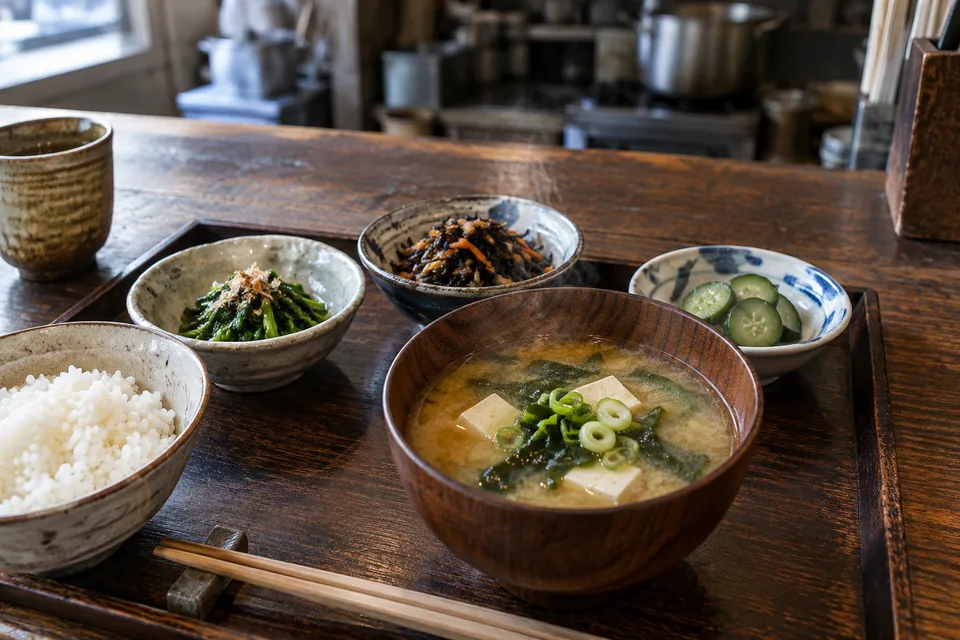
THE QUIET CENTRE OF A TEISHOKU
The smallest bowls can hold the longest story.
After choosing the main, attention usually stays on the largest plate. Yet a kobachi can hold the knowledge of rehydrating pantry foods, a brief season or a household’s sweet-savoury balance. Miso soup can carry koji, maturation, stock and regional preservation. This is not a ranking of sides. It is an atlas for reading the few bites in front of you.
- 12
- small sides
- 8
- soups
- 6
- regional windows
30 SECONDS AT THE TABLE
At the tray now? Read only these three things.
- 01
Read what changes today
The side or soup may differ from the printed photograph. Check the board, ticket machine or explanation when served.
- 02
Do not decide by colour
Dark miso need not mean saltier; clear soup need not be plant-based; a vegetable side may still contain fish or meat.
- 03
Ask about the whole tray
For allergies or dietary needs, check dashi, seasoning, pickling liquid and shared equipment too.
ONE SOUP, MORE THAN ONE STORY
“One soup, three dishes” is a doorway—not a guarantee of today’s tray.
One soup and three dishes is often used to explain a Japanese meal built around rice, soup, a main and sides. Everyday set meals, however, may be simpler, a rice bowl with soup, or a substantial soup beside one small dish. Do not count vessels as a correctness test. Notice the relationships: rice receives the main’s seasoning, soup places warmth on the tray, and a side shifts texture or acidity.
01 · READ THE MENU
Twelve words before the dish has a name.
Kobachi points to a vessel and serving size, not one recipe. Aemono points to a method. Read what each word tells you—and what it cannot.
小鉢
こばち · kobachiA small vessel and, by extension, the small serving in it. The word tells you size, not one recipe.
副菜
ふくさい · fukusaiA supporting dish, often using vegetables, mushrooms, potatoes, beans or seaweed. It can still contain fish or meat stock.
おひたし
おひたし · ohitashiCooked greens served with seasoned dashi or soy-based liquid; the name points to a method, not only spinach.
和え物
あえもの · aemonoIngredients dressed together after preparation. Sesame, miso, tofu or vinegar may form the dressing.
煮物
にもの · nimonoIngredients cooked in seasoned liquid. The broth may remain inside tofu, roots, seaweed or dried vegetables.
酢の物
すのもの · sunomonoA small vinegared dish, often cool and crisp. Sweetness, soy, dashi and seafood vary by recipe.
漬物
つけもの · tsukemonoFood seasoned or preserved in salt, rice bran, soy sauce, miso, sake lees, koji or vinegar. Not every pickle is fermented.
汁物
しるもの · shirumonoThe broad menu category for soup. It may be miso soup, clear soup, pork soup or a regional bowl.
味噌汁
みそしる · misoshiruSoup seasoned with miso, commonly built on dashi with one or more ingredients. Miso colour alone does not reveal every ingredient.
すまし汁
すましじる · sumashijiruA clear seasoned soup. Its appearance does not mean plain water or plant-only stock.
日替わり
ひがわり · higawariThe item changes by day. A side, soup or the whole set may change under this label.
香の物
こうのもの · kōnomonoA traditional menu expression commonly referring to pickles. The wording does not identify the vegetable or seasoning.
02 · TWELVE SMALL SIDES
Two bites can leave a long memory.
Read each representative form through taste, context and the check that still matters. Vegetable, stock, sweetness and serving change by kitchen, place and season even under the same name.
おひたし
おひたしGreens yield softly but keep their stems and leaves distinct; cool dashi and a light soy note often follow.
What these few bites can tell youThe changing green can be a quiet seasonal clue, but the printed name may stay the same.
Sesame-dressed vegetables
胡麻和えGround sesame makes a soft, nutty coating that clings to greens or beans; sweetness varies widely.
What these few bites can tell youAemono shows how the same vegetable changes when the dressing becomes the centre.
Simmered hijiki
ひじきの煮物Dark seaweed, carrot and fried tofu often hold a sweet-savoury cooking liquid in several textures.
What these few bites can tell youDried sea vegetables connect pantry preservation with a few ready-to-serve mouthfuls.
Kinpira burdock
きんぴらごぼうThin roots stay chewy under soy, sweetness and optional chilli or sesame.
What these few bites can tell youCut size tells you how the kitchen balanced speed, chew and seasoning.
Simmered dried daikon
切り干し大根の煮物Rehydrated strips have a light chew and concentrated sweetness, often beside carrot or fried tofu.
What these few bites can tell youDrying turns a familiar root into pantry time: season stored for a later meal.
Chilled tofu
冷奴Cool, tender tofu lets ginger, scallion, bonito flakes or soy sauce change each bite.
What these few bites can tell youIts simplicity exposes the difference between tofu itself and everything placed on top.
Rolled omelette
卵焼きLayers may be sweet, savoury or dashi-rich; cool slices can sit quietly beside a strong main.
What these few bites can tell youA familiar egg dish can reveal household and regional preferences without one national rule.
Japanese diner potato salad
食堂のポテトサラダSoft potato may hold cucumber, carrot, onion, ham or egg under a creamy dressing.
What these few bites can tell youYōshoku and home cooking entered the teishoku tray; everyday culture is not limited to old recipes.
Vinegared cucumber and additions
きゅうりなどの酢の物Cool acidity and crisp cucumber reset the mouth; wakame, octopus or tiny fish may add another texture.
What these few bites can tell youA few sour bites can change how a fried or sweet-savoury main feels.
Fried and soaked aubergine
なすの揚げびたしAubergine absorbs oil and seasoned dashi, becoming cool, soft and deeper than its pale-looking sauce suggests.
What these few bites can tell youSummer produce can appear as a prepared side rather than a raw seasonal display.
Simmered beans
煮豆Beans hold sweetness slowly; a glossy spoonful may be both a side and a preserved pantry rhythm.
What these few bites can tell youSweetness in a savoury tray is not automatically dessert; it can pace salt and rice.
Pickles and kōnomono
漬物・香の物Salt, acid, fragrance and crunch can occupy only two bites while carrying a long preservation story.
What these few bites can tell youRice bran, smoke, sake lees, koji, miso or vinegar can point to a climate and pantry—not one universal pickle.
03 · INSIDE ONE BOWL
Miso soup is more than “miso flavour.”
Read one bowl through four layers: dashi, miso, ingredients, and heat and timing. This is not a diagram for guessing by sight; it organises what to ask the kitchen.
- 01出
Dashi: the layer below the colour
Bonito, kombu, dried small fish, mushrooms, shellfish, chicken or pork can shape the liquid. Some kitchens use blended or prepared stock. You cannot identify every source from colour or visible ingredients.
Action: Ask about the stock before asking whether the visible pieces can be removed. - 02麹
Miso: grain, soybean, salt and time
Miso is commonly grouped by koji made from rice, barley or soybean; blends also exist. Colour, sweetness, aroma and depth reflect raw materials, ratios and maturation, not a simple light-equals-mild rule.
Action: Notice aroma and finish, then ask which miso the kitchen uses if it matters. - 03具
Gu: today’s ingredients set the season
Tofu and wakame are familiar, but clams, mushrooms, roots, leafy vegetables, fried tofu and leftovers from fish preparation can turn the same soup into another meal.
Action: Ask what is in today’s soup; do not assume from yesterday’s photograph. - 04火
Heat and timing: miso is not the whole method
Ingredients may be simmered first and miso dissolved later; some bowls are reheated or held for service. Temperature, settling miso solids and softened vegetables can reflect service timing as well as recipe.
Action: Stir only if needed and take a small first sip; the bowl and contents may be very hot.
04 · EIGHT SOUPS
From a light bowl to a second main.
Begin with tofu and wakame, then move through clams, pork, roots, fish trimmings, red miso and clear broth. Compare contents and role—not only colour.
Tofu and wakame miso soup
Soft tofu, yielding seaweed and scallion make an easy reference bowl, but stock and miso still vary.
Nameko mushroom miso soup
Small mushrooms give the soup a natural slip and gloss. Tofu or grated daikon may join them.
Clam miso soup
Shell aroma enters the whole liquid; empty shells remain part of the eating rhythm.
Tonjiru pork and vegetable soup
Pork, roots, konnyaku and tofu can make soup almost another main. The reading is tonjiru or butajiru by place and speaker.
Kenchinjiru root-vegetable soup
Roots, konnyaku and tofu form a substantial clear or lightly seasoned soup with many local and household versions.
Arajiru fish-bone soup
Fish head, bones and trimmings give depth and show how more of the catch enters the meal.
Akadashi-style red miso soup
A dark bowl with a firm fermented finish, often using soybean miso or a blend. The term does not reveal the exact recipe.
Clear soup
A clear broth places stock, salt and aroma in the foreground; mushrooms, fish cake, shellfish or greens may appear.
05 · SIX WINDOWS ON PLACE
Not a miso map: six windows into place.
Taste does not switch at a prefectural border. Distribution, households, kitchens, makers and maturation overlap. Treat regional names as clues for finding another bowl, never as certainty.
Rice miso is one family, not one taste
Rice-koji miso is made widely, from pale and sweet to red-brown and savoury. Shinshu, Sendai and sweet white miso are useful names to recognise, not shortcuts to one prefecture-wide bowl.
Barley koji can bring grain aroma and sweetness
Barley miso is strongly associated with parts of Kyushu, Shikoku and Chugoku, while recipes and maturation still differ. Ask the kitchen rather than assigning a taste from the map alone.
Soybean miso carries a long, deep finish
Soybean koji distinguishes this regional family from rice- or barley-koji miso. Its dark colour and concentrated savoury character do not by themselves tell you the salt level of today’s soup.
Hiyajiru changes the temperature of the meal
Miyazaki hiyajiru combines fish, miso and sesame in a cool serving often eaten with rice and summer vegetables. It is related to the world of soup, but not simply cold everyday miso soup.
Sake lees can make winter soup opaque and rich
Kasujiru uses sake lees with roots and often fish or meat. Miso may be added too. “Soup” can therefore carry brewing culture, alcohol-derived ingredients and a substantial second centre to the meal.
A preserved staple can enter the soup itself
Aomori’s senbei-jiru simmers purpose-made wheat crackers in soup until they become pleasantly chewy. It carries the history of grain, cold-climate preservation and later regional promotion without representing every Aomori bowl.
06 · FOUR SEASONS IN A FEW BITES
The calendar may reach the small bowl first.
Bitter shoots and new greens
Bamboo shoots, nanohana and mountain vegetables may enter ohitashi or nimono. Bitterness can be intentional, while exact harvest and origin still need confirmation.
Cool bowls, acid and aubergine
Cucumber sunomono, chilled tofu and soaked aubergine may create relief beside a hot main. “Refreshing” says nothing about stock, salt or allergens.
Mushroom aroma and stored roots
Mushrooms can move between the soup and small side; roots begin to deepen simmered dishes. Availability does not prove local harvest or peak freshness.
Roots, leafy vegetables and held heat
Daikon, turnip, burdock, carrot, Chinese cabbage and leek often appear in simmered sides or substantial soup. Dense pieces can stay hotter than they look.
07 · READ THREE ACTUAL TRAYS
What you know, what you do not, what to ask.
Three practices that move from observation to verification—without turning culture into a quiz.
The main is fixed; the calendar moves
The grilled-fish set keeps its name. In spring, nanohana ohitashi arrives; in summer, cucumber sunomono.
- What you know
- The side changed and changes the temperature, texture and rhythm of the tray.
- What remains unknown
- The photograph cannot prove origin, today’s dashi, seasoning or allergens.
Ask in this scene今日の小鉢は何ですか? だしと味付けも教えてください。
What is today’s small side? Please also tell me about the stock and seasoning.
A small bowl can be a second main
A fried main arrives with potato salad and tonjiru. The soup contains pork, tofu and roots.
- What you know
- Bowl size does not measure ingredient complexity or how filling it will be.
- What remains unknown
- Egg, milk, ham, dashi, soy, wheat and shared utensils depend on the kitchen.
Ask in this scene汁物とポテトサラダの原材料も確認できますか?
Could you also check the ingredients in the soup and potato salad?
Plant-forward is not a safety label
The tray shows tofu, hijiki, greens and pickles, with no visible meat or fish.
- What you know
- The visible ingredients give a useful starting point for a preference.
- What remains unknown
- Dashi, fried tofu, seasoning, pickling bed and shared equipment can introduce fish, meat, wheat, sesame or other ingredients.
Ask in this scene肉と魚は、だしと調味料にも使っていませんか? 共用器具も確認してください。
Are meat or fish used in the stock or seasonings? Please also check shared equipment.
08 · THE HIDDEN HALF OF THE TRAY
For food allergies, never skip the small vessels.
Food prepared by restaurants or shops may not present information in the same way as packaged food. Before eating, ask the venue about current ingredients and the preparation environment. If the information you need cannot be confirmed, do not eat it.
Stock
Bonito, dried small fish, shellfish, chicken or pork can remain in soup and simmered food after visible pieces are removed.
Dressings & seasoning
Sesame, miso, tofu, egg, wheat, soy, milk or alcohol-derived ingredients may sit in dressings or cooking liquid.
Pickling medium
Rice bran, soy sauce, miso, sake lees, koji, vinegar or mustard may not be evident from the vegetable’s name.
Shared equipment
With a serious allergy, ask separately about shared ladles, pans, knives, boards, tongs, fryers and plating areas.
NINE SHORT CHECKS
Point to one vessel and ask one thing.
These short questions open a conversation. They are not a reason to proceed when the answer remains unclear.
今日の小鉢は何ですか?
What is today’s small side?今日の汁物には、何が入っていますか?
What is in today’s soup?味噌は何味噌ですか?
What kind of miso is used?この汁物に、魚のだしは使っていますか?
Is fish stock used in this soup?この小鉢に、ごまは入っていますか?
Does this small side contain sesame?この漬物は、何で漬けていますか?
What is this pickle seasoned or pickled with?小鉢を変更できますか? 変更後の原材料も確認してください。
Can the small side be changed? Please also check the replacement ingredients.食物アレルギーがあります。汁物、小鉢、漬物、だし、調味料、共用器具も確認してください。
I have a food allergy. Please also check the soup, sides, pickles, stock, seasonings and shared equipment.BEFORE THE NEXT BOWL
Six boundaries visitors often miss.
Is every small side vegetarian?
No. Dashi, fried tofu seasoning, minced meat, fish flakes, seafood, egg or dairy may appear even when vegetables are most visible. Check the current dish with the venue.
Is all miso soup made with fish stock?
No. Bonito and dried small fish are common, while kombu, mushrooms, shellfish, blended prepared stock and other recipes also exist. Ask about this kitchen’s current stock rather than assuming.
Does dark miso mean the soup is saltier?
Not reliably. Colour can reflect raw materials and maturation; recipe concentration and serving size also matter. Taste and product information are more useful than colour alone.
Are all Japanese pickles fermented?
No. Fermented pickles exist, while quick pickles and foods seasoned in vinegar or other liquids may not depend on fermentation. Ask about the specific pickling method.
Can I change the side dish?
Sometimes, but it is not guaranteed and a replacement may introduce different ingredients or shared equipment. Ask before ordering and check the replacement too.
Should I finish the soup?
No completion rule is needed. Enjoy the amount that suits you. If salt, heat or portion matters, take a small first sip and decide without treating the bowl as a test.
OFFICIAL SOURCES & EDITORIAL LIMITS
Go deep on context; stay careful about today’s bowl.
Sources checked 2026-09-12; next review scheduled for 2026-12-12. Official materials were compared for miso, pickles, regional soups and seasons. Regional notes are representative doorways, not one flavour imposed on every kitchen, household or prefecture. Current venue information prevails for price, serving, origin, ingredients, recipe, stock, alcohol-derived ingredients and shared processes.
AI language quality review completed; no human native-speaker review was performed.
- MAFF: one soup and three dishes in everyday meals
- MAFF: miso, soy sauce and regional fermentation
- MAFF: pickles, preservation and regional variety
- MAFF: regional soup collection
- MAFF: food and Japan’s four seasons
- MAFF: Miyazaki hiyajiru
- MAFF: Hyogo kasujiru
- MAFF: Aomori senbei-jiru
- Consumer Affairs Agency: allergies in restaurant and prepared food