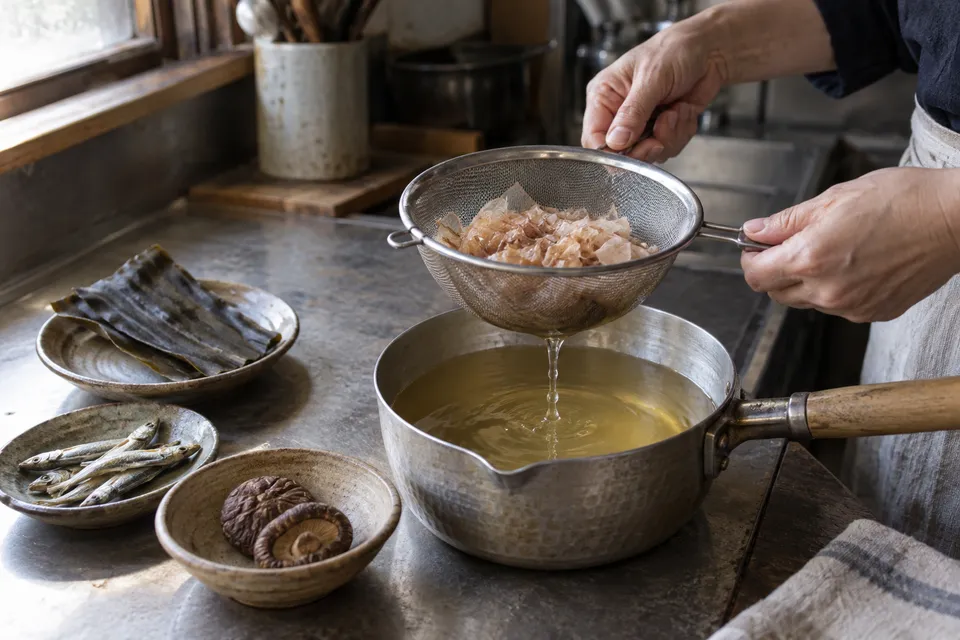
THE TASTE BENEATH THE DISH
Because it is invisible, look for the work inside the water.
Dashi can disappear from the dish name, photograph and finished bowl. Yet the sea where kombu was dried, the smoke that turned fish into flakes, the time that softened shiitake and the ships connecting ports can remain in one mouthful. This is not an ingredient-guessing test. It is a tool for tasting slowly—and asking the kitchen precisely when it matters.
- 10
- dashi sources
- 12
- dishes
- 6
- windows on place
30 SECONDS AT THE TABLE
At the bowl now? Keep only these three things.
- 01
Do not decide by colour
A clear stock may contain fish, shellfish or meat. A dark bowl may show soy sauce or miso rather than stock strength.
- 02
Separate stock from seasoning
Ask what the stock is made from, then what soy sauce, miso, mirin or other seasoning finishes the dish.
- 03
Never use aroma as a safety check
For allergies or dietary needs, ask about ingredients, prepared stock, extracts and shared equipment.
DASHI IS NOT THE WHOLE BOWL
Separate stock, seasoning and ingredients; the bowl becomes three-dimensional.
“Soy sauce”, “miso” and “salt” describe only part of a finished flavour. The bowl changes with the stock underneath, aromatic oil or garnish above, and whatever the ingredients release back into the liquid. Clarity and colour begin an observation; they are not ingredient lists.
01 · THE LANGUAGE OF STOCK
Twelve words, twelve different boundaries.
Keep source names, extraction methods and product names apart. Shiro dashi, in particular, is a seasoned concentrate—not an unseasoned white stock.
だし/出汁
dashiLiquid made by drawing flavour and aroma from ingredients into water. On a menu, the word does not identify which ingredient was used.
うま味
umamiOne of the basic tastes. It can give length and fullness, but dashi also carries aroma; umami and “delicious” are not interchangeable words.
合わせだし
awase dashiA stock combining sources, often kombu with a fish product or kombu with dried shiitake. “Combined” is not one fixed recipe.
一番だし
ichiban dashiThe first extraction from fresh dashi ingredients, prized where a clear aroma and colour matter. Kitchens vary in material, ratio and method.
二番だし
niban dashiA further extraction from ingredients used for first dashi, sometimes with fresh flakes added. It suits dishes where stock cooks with seasoning and ingredients.
昆布だし
kombu dashiStock drawn from dried kombu. It may be used alone or as the base of a combined stock.
かつおだし
katsuo dashiStock from katsuobushi, bonito processed by cooking, drying and smoking, with further maturation in some products.
煮干し/いりこ
niboshi / irikoSmall fish cooked and dried for stock. Iriko is a common regional name; fish species, size and preparation affect the result.
あごだし
ago dashiStock made with flying fish, commonly dried or grilled before drying. It is associated with parts of Kyushu, but is now sold and used more widely.
精進だし
shōjin dashiStock intended without fish or meat, often using kombu and dried shiitake. The finished dish still needs its own ingredient and shared-equipment check.
白だし
shiro dashiA pale concentrated seasoning that commonly combines dashi with soy sauce, salt, sweetener and other ingredients. It is not plain “white stock”.
だしの素/だしパック
instant dashi / dashi bagConvenient prepared stock in granules, powder or a porous bag. It may blend extracts, fish products, seaweed, mushroom and seasoning.
02 · TEN SOURCES
Seaweed, fish, mushroom and bone: long work before the water.
Read ten doorways through preservation, processing, movement and cooking as well as taste. Because blends are common, recognising one source never proves the full recipe.
Kombu
昆布A marine, rounded savouriness with little smoky aroma. The liquid can look almost like water.
Before it meets the waterDried kelp stores and travels. Its route from Hokkaido through ports helped shape food cultures far from where it grows.
Katsuobushi
かつお節A lifted, smoky fish aroma and a clean finish when lightly extracted; longer or blended extraction can feel deeper.
Before it meets the waterHeat, smoke, drying and sometimes mould-assisted maturation turn a perishable fish into a compact flavour material.
Kombu and bonito
昆布とかつおの合わせだしKombu gives breadth while bonito adds aroma and a longer savoury line; neither needs to dominate.
Before it meets the waterCombining glutamate-rich kombu with inosinate-rich fish is one established way to create umami synergy.
Niboshi / iriko
煮干し・いりこA direct dried-fish aroma, gentle bitterness or mineral edge may remain, depending on species and preparation.
Before it meets the waterSmall local fish become a stable pantry ingredient; in Kagawa, iriko sits beside wheat, salt and soy sauce in the story of udon.
Ago / flying fish
あご・トビウオA clear fish aroma with roasted notes when grilled flying fish is used; strength depends on product and extraction.
Before it meets the waterAround the Gotō Islands, flying fish stock meets hand-stretched noodles; the bowl holds sea, preservation and island movement together.
Other fish flakes
さば節・宗田節・むろ節などSome give a darker, firmer body than delicate bonito stock and can stand up to soy sauce and noodles.
Before it meets the water“Kezuribushi” is a family, not one fish: mackerel, frigate tuna, tuna, horse mackerel and sardine products have distinct uses.
Dried shiitake
干し椎茸A woodsy aroma and deep, lingering savouriness; the soaking liquid often becomes part of the stock.
Before it meets the waterDrying changes both storage time and flavour. With kombu, it can build a plant-based stock used in shōjin cooking.
Shōjin blend
精進だしKombu, dried shiitake, dried vegetables or beans can create quiet layers without fish or meat.
Before it meets the waterAbsence becomes technique rather than emptiness: ingredients are dried, soaked and combined to support vegetables and tofu.
Shellfish
貝のだしClams and other shellfish can bring saline sweetness and a rounded ocean aroma, sometimes without another stock.
Before it meets the waterThe ingredient may be both the visible gu and the stock source, as in a clam soup; strained broth can hide the shellfish completely.
Fish bones, trimmings and animal stock
魚のあら・鶏や豚のだしLonger cooking can give body, fat and opacity; clear fish-bone soup is also possible, so appearance alone is unreliable.
Before it meets the waterJapanese kitchens do not use dried seafood alone. Whole-animal cookery, ramen and regional soups turn bones and trimmings into another layer.
03 · ONE SPOON, FOUR PASSES
Unfold one spoon through water, stock, aroma and finish.
This separates what you notice from what you cannot prove. Use it for attention and pleasure, never to decide dietary safety.
- 01水
Water carries; it does not announce
Dashi begins as water, yet water hardness, temperature and contact time affect extraction. A clear bowl may carry several dried ingredients.
Try this: Use clarity as a visual fact, never as proof of a simple recipe. - 02出
Stock is the foundation, not the finished flavour
The stock contributes savouriness and aroma. Salt, soy sauce, miso, sugar, mirin, vinegar and oils then build the finished dish.
Try this: Separate “what is the stock?” from “how is the dish seasoned?” - 03香
Aroma arrives before basic taste
Smoke, dried fish, seaweed, mushroom, roast and animal fat can suggest a source. Temperature and toppings can amplify or cover those cues.
Try this: Smell once before adding chilli, citrus, sesame or extra sauce. - 04余
The finish tells a slower story
Salt often speaks first. Dashi may become clearer after swallowing as length, roundness, smokiness or a mineral edge.
Try this: Take one plain spoonful, wait, then eat it with the main ingredient.
04 · TWELVE DISHES
Dashi remains even when no soup is visible.
Move from clear soup into batter, egg, rice and ramen. Compare where stock enters the inside of a dish rather than remaining a visible liquid.
Clear soup
お吸い物・すまし汁A clear bowl can foreground first dashi, a seasonal aromatic garnish and one or two ingredients.
At the tableSmell before stirring; compare the plain broth with the bite that includes garnish.
Miso soup
味噌汁Miso changes colour and aroma, but the stock below it may be bonito, niboshi, shellfish, kombu, mushroom or an instant blend.
At the tableLet solids settle and taste the upper liquid, then the ingredients; neither reveals the full recipe alone.
Udon broth
うどんのつゆKombu, iriko, bonito and other fish flakes can meet soy sauce and sweet seasoning in different balances.
At the tableCompare aroma, colour and finish, but do not call pale broth weak or dark broth more salty without tasting.
Soba dipping sauce and broth
そばつゆ・かけつゆFirm fish flakes can support concentrated soy seasoning; dipping sauce and hot broth are not necessarily the same strength.
At the tableSip a little only if appropriate; dipping sauce is designed to meet noodles, not always to drink straight.
Simmered dishes
煮物Dashi sits inside roots, tofu, konnyaku and dried foods after the cooking liquid is reduced or removed.
At the tableTaste the cut surface: cooking time and shape decide how far seasoning travels.
Ohitashi
おひたしCooked greens can hold a cool seasoned stock; bonito flakes on top may be only one of several fish components.
At the tableNotice stem, leaf and liquid separately; the vegetable is not the whole dish.
Dashimaki tamago
だし巻き卵Stock loosens the egg and carries aroma between thin rolled layers; moisture and sweetness vary by kitchen.
At the tableCompare the centre and browned edge; the same roll can hold delicacy and pan aroma.
Takoyaki and okonomiyaki batter
たこ焼き・お好み焼きの生地Dashi can live inside the batter rather than in a visible soup, helping the interior taste seasoned before sauce is added.
At the tableTry an unsauced edge if the shop’s serving allows; sauce is only the outermost layer.
Oden
おでんStock changes as radish, fish cakes, eggs, meat and other pieces cook in it; the pot is a conversation, not a neutral bath.
At the tableTaste broth early and late in the meal, while remembering every item shares the pot.
Ochazuke and dashi-chazuke
お茶漬け・だし茶漬けTea, hot water or seasoned dashi may be poured over rice; the menu name and venue decide which liquid arrives.
At the tableWatch what is poured before assuming “tea”; toppings may also season the bowl.
Seasoned mixed rice
炊き込みご飯Rice absorbs stock as it cooks, so the liquid disappears while its aroma and ingredients remain throughout every grain.
At the tableLift the lid or bowl and notice the first steam; it often tells more than the visible garnish.
Ramen soup
ラーメンのスープAnimal bones, fish, shellfish, kelp and dried mushrooms may be extracted separately, then joined with tare and aroma oil.
At the tableRead broth, tare and oil as three decisions. “Shio” or “shōyu” usually names seasoning, not every stock source.
05 · SIX WINDOWS ON PLACE
Place comes from routes as much as origins.
Hokkaido kombu supports cooking in Osaka, Seto Inland Sea fish enter Kagawa noodles, and Gotō flying fish meet island udon. Follow movement between places instead of colouring one flavour per prefecture.
Hokkaido to the ports
Kombu grows in northern seas, but much of its culinary story unfolded after drying and transport. Read Osaka, Kyoto, Hokuriku and Okinawa as connected points, not isolated “local flavours”.
Osaka
Kombu arriving through maritime trade met soft water, fish flakes and a city of merchants and kitchens. Dashi is present beyond soup, including batter-based foods.
Kagawa and the Seto Inland Sea
Wheat, salt, soy sauce and anchovies dried as iriko form a practical landscape around Sanuki udon.
Nagasaki and the Gotō Islands
Flying fish from island waters becomes ago dashi and meets hand-stretched Gotō udon, tying marine harvest to a durable noodle culture.
Temple and shōjin kitchens
Kombu and dried shiitake show that plant-based stock is an active craft of drying, soaking and combining, not merely fish stock with something removed.
The convenience shelf
Dashi bags, granules, concentrates and bottled seasoning carry regional words into ordinary homes and commercial kitchens. Convenience is part of contemporary food culture.
06 · PRESERVATION, TRADE, THE KITCHEN
A quick bowl rests on long work upstream.
Extraction may take minutes in the kitchen, after harvesting, drying, smoking, moving and shaving have already taken time. Read dashi history as a chain of work, not one hero’s invention.
Drying turns distance into possibility
Kombu, fish flakes, niboshi and shiitake concentrate flavour while becoming easier to store and move. A bowl can therefore join sea, mountain, season and a city far from the harvest.
Trade routes become taste routes
The Kitamaebune network moved kombu from Hokkaido through Japan Sea ports toward Osaka. The ingredient was eaten, processed and reinterpreted at ports and inland destinations.
A hard preserved block becomes seconds of aroma
Fish is cooked, dried and smoked into fushi, then shaved so hot water can meet a wide surface. Long preparation upstream allows a short extraction in the kitchen.
Combination becomes a grammar
Kombu, fish, mushroom and other materials can be drawn separately or together. The cook chooses which voice provides breadth, aroma, body or finish, then adds seasoning and ingredients.
Packets and concentrates are also today’s kitchen
Households and restaurants may use scratch stock, prepared products or both. Honest observation includes contemporary speed and consistency instead of treating only laborious methods as culture.
07 · COMPARE WITHOUT RANKING
Compare world soup bases; notice the time stored in dried ingredients.
Dashi is not always “delicate”, and other cuisines’ stocks are not simply “heavy”. The useful difference is where each kitchen places work—in which ingredient, at what time and for how long.
Dashi
- How flavour enters water
- Often begins with ingredients whose flavour was concentrated earlier by drying, smoking or fermentation-related maturation; extraction can be brief.
- Possible result
- Can be pale and low in fat while carrying long savouriness and a distinct dried-ingredient aroma.
- Limit of the comparison
- There is no single dashi method; fish bones, shellfish, meat and modern extracts broaden the category.
Stock / broth
- How flavour enters water
- May simmer fresh bones, meat, vegetables or aromatics for longer, with roasting or skimming depending on the cuisine.
- Possible result
- Can build body through gelatin, fat and roasted flavours, though clear, light examples also exist.
- Limit of the comparison
- English usage varies by region and cook; this is a comparison lens, not a rigid dictionary rule.
Bouillon / fonds / Chinese gāotāng and other soup bases
- How flavour enters water
- Cuisines around the world extract and layer savoury ingredients using their own materials, heat and time.
- Possible result
- The useful comparison is what each kitchen asks water to carry—not a claim that one culture “discovered flavour”.
- Limit of the comparison
- Names, techniques and histories deserve their own context; do not flatten them into “foreign dashi”.
08 · A THREE-CUP HOME FLIGHT
Compare three small cups before adding salt.
A small experiment for before or after the journey. Follow each product’s storage, ratio, heating and date instructions; handle finished stock hygienically and use it promptly.
01昆 Cup 1 · kombu
Soak a small clean piece of dashi kombu in measured water according to its product guidance. Warm gently if directed, then remove it before vigorous boiling.
02鰹 Cup 2 · bonito
Use the packet’s ratio and method for katsuobushi. Strain without pressing hard unless the recipe specifically asks for it.
03合 Cup 3 · combine
Mix equal small amounts of the two finished stocks. Do not add salt yet; the exercise is comparison, not a definitive restaurant recipe.
09 · THREE TABLES
Observe first; ask precisely when it matters.
Three scenes separate visible facts from questions only the kitchen can answer. If an answer remains unclear, do not rush the decision to eat.
At a breakfast miso soup
The buffet label says only “miso soup”. Tofu and wakame are visible.
- What you know
- The seasoning contains miso; tofu and seaweed are present.
- What remains unknown
- The stock, exact miso, hidden ingredients, alcohol-derived seasoning and shared utensils.
Ask in this sceneこの味噌汁のだしと、味噌の原材料を確認できますか?
Could you check the stock and the ingredients in the miso?
At a pale udon broth
The broth is clear and the menu calls it “light”, but you avoid fish.
- What you know
- The visual colour and the restaurant’s description of the taste.
- What remains unknown
- Whether kombu, iriko, bonito or other fish flakes are combined, and what is in the seasoning.
Ask in this sceneこのつゆに、かつお節、煮干し、さば節などの魚を使っていますか?
Does this broth use fish such as bonito, niboshi or mackerel flakes?
At a shōjin meal
The set is introduced as shōjin cuisine and the stock is described as kombu and shiitake.
- What you know
- The stated stock sources and the venue’s description of the meal.
- What remains unknown
- Every condiment, garnish, dessert and the degree of kitchen separation relevant to your needs.
Ask in this scene食事全体の原材料と、調理器具の共用について確認できますか?
Could you check the whole meal’s ingredients and whether cooking equipment is shared?
10 · ALLERGY & DIETARY BOUNDARIES
Never exclude an invisible ingredient by guesswork.
If you have a food allergy, ask the venue before eating about the current stock sources, prepared dashi, extracts, tare, miso, soy sauce, alcohol-derived seasoning, aroma oils, ingredients and shared equipment. If the information you need cannot be confirmed, do not eat it.
Fish flakes, dried fish and extracts
Bonito, mackerel, sardine, flying fish and other fish can remain in liquid or powder with no visible piece.
Shellfish, prawn and crab
They may appear in stock, extract, seafood blends or aroma oil and cannot be removed by taking out visible pieces.
Seasoning after the stock
Soy and wheat in soy sauce, soy or grains in miso, mirin or sake, milk, egg and sesame belong to separate layers.
Shared kitchen
Ask as needed about shared pans, stockpots, strainers, ladles, measures, containers and work surfaces.
11 · SHOW THE KITCHEN
Ask one layer at a time.
Begin with one short question and name the ingredient you need checked. If staff cannot confirm during a busy service, do not pressure them; choose another option.
この料理は、何のだしを使っていますか?
What is the stock in this dish made from?かつお節、煮干し、さば節などの魚を使っていますか?
Does it contain fish such as bonito, niboshi or mackerel flakes?えび、かに、貝のだしやエキスを使っていますか?
Does it contain prawn, crab or shellfish stock or extract?鶏や豚のだし、エキス、油を使っていますか?
Does it contain chicken or pork stock, extract or fat?魚や肉を使わない、昆布と椎茸だけのだしですか?
Is the stock made only with kombu and shiitake, without fish or meat?白だしや、だしの素の原材料も確認できますか?
Could you also check the ingredients in the shiro dashi or prepared stock?だしとは別に、醤油、小麦、大豆、酒類を使っていますか?
Apart from the stock, does it contain soy sauce, wheat, soy or alcohol-derived seasoning?同じ鍋、こし器、おたまを他のだしと共用していますか?
Are the same pot, strainer or ladle shared with other stocks?12 · SEVEN USEFUL BOUNDARIES
Seven questions colour, aroma and names cannot settle.
Is clear dashi vegetarian or vegan?
Not necessarily. Bonito, niboshi, mackerel flakes, shellfish and clear animal stocks can all produce a pale or clear liquid. Ask about the exact stock and the finished dish.
Is pale udon broth always less salty than dark broth?
Colour is not a reliable salt measure. Soy sauce type, stock, dilution and sweet seasoning all affect appearance and taste. If sodium matters medically, use venue or product nutrition information rather than colour.
Does “shōjin dashi” make the whole dish vegan?
The stock description alone does not establish every condiment, garnish, side or shared process. Confirm the whole meal and explain the ingredients or processes you avoid.
Are instant dashi and dashi bags inauthentic?
They are contemporary tools used in homes and some professional kitchens. The useful questions are what is inside, how it is used and what result the cook wants—not whether convenience cancels culture.
Can I identify dashi by smell?
Aroma gives clues, but blends, toppings, temperature, soy sauce, miso and aroma oils can disguise or amplify them. Use sensory reading for curiosity; use the kitchen’s ingredient check for safety.
Is dashi the same as umami?
No. Umami is a basic taste. Dashi is a liquid preparation that can carry umami, aroma and other taste qualities; seasoning and ingredients then create the finished dish.
Why does Local Japan avoid one regional dashi map?
Regional history matters, but products, chains, migration, household preference and individual kitchens cross prefectural borders. We use place as a doorway, then ask what today’s bowl actually contains.
OFFICIAL SOURCES & EDITORIAL LIMITS
Go deep on history; confirm today’s bowl at the venue.
Sources checked 2026-09-13; next review scheduled for 2026-12-13. Official material was compared for stock sources, fish-flake processing, umami, distribution and regional dishes. Place notes are representative doorways, not one recipe imposed on every home, restaurant or prefecture. Current labels and venue information prevail for product, origin, ingredients, recipe, prepared stock, extracts, seasoning and shared processes.
AI language quality review completed; no human native-speaker review was performed.
- MAFF: dashi and umami
- MAFF: dried and smoked fish flakes
- MAFF: washoku training text and dashi ingredients
- MAFF: Osaka and kombu dashi culture
- MAFF: Kagawa, iriko and udon
- MAFF: Nagasaki and ago dashi
- MAFF: kenchin-jiru and plant-based stock
- MAFF: the Kitamaebune kombu route
- Consumer Affairs Agency: food allergy information