17 TRAYS · 5 BOWLS · ONE EVERYDAY MEAL
The menu names the main. The meal is the whole tray.
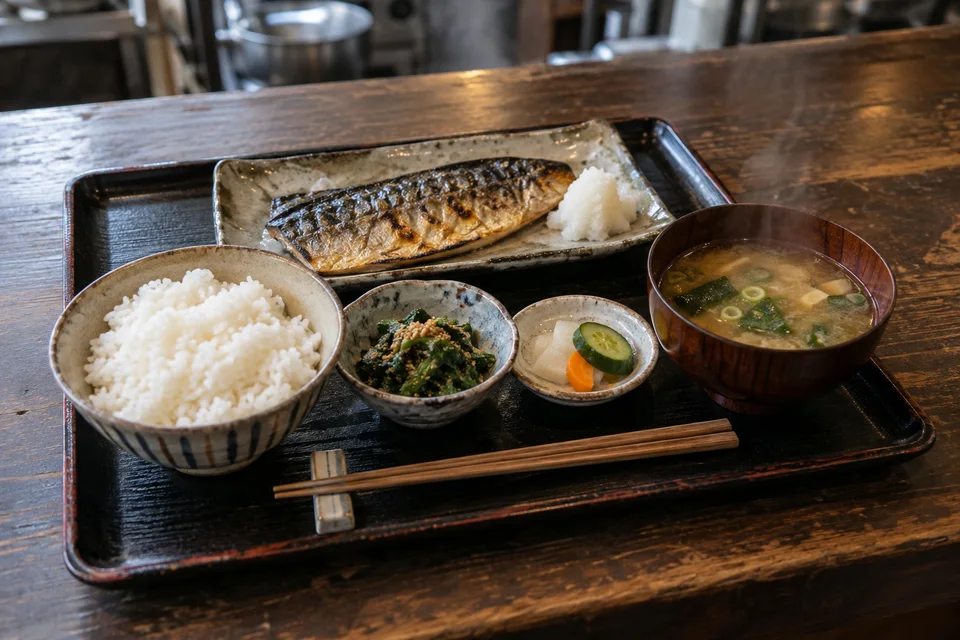
Order grilled mackerel and a whole arrangement may arrive: rice, miso soup, a small side and pickles. Do not let the number of bowls become a test. Read each role, then choose a main and portion for today.
- 17
- representative sets
- 5
- parts of the tray
- 6
- regional windows
NOT ONE RECIPE
Teishoku is not one recipe. It is an edited meal.
“Set meal” is a useful translation, not a complete definition. A main and rice often arrive with soup, a small side and pickles in separate vessels. You can move between temperatures, salt levels and textures at your own pace.
Ichiju-sansai—one soup and three dishes—is a representative way to understand this structure. It is not a rule for every meal, and bowl count does not grade health or authenticity. Rice bowls, curry, yōshoku and regional cooking all enter everyday Japanese tables.
Look less for a “correct arrangement” and more for how this kitchen composed today’s meal.
02 · READ THE WHOLE TRAY
Five vessels, five temperatures and roles.
Rice on the left and soup on the right is a familiar arrangement, but trays, venues, handedness and vessels change it. Do not turn a photograph into an etiquette diagram; read the heat and contents in front of you.
- 01飯
Rice · gohan
The quiet centre of the tray. White rice is common, but mixed grain, barley or seasoned rice may appear. “Small” and “large” refer to the portion, not the bowl’s importance.
Check: Confirm grain blends, seasonings and whether a refill is included or charged. - 02汁
Soup · shirumono
Often miso soup, but clear soup, pork soup or a regional broth can change the meal’s direction. The bowl may look simple while carrying fish, seaweed or meat stock.
Check: Ask about dashi, miso, shellfish, meat and garnish; do not infer from colour alone. - 03主
Main dish · shusai
Grilled fish, fried chicken, pork, tofu or simmered food usually gives the set its menu name. It is the loudest element, not the whole meal.
Check: Sauce, marinade, batter, garnish and shared grill or fryer all belong to the check. - 04副
Small side · kobachi or fukusai
A few bites of greens, tofu, seaweed or simmered vegetables can reset the palate and show the day or region. The small bowl is rarely decorative.
Check: Daily sides often change before the printed menu does; ask what today’s bowl contains. - 05香
Pickles · tsukemono
A small salty, sour or crisp pause beside the rice. Daikon, cucumber, cabbage or plum may be seasoned in very different ways.
Check: Soy sauce, sesame, fish seasoning, sweetener or alcohol can appear; a tiny portion is still an ingredient.
THE TRAY CHANGED WITHOUT LOSING ITS RHYTHM
The set meal endured by making room for change.
Today’s teishoku was not completed in one historical moment. Put four layers together—the personal tray, rice-centred composition, dishes adapted from abroad and the modern diner—and a hamburg steak or regional speciality can belong without contradiction.
One small tray kept a meal human-sized
MAFF’s washoku guide describes one personal tray as the everyday format used into the early twentieth century; more trays meant a more elaborate meal for guests. This is background to the scale of a composed meal, not proof that every modern teishoku descends through one unbroken recipe.
The framework stayed; the rice and dishes changed
A MAFF training text explains that everyday grain was not always today’s white rice: mixed grains and rice extended with daikon or potato differed by region. Rice, soup and accompanying dishes made a flexible framework because seasonal ingredients could enter without rebuilding the whole meal.
New mains entered an older rhythm
Tonkatsu, croquettes and other yōshoku grew from Western influence after Japan opened further to the world. MAFF’s guide places such dishes inside the rice, soup and side-dish pattern rather than outside “Japanese food”. A hamburg steak set therefore tells a story of adaptation, not failed imitation.
The tray became a fast, legible promise
JNTO describes teishoku as dishes served together, and notes cafeteria-style restaurants where a ticket is bought before the kitchen assembles the meal. The modern strength is not speed alone: a named main and visible companions let a traveller understand the rough shape of lunch before every detail is known.
03 · CHOOSE BY THE MEAL YOU WANT
Begin with the feeling you want, not a name you know.
There is no single “most Japanese” answer to guess. Begin with lightness, crisp coating, sweet-savoury depth or a sense of place, then keep the whole tray manageable.
I want a clear, lighter first tray
Look for grilled fish, chilled tofu or a vegetable-led main. “Grilled” does not mean low-salt, and the soup may still contain animal or fish stock.
I want something crisp and aromatic
Karaage, aji fry, tonkatsu and tempura move from juicy to flaky and from fine crumbs to light batter. Shared frying oil matters for dietary needs.
I want rice-moving sweet and savoury flavour
Ginger pork, simmered mackerel and meat tofu use sauce as part of the architecture. Start with regular rice before assuming you need a large bowl.
I want the place to enter the meal
Ask for a local set rather than assuming one famous dish is served everywhere. Recipes, accompaniments and even the name can shift within a prefecture.
04 · FOUR COMPLETE FIRST ORDERS
Choose a whole tray, not only a main.
Each route includes the main, rice, sauce, today’s sides and stock where relevant. Showing the sentence starts a conversation; it does not guarantee a change or a safe meal.
I want to notice the rice and soup
Choose salt-grilled mackerel or hokke. Their direct seasoning leaves room to compare fish, grated daikon, rice and soup.
焼き魚定食を、ご飯少なめでお願いします。
One grilled-fish set, with a smaller portion of rice, please.
I want a crisp first set
Choose aji fry, karaage or tonkatsu, then keep sauce on one part so the first dry bite remains a reference.
アジフライ定食を一つ。ソースは別にできますか?
One aji-fry set. Could the sauce be served separately?
I want to meet this kitchen today
Ask about the higawari, or daily set. It may reveal the fish, vegetables and working rhythm of the neighbourhood better than a permanent signature dish.
今日の日替わり定食は何ですか? 何が付きますか?
What is today’s set meal, and what comes with it?
I want a plant-forward tray
A tofu or vegetable-led main is a useful starting point, but the whole set may still use fish stock, meat seasoning, egg or shared equipment.
肉と魚を使っていない定食はありますか? だしと共用の調理器具も確認してください。
Is there a set without meat or fish? Please also check the stock and shared cooking equipment.
05 · SEVENTEEN EVERYDAY TRAYS
The same white rice changes with every main.
These are representative readings. Meat cut, fish, sauce, sides, portion and price can change under the same name. Let today’s menu and dish have the last word.
Salt-grilled mackerel set
鯖の塩焼き定食 · さばのしおやきていしょくA split or filleted piece of mackerel grilled until the skin tightens, usually with grated daikon and a small citrus or soy condiment.
- Taste & texture
- Oily fish, browned skin and direct salt; daikon gives a cool, clean contrast.
- First approach
- Try fish alone, then add only a little daikon or citrus. Bones may remain even in a neat fillet.
- Place
- Found nationwide; species, cut and seasonal origin vary by shop.
Ask this kitchen one thing
今日の鯖はどこのものですか? 小骨はありますか?
Where is today’s mackerel from, and should I expect small bones?
Grilled hokke set
ほっけ焼き定食 · ほっけやきていしょくA broad butterflied atka mackerel, often salted and dried before grilling. It may occupy most of the tray.
- Taste & texture
- Flaky, moist flesh with concentrated salt and grill aroma.
- First approach
- Work from the spine outward and keep a clear area for bones. Portion size can be much larger than the photograph suggests.
- Place
- Strongly associated with Hokkaido and northern seafood, but served nationwide.
Ask this kitchen one thing
ほっけは一尾ですか、半身ですか?
Is the hokke a whole fish or half a fish?
Ginger pork set
豚の生姜焼き定食 · ぶたのしょうがやきていしょくThin pork slices or small cuts cooked in a glossy ginger, soy and sweet seasoning, commonly beside shredded cabbage.
- Taste & texture
- Warm ginger, sweet-savoury sauce and pork fat; cabbage catches the sauce.
- First approach
- Use the cabbage as part of the dish rather than a separate salad; sauce strength varies widely.
- Place
- An everyday home and lunch-counter staple across Japan.
Ask this kitchen one thing
生姜焼きのたれは甘めですか?
Is the ginger-pork sauce on the sweeter side?
Tonkatsu set
とんかつ定食 · とんかつていしょくA pork cutlet coated in flour, egg and panko, fried and sliced, commonly served with finely shredded cabbage and a thick sauce.
- Taste & texture
- Crisp crumbs, juicy or firm pork and fruity-spiced sauce.
- First approach
- Start at a cut edge and add sauce to part of the cutlet, preserving a dry bite for comparison.
- Place
- Nationwide, with regional sauces and miso-based adaptations.
Ask this kitchen one thing
ロースとヒレは、脂とやわらかさがどう違いますか?
How do the loin and fillet differ in fat and tenderness?
Chicken nanban set
チキン南蛮定食 · ちきんなんばんていしょくFried chicken is dipped or dressed in sweet vinegar; many versions add tartar sauce, while lineages without tartar also exist.
- Taste & texture
- Sweet, sour and rich; the coating softens where vinegar meets it.
- First approach
- Ask whether thigh or breast and whether tartar is included; neither answer decides authenticity.
- Place
- Closely associated with Miyazaki, especially its Nobeoka origin stories.
Ask this kitchen one thing
タルタルソースは付きますか? 鶏肉はももですか、むねですか?
Does it come with tartar sauce, and is the chicken thigh or breast?
Karaage set
鶏の唐揚げ定食 · とりのからあげていしょくBite-size chicken marinated or seasoned, dusted with flour or starch and fried. Coating and marinade are house decisions.
- Taste & texture
- Juicy meat, crisp ridges and garlic, ginger or soy aroma.
- First approach
- Let the first piece release steam. Lemon is optional; squeezing it over every piece changes everyone’s portion on a shared plate.
- Place
- Nationwide, with regional seasoning traditions including Hokkaido zangi.
Ask this kitchen one thing
唐揚げは何個付きますか?
How many pieces of karaage come with the set?
Toriten set
とり天定食 · とりてんていしょくChicken pieces in a light tempura-like batter, commonly eaten with ponzu and mustard; parts and sauces vary.
- Taste & texture
- Tender chicken under a pale, airy coating, sharpened by citrus-soy sauce.
- First approach
- Do not expect the craggy shell of karaage. Taste once before adding ponzu and mustard.
- Place
- A familiar local dish in Oita Prefecture.
Ask this kitchen one thing
ぽん酢とからしで食べますか?
Do you recommend eating the toriten with ponzu and mustard?
Zangi set
ザンギ定食 · ざんぎていしょくHokkaido-style seasoned fried chicken; boundaries between zangi and karaage are described differently by cooks and regions.
- Taste & texture
- Deep seasoning under a crisp coat; garlic, ginger and soy are common directions, not a fixed formula.
- First approach
- Ask what this shop means by zangi instead of looking for a universal difference from karaage.
- Place
- Hokkaido; also sold elsewhere as a northern speciality.
Ask this kitchen one thing
この店のザンギは、どんな下味ですか?
How does this restaurant season its zangi?
Miso-simmered mackerel set
鯖の味噌煮定食 · さばのみそにていしょくMackerel simmered in miso, sugar and sake-like seasonings until the sauce clings to the flesh.
- Taste & texture
- Rich fish, fermented depth and rounded sweetness; ginger may lift the finish.
- First approach
- Take sauce and fish with rice in small ratios. Watch for bones beneath the opaque glaze.
- Place
- A nationwide home-style dish; miso and sweetness reveal house and region.
Ask this kitchen one thing
鯖の味噌煮に骨はありますか? 味噌は甘めですか?
Does the miso-simmered mackerel have bones, and is the miso on the sweeter side?
Meat and tofu set
肉豆腐定食 · にくどうふていしょくTofu, sliced meat and onion or leek simmered in a soy-sweet broth; it can sit near sukiyaki in flavour without being the same meal.
- Taste & texture
- Broth-soaked tofu, soft onion and savoury-sweet meat.
- First approach
- The tofu stores heat; open it before a full bite. Ask whether the meat is beef or pork.
- Place
- A flexible home and diner dish found around Japan.
Ask this kitchen one thing
肉豆腐の肉は、牛肉ですか、豚肉ですか?
Is the meat in the niku-dofu beef or pork?
Japanese hamburg steak set
ハンバーグ定食 · はんばーぐていしょくA shaped minced-meat patty served without a bun, usually with sauce and cooked vegetables. “Hamburg” on a Japanese menu is not a hamburger sandwich.
- Taste & texture
- Tender minced meat and sauce that may be demi-glace, grated daikon, tomato or soy-based.
- First approach
- Read the sauce name as carefully as the meat. A fried egg or cheese may be an addition, not the base.
- Place
- A Japanese yōshoku classic shaped by modern Western-influenced cooking.
Ask this kitchen one thing
ハンバーグの肉とソースは何ですか?
What meat and sauce are used for the hamburg steak?
Gyoza set
餃子定食 · ぎょうざていしょくPan-fried dumplings become a rice-and-soup set, sometimes with extra dumplings or a small noodle dish.
- Taste & texture
- Browned, crisp base; juicy cabbage, chive, garlic and meat filling; sharp dipping sauce.
- First approach
- Check quantity before ordering; a “double” set may be much larger than a side-dish portion.
- Place
- Adapted in Japan from Chinese dumpling traditions and now embedded in everyday dining.
Ask this kitchen one thing
餃子は何個付きますか? にんにくは入っていますか?
How many gyoza come with the set, and do they contain garlic?
Tempura set
天ぷら定食 · てんぷらていしょくSeafood and vegetables fried in a light batter, often with dipping sauce and grated daikon. The assortment is not fixed.
- Taste & texture
- Fragile crispness, steamed ingredient within and dashi-led dipping sauce.
- First approach
- Eat one piece while the coating is dry, then compare salt or sauce only if offered.
- Place
- Nationwide, from specialist counters to neighbourhood diners.
Ask this kitchen one thing
今日の天ぷらは、何が入っていますか?
What is included in today’s tempura assortment?
Aji fry set
アジフライ定食 · あじふらいていしょくHorse mackerel opened or filleted, breaded and fried, often with cabbage, tartar or a dark sauce.
- Taste & texture
- Crisp crumbs around soft, aromatic fish; sauce choice changes the first impression.
- First approach
- Try the first corner plain. Ask whether sauce, tartar or soy is the house recommendation—not a national rule.
- Place
- Served nationwide, particularly memorable where fresh local horse mackerel is landed.
Ask this kitchen one thing
アジフライには、どのソースがおすすめですか?
Which sauce do you recommend with the aji fry?
Tofu or vegetable-led set
豆腐・野菜中心の定食 · とうふ・やさいちゅうしんのていしょくA main built around tofu, seasonal vegetables or soy foods, with the same rice, soup and side-dish rhythm as other sets.
- Taste & texture
- Can move from clean and steamed to deeply fried or miso-rich; “vegetable” is not one flavour.
- First approach
- Use it as a plant-forward choice, not proof of vegetarian or vegan preparation.
- Place
- Nationwide, especially at cafeterias and restaurants foregrounding seasonal produce.
Ask this kitchen one thing
だしや調味料に、魚や肉を使っていますか?
Are fish or meat used in the stock or seasonings?
Sashimi set
刺身定食 · さしみていしょくSlices of raw seafood served with rice, soup and small sides. The fish and quantity follow the market, season and venue.
- Taste & texture
- Temperature, cut and fat make each piece different; soy and wasabi are optional tools, not a requirement.
- First approach
- Ask what fish is served today and whether any item is seared, cured or marinated.
- Place
- Common near fish markets and ports, and also available in cities nationwide.
Ask this kitchen one thing
今日の刺身は、何の魚ですか?
Which fish are in today’s sashimi?
Goya champuru set
ゴーヤーチャンプルー定食 · ごーやーちゃんぷるーていしょくBitter melon stir-fried with island-style tofu and commonly egg or pork; the exact combination varies.
- Taste & texture
- Pleasant bitterness, browned tofu, egg richness and savoury seasoning.
- First approach
- Let the bitterness be part of the dish rather than a defect; compare it with rice and tofu.
- Place
- A household dish closely associated with Okinawa.
Ask this kitchen one thing
豚肉と卵は入っていますか?
Does the goya champuru contain pork and egg?
FIVE COMPARISONS · NO RANKING
The second tray explains the first.
This is not a completion challenge. Choose one tray on one day and another later in the trip; compare fish, coating, sauce and the role of tofu from memory. These five routes explain difference without turning related dishes into a ranking.
One fish, two relationships with rice
Salt-grilling lets fat, browned skin and the fish itself lead. Miso simmering folds the same fish into a sweet-savoury sauce. The comparison is not “simple versus sophisticated”; it is dry heat beside moist cooking, and seasoning on the surface beside sauce carried into each bite.
- Read in this order
- Try a small piece alone, then with rice. Notice whether rice softens salt and fat, or receives miso sauce as part of the bite. Both versions may contain bones.
- Pace it through the trip
- Choose one on a grilled-fish lunch and the other on another day. Memory—not a scorecard—will reveal the difference.
- Safety boundary
- Confirm bones, miso recipe, soy or wheat, alcohol in seasoning and shared utensils with the venue.
Four fried-chicken dialects, not four ranks
Karaage, Hokkaido zangi, Oita toriten and Miyazaki chicken nanban can all begin with chicken and hot oil, yet the decisive work moves: seasoning beneath the surface, a light batter, sweet vinegar after frying or tartar at the table. Names and boundaries are explained differently by cooks, so no single checklist can authenticate every plate.
- Read in this order
- Read in this order: seasoning inside, coating outside, sauce after frying. That order explains more than crispness alone.
- Pace it through the trip
- Let geography set the sequence across a trip. In each place, ask what the kitchen means by the name instead of demanding the last plate again.
- Safety boundary
- Chicken, wheat, egg, soy, mayonnaise, mustard, ponzu and a shared fryer can differ with every version.
Three coatings turn frying into three textures
Tonkatsu wraps meat in breadcrumbs; aji fry gives a similar crumb structure to aromatic fish; tempura uses a lighter batter that cooks the ingredient in trapped steam. Comparing them separates the flavour of oil from the design of the coating and the ingredient held inside.
- Read in this order
- Taste one dry edge before sauce. Listen for coarse crumbs, then notice whether the centre is meat fibres, flaky fish or a vegetable or seafood piece steamed under batter.
- Pace it through the trip
- Do not order three fried mains at once. Carry the first texture into a later meal, when appetite and oil condition are different.
- Safety boundary
- Wheat, egg, seafood, sauces and shared fryer oil are central checks; removing the coating after frying is not equivalent to avoiding it.
Dishes crossed borders, then became weekday food
Tonkatsu grew through Western-influenced yōshoku, gyoza through Chinese dumpling traditions and hamburg steak through a minced-meat dish adapted to Japanese menus. Their value is not how closely they reproduce a foreign original. Rice, soup, sauce and the needs of homes and diners made new everyday forms.
- Read in this order
- Look for the Japanese edit: no bun around hamburg steak, rice beside gyoza, shredded cabbage and miso soup beside cutlet. Adaptation is visible in the companions, not only the main.
- Pace it through the trip
- Try one where it fits an ordinary day—near an office, station or neighbourhood shopping street. Everyday context is part of the story.
- Safety boundary
- Minced meat, wrappers, breadcrumbs and sauces can involve beef, pork, wheat, egg, milk, soy or shared cooking surfaces.
Tofu changes role; it does not certify a diet
A tofu-led vegetable set can make soy the main. Niku-dofu lets tofu absorb broth beside meat. Goya champuru browns island-style tofu with bitter melon and commonly egg or pork. The same ingredient can be centre, sponge or supporting texture.
- Read in this order
- Notice firmness, browned surface and absorbed stock before judging from the word “tofu”. Those three cues often reveal how the kitchen intends it to eat with rice.
- Pace it through the trip
- Choose this route for contrast, not as a vegetarian shortcut. One direct stock-and-seasoning question matters more than the menu photograph.
- Safety boundary
- Soy is only the first check. Fish or meat stock, pork, egg, wheat, sesame and shared equipment may still be present.
COMPARE WITHOUT COLLAPSING DIFFERENCE
Place it beside other ways of composing a complete meal.
Rice bowls and one-plate meals
A rice bowl lets topping and rice share one vessel; a teishoku lets you move between separate dishes. The boundary is not absolute—a rice bowl may come with soup and sides.
Kaiseki and formal sequences
Teishoku is commonly an everyday meal arriving together. Kaiseki traditions more deliberately shape sequence, season and occasion. Price alone does not define either form.
Banchan, thali and complete meals elsewhere
Many cultures compose a meal with grain, small dishes, soup or sauces. Similarity can build familiarity, but it should not erase origins, sharing customs, religion, flavour or eating sequence.
06 · THE TRAY HAS A MAP
Let a speciality open a place, not imprison it.
Regional food is an entrance, not proof that every household or restaurant in a prefecture cooks the same way. Use one famous dish to notice climate, preservation, working life and the movement of ingredients.
Hokkaido · Zangi
A cold evening and a plate of deeply seasoned fried chicken make rice and hot soup feel like shelter. The useful local question is how this cook seasons zangi—not whether it passes a universal karaage test.
Hida, Gifu · Hoba miso
Miso warms on a magnolia leaf and perfumes the table. Once a way to make preserved miso more appetising in a cold mountain region, it now appears with mushrooms, leek or beef in many local arrangements.
Oita · Toriten
The pale coating looks quieter than karaage, then ponzu and mustard bring the edges into focus. Chicken part, batter and dipping sauce differ from shop to shop.
Miyazaki · Chicken nanban & hiyajiru
One plate carries fried chicken, sweet vinegar and changing tartar traditions; another pours a cool fish-and-miso mixture over rice. Together they show that a region is never one texture or one temperature.
Aichi · Bean-miso depth
Dark colour does not automatically mean one level of salt or sweetness. Regional bean-miso culture can enter sauces, simmered dishes and soup, changing the whole tray rather than only one famous topping.
Okinawa · Goya champuru
Bitter melon, firm island tofu and everyday stir-frying make bitterness part of nourishment, not a flaw to hide. Egg, pork and seasoning can change by household and restaurant.
FOUR SEASONS · READ THE SMALL BOWL
Season often enters more quietly than the named main.
Shun is a way of thinking about the time produce naturally comes into harvest or fish is caught in greater quantity. Modern supply can make ingredients available year-round, so use the calendar to ask about today’s side, soup, rice or fish—not as a guarantee.
Spring · New growth may appear in the smallest bowl
MAFF highlights bamboo shoots, fuki buds, nanohana and beans as spring ingredients. A teishoku may show that shift not by changing its named main, but through a few bites of greens, a simmered side or soup garnish.
- Notice on the tray
- Ask what today’s kobachi is. Bitterness can be an intended spring flavour, not evidence that a vegetable has spoiled.
- Do not assume
- Availability, origin and exact season differ by region and supply; a spring label does not prove that every ingredient is local.
Summer · Coolness is designed across temperature and acidity
Tomato, cucumber, eggplant and other summer produce can enter chilled tofu, vinegared sides, grated garnishes or soup. A hot main beside one cool, bright side can make the entire tray feel lighter without making it a cold meal.
- Notice on the tray
- Compare the main before and after a cool or sour side. The side may reset the mouth rather than compete for attention.
- Do not assume
- Cold, vegetable-led or refreshing does not mean vegan, low-salt or allergen-free; dashi and dressings still require a current check.
Autumn · A tray can become deeper without becoming heavier
MAFF describes autumn through mushrooms, chestnuts and fish such as salmon or sanma. In an everyday set, a mushroom side, seasoned rice or a fattier fish can bring a darker aroma even when the number of bowls stays unchanged.
- Notice on the tray
- Notice whether the season is in the main, rice or one side. “Seasonal” can describe one component, not the whole tray.
- Do not assume
- Fish condition, catch area and timing vary. Confirm today’s species and origin instead of turning a calendar into a freshness guarantee.
Winter · Roots, leaves and broth hold warmth
Daikon, turnip, carrot, burdock, Chinese cabbage and leek are among the winter cues described by MAFF. They may appear in simmered sides or a substantial soup, moving part of the meal’s weight away from the named main.
- Notice on the tray
- Open tofu and root vegetables before a full bite; dense pieces and soup can hold more heat than their surface suggests.
- Do not assume
- A warming dish can also be salty or contain meat, fish stock or alcohol-based seasoning. “Winter comfort” is a sensory description, not a dietary claim.
07 · FOUR DOORS TO THE SAME TRAY
Read the ordering system before reading every dish.
A ticket machine at the door, a tablet at the table, spoken ordering or a self-service line; payment timing varies too. The goal is not to match the queue’s speed, but to know your order went through once.
- 01券
Ticket machine first
Choose language if available → find the base set → choose rice size or additions → pay → hand over or keep the ticket as instructed.
Recovery: If a queue forms, step aside before paying and photograph only the public menu—not other customers. - 02卓
Tablet or QR at the table
Confirm table number → open the current menu → check that a “set” rather than a standalone dish is selected → review quantity → submit once.
Recovery: Do not assume an old web menu matches the branch. Ask staff if translation and displayed photograph disagree. - 03席
Order from staff after sitting
Choose the named main → ask what comes with it → state rice size → confirm any change → learn whether payment is at the table or register.
Recovery: Point to one menu item and ask one short question. A long translated paragraph is harder to verify. - 04膳
Cafeteria or self-service line
Take a tray → select a main and sides → avoid duplicating a set already assembled → pay in the shown order → return dishes where instructed.
Recovery: Price may accumulate by dish. Pause before the register and count the full tray, including drinks and small bowls.
AT THE TABLE
Once the order stops being a test, the meal becomes clearer.
- Read the steam
Soup, tofu and fried food hold heat. Make the first bite small and leave a clear place to return each vessel.
- Use three tastes
Try the main alone, then with rice, then after soup or a side. Its intensity and role become clear before you reach for condiments.
- Make a bone or shell space
Keep fish bones or shells in one corner of a plate. Watch the venue before stacking dishes or placing anything directly on the table.
- The system continues after eating
Self-service venues may have a return point; table-service venues often do not. Follow signs, and ask before transferring leftovers into your own container.
08 · THE SMALLEST BOWL CAN HIDE THE DECIDING INGREDIENT
A safe-looking main does not make the whole set safe.
Restaurant meals may not present information in the same way as packaged food. Before eating, confirm the current main, coating and sauce, plus soup, sides, pickles, dashi, dressing, garnish and shared oil, grill, griddle, knives or tongs with the venue. Japan’s Consumer Affairs Agency also publishes consumer guidance for checking information and unintended cross-contact when eating food prepared away from home.
Fish or meat you cannot see
Soup, simmered sides and sauces may contain bonito, small fish, kelp, shellfish, chicken or pork stock. Removing a visible piece does not remove the stock.
More than soy
Soy sauce or miso may involve soy and wheat; mayonnaise egg; dressings sesame, milk or fruit. Check the specific current recipe.
Cross-contact in one kitchen
Fryers, grills, griddles, pans, knives, boards or tableware may be shared. With a serious allergy, separate “not an ingredient” from “no cross-contact.”
EIGHT SHORT SENTENCES
One check travels better than a long translation.
Point to one item and show one question. A copied phrase supports the conversation; it cannot guarantee stock, accommodation, ingredients or safety.
この定食には何が付きますか?
What comes with this set meal?ご飯の量を少なめにできますか?
Could I have a smaller portion of rice?ご飯のおかわりはできますか? 有料ですか?
May I have more rice, and does it cost extra?今日の小鉢は何ですか?
What is today’s small side dish?この料理に魚のだしは使われていますか?
Is fish stock used in this dish?食券は先に買いますか?
Should I buy a meal ticket first?食器はどこへ返しますか?
Where should I return the dishes?食物アレルギーがあります。主菜だけでなく、味噌汁、小鉢、漬物、たれ、だし、共用の調理器具も含めて確認してください。
I have a food allergy. Please check not only the main dish but also the miso soup, small sides, pickles, sauces, stock and shared cooking equipment.AN EASY FIRST DOOR, NOT A RANKING
Choose a national chain or local diner by purpose.
Ease of entry, English information and local character are different values. This is neither a taste ranking nor an advertisement. Local Japan receives no payment from these listings.
Ootoya
A useful orientation point for cooked-to-order set meals, with an official English introduction and current Japanese menu information.
YAYOI KEN
A broad set-meal menu and an official English menu can make the basic tray structure easier to recognise.
A neighbourhood shokudo
Handwritten daily sets can reveal local fish, vegetables and working-life rhythms that a national menu cannot.
BEFORE YOUR FIRST TRAY
Six questions before the first tray.
Does every teishoku follow ichiju-sansai?
No. Rice, soup and three accompanying dishes are a useful representative pattern, not a rule every restaurant or household follows at every meal. A tray may have fewer or more components, and one dish can contain several ingredients.
Are rice refills always free?
No. Some menus include refills, some charge, some limit the rice type or time, and others offer no refill. “Large rice” is an initial portion choice, not the same service. Read the current menu or ask.
Is there a correct order for eating the dishes?
You can move between rice, soup, main and sides as comfortable. Alternating bites may help you notice contrasts, but it is not an etiquette test. Follow medical needs and the venue’s practical instructions first.
Is a vegetable set vegetarian or vegan?
Not necessarily. Dashi, sauces, miso soup, garnish and shared cooking may involve fish, meat, egg, dairy or other animal ingredients. Ask about the whole tray and current kitchen process.
Can I take unfinished food away?
Do not assume so. Food-safety policy, packaging and the dish itself differ. Ask before moving food into your own container, and follow the venue’s answer.
Is teishoku only a lunch meal?
No. Many places serve sets at lunch and dinner; others have time-limited lunch sets or a different evening menu. The word describes the arrangement more than a fixed hour.
OFFICIAL SOURCES & EDITORIAL LIMITS
Go deep on culture; stay precise about today’s tray.
Sources checked 2026-09-12. Cultural and regional claims were compared with official material without turning one restaurant or household into a national template. Current venue information prevails for price, hours, stock, ingredients, recipe, sides, rice service and ordering.
AI language quality review completed; no human native-speaker review was performed.
- MAFF: Ichiju-sansai and everyday balance
- MAFF: Washoku guide and meal structure
- MAFF: Washoku training text and the history of meal composition
- MAFF: Japan’s four seasons and ingredients
- JNTO: Dining out in Japan
- JNTO: Japanese food etiquette
- Consumer Affairs Agency: Food allergies when eating out
- MAFF: Our Regional Cuisines
- Ootoya: Official English guide
- Ootoya: Current menu and allergen notes
- YAYOI KEN: Official English menu
- YAYOI KEN: Current allergen information