BUCKWHEAT · WATER · HANDS · PLACE
A quiet tray can hold an entire landscape.
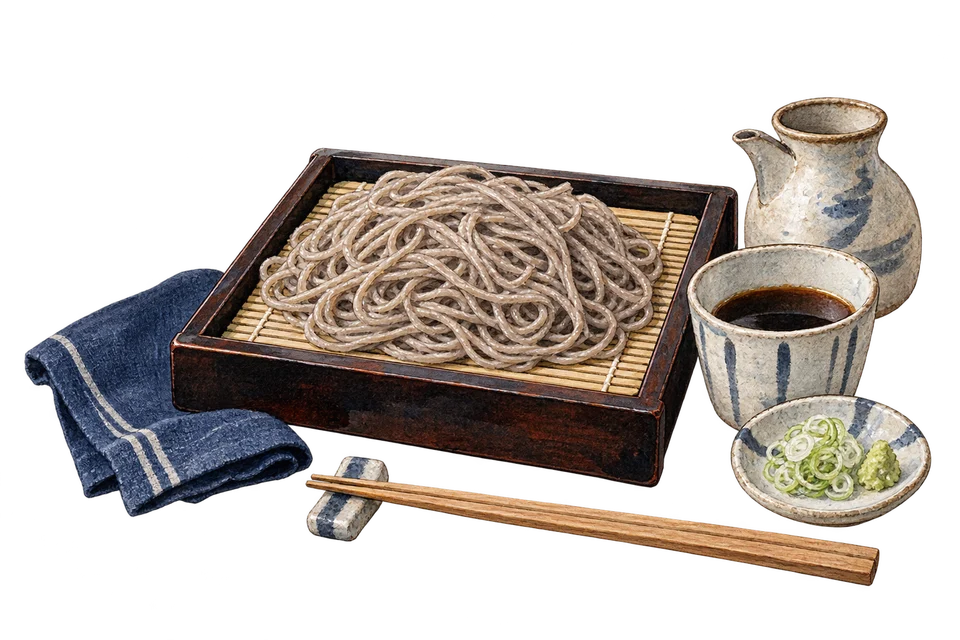
Soba can be a five-minute lunch under a station platform, a mountain meal reached after a long bus ride, or the final plate after sake and small dishes. The noodles look restrained; the culture around them is not. Flour, water, cut, sauce, garnish and serving vessel all tell you where to look next.
Use the first section while standing at a ticket machine. Read the rest before choosing a region. The aim is not to find Japan’s single “best” soba, but to recognise why one tray could only have appeared in that place.
01 · SOBA FIELD NOTES
Four decisions before you press a button.
1 · Temperature
Cold noodles show texture clearly. Hot broth puts warmth and stock first.
2 · Format
Dip mori or seiro; pour sauce for some bukkake and regional forms.
3 · Meal size
Plain soba can be light. Tempura, duck or rice makes it a fuller meal.
4 · Confirm first
For allergies or dietary needs, ask before buying a ticket or ordering.
YOUR FIRST TRAY
Start with the feeling you want—not the “correct” order.
Choose one line that sounds like lunch today. You can study the vocabulary after the bowl arrives.
I want to understand the noodle itself
Mori or seiro
Cool noodles and separate sauce make texture, aroma and the effect of each dip easier to notice.
I want something warm and simple
Kake
The bowl keeps its heat and lets you taste the shop’s stock and seasoning with the noodle.
I need a complete lunch
Ten-seiro or a small rice set
Tempura or rice adds weight without hiding how the soba itself is served.
I like rich, savoury flavours
Kamo seiro or kamo nanban
Duck fat, scallion and a hot sauce or broth give the meal a deeper, rounder finish.
I want a dish that belongs to this place
The named regional form
Ask what regulars order here: warigo, hegi, oroshi, ita, wanko or another local form.
03 · SOBA FIELD NOTES
The colour is a clue. The label is the answer.
Buckwheat percentage, milling and binder affect the noodle, but colour alone cannot prove the recipe. Some noodles include egg or other binders; every current product or venue must be checked when ingredients matter.
- 二八そばnihachi soba
- Today this commonly indicates roughly 80% buckwheat flour and 20% wheat flour, though shop wording and historical explanations vary. It contains wheat unless the shop provides a different, verified recipe.
- 十割そばjuwari / towari soba
- Made without a wheat-flour binder in the noodle dough. It can feel fragile, firm or silky depending on flour, water and technique. The name does not tell you whether the kitchen separates boiling water, tools or work surfaces.
- 更科そばsarashina soba
- A pale, refined style using the inner part of the buckwheat seed. Its elegance is visual and textural; pale colour does not mean an absence of buckwheat protein or allergy risk.
- 田舎そばinaka soba
- Usually darker and more rustic, often with a stronger husk-like aroma and a thicker cut. It is a style word, not one nationally fixed milling specification.
- 挽きぐるみhikigurumi
- Flour made by milling broader parts of the buckwheat seed together. It can create darker colour and a fuller aroma; Izumo soba is a celebrated regional expression.
- 茶そばcha soba
- Soba coloured and scented with tea, often green tea. The name still does not reveal the buckwheat percentage, wheat content or every ingredient; check the product or restaurant.
04 · SOBA FIELD NOTES
Before the tray: six decisions made by field and hand.
This is a reading map, not a recipe. Shops use different equipment and methods; the point is to notice where the character of a noodle can begin.
- 01
Grow and harvest
Buckwheat matures quickly, but it dislikes excess moisture and ripens unevenly. Variety, weather, harvest timing and careful drying already shape what reaches the mill.
Notice: In season, ask for the producing area and harvest rather than treating “new” as a complete quality score.
- 02
Hull, mill and sift
Milling decides which parts of the seed enter the flour. A pale refined flour and a darker whole-grain style can begin with the same small seed and reveal different aromas and textures.
Notice: “Stone-milled” describes a method, not a guarantee that you will prefer the result.
- 03
Distribute the water
Water is added through the flour so that countless dry particles can gather into one dough. This early mixing is called mizumawashi; speed, humidity and judgement matter before the dough looks like noodles.
Notice: A shop speaking about today’s humidity is not making small talk; it may be describing the dough.
- 04
Gather and knead
The moistened crumbs are brought together and kneaded into an even body. Buckwheat has no gluten network of its own, so flour choice, any binder and handling affect whether the sheet holds together.
Notice: Juwari and nihachi describe the recipe direction; they do not rank the craft.
- 05
Roll to an even sheet
The dough is opened, rolled and turned until its thickness is controlled across the sheet. A small unevenness here becomes a different cooking time in the pot.
Notice: Look at thickness as well as width. Fine noodles are not automatically more skilled or more authentic.
- 06
Cut, boil and finish
The folded sheet is cut, boiled, then either washed and tightened in cold water or placed in hot broth. The final temperature changes firmness, aroma and how quickly the noodle asks to be eaten.
Notice: Cold soba waits poorly. Photograph briefly, then meet it while the surface and tension are alive.
05 · SOBA FIELD NOTES
The meal has a sequence, not a test.
- 一
Meet the noodle before seasoning it heavily.
Taste one strand or a small mouthful as served. This is optional, not a performance for the shop. Then dip or pour according to the dish.
- 二
Let garnish change one mouthful at a time.
Scallion adds lift, wasabi adds a clean edge, grated daikon can be sweet or fierce, nori adds sea aroma. Adding everything at once is allowed; adding gradually simply lets you notice more.
- 三
Slurp if comfortable. Do not imitate at the cost of safety.
Slurping is accepted and can draw air and aroma across hot noodles, but visitors are not required to do it. Take smaller mouthfuls if heat, mobility, breathing or swallowing makes that safer.
- 四
Sobayu is an ending, not an obligation.
If a pot arrives, add a little sobayu to the remaining dipping sauce and find a comfortable strength. You may also taste it plain. Not every venue offers it, and people with buckwheat allergy must avoid it.
06 · SOBA FIELD NOTES
Why this restrained food belonged to a great city.
Soba-kiri—buckwheat made into cut noodles—spread through Edo, where shops and street stalls could serve it quickly. Concentrated dipping sauce made sense beside cool noodles; a hot kake bowl made sense in another season. Tempura and duck turned the same grammar into a richer meal.
The enduring lesson is not that every Tokyo shop preserves one recipe. It is that a flexible craft fitted the tempo of a growing city. A standing-soba counter and a quiet specialist restaurant still occupy different points on that same urban line.
One noodle. Two temperatures. A city’s whole range of time.
07 · SOBA FIELD NOTES
Ten places, ten reasons to take the train.
The route runs roughly north to south. These are doors into regional culture, not rankings or claims that every shop serves the same bowl. Check current opening days, reservations and access with the venue.
Horokanai, Hokkaido · a white field, then a cold store
Buckwheat flowers cover the fields in white during summer, followed by harvest in early autumn. The grain is dried in stages and kept in a snow-cooled low-temperature store before shipment. Here, the story of a bowl begins with agricultural scale and continues through restrained storage, long before water meets flour.
At the table: Ask which Hokkaido variety or harvest the shop is serving; do not assume every bowl in town uses one flour.
Iwate · wanko soba as hospitality and tempo
Small portions are added bowl after bowl by a server. The famous count can be playful, but the lasting memory is often the call-and-response of service. Listen to the venue’s stopping signal and pace yourself; finishing comfortably matters more than turning hospitality into endurance.
At the table: Before starting, ask how to signal “finished” and whether a non-challenge serving is available.
Yamagata · sturdy noodles on a broad board
Ita soba spreads robust noodles across a large shallow wooden box, often to share. Elsewhere in the prefecture, cold meat soba and local routes between villages reveal that “Yamagata soba” is a landscape of forms, not one recipe. Order a local standard before trying to rank towns.
At the table: Check portion size: a shared-looking board may be sold for one, two or more people.
Ibaraki · Hitachi Aki Soba, a variety with a home
Hitachi Aki Soba was selected from a local population around Hitachiota and adopted as a recommended prefectural variety in 1985. Its story joins breeding, careful seed management and the home table. In northern Ibaraki, soba may be dipped into warm kenchin broth crowded with root vegetables—grain and field meeting again in one meal.
At the table: Look for the flour name, then ask whether the shop recommends plain dipping sauce or local kenchin broth.
Tokyo · Edo soba as urban rhythm
Soba shops and stalls became part of everyday Edo. Mori, kake, tempura and duck forms let one basic craft move between a quick meal and a deliberate drink-and-soba evening. In a present-day shop, notice how the concentrated dipping sauce asks for only a brief dip: the city’s old efficiency can still be felt in the ratio.
At the table: Begin with mori or kake; add tempura only when you want a fuller meal.
Togakushi, Nagano · five small bundles on one tray
Togakushi soba is recognised by bocchi-mori: noodles gathered into small bundles, often five, on a bamboo tray. The shape is not mere decoration. It portions the first lift of chopsticks and makes the tray feel composed before you taste the mountain-grown grain.
At the table: Ask for zaru soba and look for the bundles; confirm current hours before travelling into the mountain area.
Niigata · hegi soba, born beside textiles
Funori seaweed is used as a binder, giving the noodles a distinctive smoothness and resilience. They are arranged in neat bite-sized loops on a wooden hegi tray. The connection with textile country matters: a material used in cloth finishing found another life in the local bowl.
At the table: Mustard may appear instead of wasabi. Treat it as a local invitation, not a compulsory amount.
Fukui · Echizen oroshi soba wakes the palate
Cool soba meets grated daikon, scallion and bonito flakes, with sauce poured over or combined according to the shop. The radish can be surprisingly sharp. That clean sting is not a flaw to hide; it is part of how the dish cuts through and leaves you ready for another bite.
At the table: Ask whether the daikon is mixed into the sauce or served separately before changing the bowl.
Izumo, Shimane · pour, stack, continue
Warigo soba arrives in stacked round boxes. Sauce and garnish go directly onto the top layer; after eating, remaining sauce can be carried to the next. Dark hikigurumi noodles give the meal depth, while the repeated boxes turn eating into a small sequence rather than one undivided plate.
At the table: Do not assume dipping. Watch the serving explanation or ask whether to pour the sauce.
Yamaguchi · kawara soba is a modern local classic
Green tea soba, beef, egg, lemon and spicy grated daikon arrive sizzling on a heated roof tile or tile-like plate. Created in the twentieth century, it is a useful reminder that regional food culture is still being made. Tradition does not need to be ancient to become loved and local.
At the table: Let the noodles touching the hot surface crisp slightly; check beef, egg and shared equipment for dietary needs.
08 · SOBA FIELD NOTES
New soba is a date, a place and a conversation.
Buckwheat grows quickly, and harvest timing differs by climate and cultivation. Autumn new soba is famous, while summer new soba also appears. A banner saying shin-soba is therefore an invitation to ask: where was the grain grown, when was it harvested, and what does the cook want you to notice this week?
Freshness alone does not make a universal winner. Storage, milling and the skill of mixing water into flour continue the work after harvest. Follow the season, but leave room for the craft between field and tray.
31 DECEMBER
Toshikoshi soba: the old year ends around one bowl.
Eating soba around New Year’s Eve became widespread among townspeople during the Edo period. Several meanings have been handed down: long noodles may suggest a long life; noodles that break cleanly may suggest leaving the year’s troubles behind; the hardy plant may suggest resilience. These are overlapping stories, not one proven origin.
Many households eat it on the evening of 31 December, but timing and custom differ. Some regions welcome soba on New Year’s Day or later in January. If you are invited to a home, ask about that family’s way instead of correcting it with a guidebook.
BEFORE THE NOODLE
Soba-gaki lets the grain speak without a cut.
Before cut noodles became the familiar form, buckwheat was also eaten as porridge or soba-gaki: flour worked with hot water into a soft dumpling-like mass. It can still appear as a modest dish at specialist shops and in regional cooking. Its texture is tender and dense, closer to the grain than to a springy noodle.
It is not an allergy workaround: soba-gaki concentrates buckwheat, and sauces or preparation can add other ingredients. For a curious diner without relevant restrictions, it reveals that soba culture is larger than noodles.
09 · SOBA FIELD NOTES
Choose the place for the time you actually have.
Station and standing soba
Best when the train and the everyday rhythm are part of the story. Buy a ticket, follow the pickup system, and keep luggage out of the narrow aisle. Speed is the craft here; do not judge the meal by the standards of a long tasting counter.
Neighbourhood soba shop
A broad menu may include rice bowls, tempura and sake. It is a good place to see how soba fits ordinary life rather than a specialist ranking. At busy lunch, order simply; at a quieter hour, ask one precise question.
Specialist and regional destination
Come for milling, hand-cut noodles, local vessels or a named regional form. Confirm reservations, children’s seating, step-free access and cash or card before a long detour. Respect photography rules: a working counter is not automatically a studio.
10 · SOBA FIELD NOTES
Buckwheat allergy: never “test with one bite”.
Buckwheat can cause a serious allergic reaction. This section supports a conversation with a venue; it is not clinical advice or a guarantee that a dish is safe.
Check five layers, not one menu word.
- Noodle doughBuckwheat, wheat, egg or other binders; current recipe, not an assumption from colour.
- Boiling and toolsShared water, baskets, colanders, worktops, knives, towels and storage.
- Sauce and stockFish, soy, wheat, alcohol or other ingredients may matter to your needs.
- Toppings and fryerTempura batter, egg, dairy, shellfish, meat and a shared fryer.
- Sobayu and the tableSobayu is not safe for buckwheat allergy. Shared condiment spoons can also transfer ingredients.
Packaged processed foods in Japan use mandatory allergen labelling rules that include buckwheat, but a restaurant conversation still has to cover recipes and cross-contact. “Juwari” means the noodle dough is made without a wheat-flour binder; it does not promise a separate kitchen. If staff cannot confirm what you need, choose not to eat. Carry your prescribed medication and follow your own clinician’s emergency plan.
11 · SOBA FIELD NOTES
A question to show—not a safety certificate.
For an allergy, also carry a card naming your exact allergens and required precautions. A translated phrase cannot replace confirmation by the restaurant.
冷たいそばと温かいそばは、どちらがおすすめですか?
Which do you recommend here: cold or hot soba?
このそばは、そば粉と小麦粉を使っていますか?
Does this soba contain both buckwheat and wheat flour?
そばアレルギーがあります。そば、そば湯、共用の釜や調理器具を避ける必要があります。対応できますか?
I have a buckwheat allergy. I need to avoid soba, sobayu, and shared boiling water or equipment. Can you accommodate this?
つゆは、つけますか、上からかけますか?
Should I dip the noodles, or pour the sauce over them?
そば湯はありますか?
Do you serve sobayu?
この料理には、魚のだし、卵、乳、小麦、甲殻類、肉を使っていますか?
Does this dish contain fish stock, egg, dairy, wheat, shellfish or meat?
これは一人前ですか? 二人で分けられますか?
Is this one serving? Can two people share it?
麺は冷たく、つゆは温かい料理ですか?
Does this dish have cold noodles and a hot dipping broth?
12 · SOBA FIELD NOTES
Questions for the next tray.
Do I have to slurp?
No. Slurping noodles is accepted in Japan, but it is not compulsory. Eat in the way that is comfortable and safe for you, without splashing people nearby.
Is juwari soba safe for someone with a wheat allergy?
The noodle recipe may omit wheat flour, but the restaurant may share boiling water, colanders, work surfaces, fryers or storage. Confirm the current ingredients and handling with the venue; if they cannot confirm what you need, do not eat it.
Are yakisoba and chuka soba made from buckwheat?
Often they are wheat noodles despite the word soba. Names alone do not prove ingredients in either direction, so check the actual dish and kitchen when an allergy or dietary restriction matters.
What is sobayu?
It is hot water associated with cooking soba, often brought near the end of a cold-soba meal. People add it to remaining dipping sauce and drink it to taste. Service and concentration vary, it may contain both buckwheat and wheat, and it is unsafe for a buckwheat allergy.
Is autumn the only season for new soba?
Autumn new soba is widely celebrated, but growing cycles and regions differ, and summer new soba also exists. Treat “shin-soba” as a seasonal invitation; ask the shop where and when its current grain was harvested.
Should I mix all the wasabi into the sauce?
There is no single compulsory method. Try a small amount on the noodle or dissolve a little into the sauce if you enjoy it. Regional condiments differ; mustard or grated daikon may be the local partner.
Is cold soba always served with cold sauce?
No. Kamo seiro and other tsuke-soba styles can pair chilled noodles with a hot dipping broth. Read temperature words separately for noodles and sauce.
Can a vegetarian or vegan assume plain soba is suitable?
No. Dipping sauce and broth commonly use bonito or other fish, and garnishes or tempura may add animal ingredients. Ask about the noodles, sauce, stock, toppings and shared cooking separately.
What does “handmade” tell me?
It tells you that hands are part of making the noodle; it does not set one national recipe, thickness or quality rank. Look at how the shop matches flour, cut, boiling and sauce, then decide what you enjoy.
What is soba-mae?
It is the time before the final soba, often spent with sake and small dishes in a traditional shop. It is one way to enjoy a quiet meal, not a required course and never a reason to drink. Check the hour and the venue’s pace; a busy lunch counter serves a different purpose.
Sources, review and limits
Sources checked and article reviewed: · Next review:
Regional and historical facts draw mainly on the Ministry of Agriculture, Forestry and Fisheries; dining guidance uses JNTO, and allergen guidance uses the Consumer Affairs Agency. Tasting routes and ordering suggestions are editorial proposals, not reports of an on-site visit or paid recommendation. Current venue, product and medical information takes priority.
English and Japanese received AI language quality review; no human native-speaker review was performed. Korean and Chinese versions are not yet published for this article.
- MAFF: soba types, flour and regional dishes (new tab)
- MAFF: soba-kiri and the food culture of Edo (new tab)
- MAFF: new soba, history and flour styles (new tab)
- MAFF Tokai: how buckwheat becomes soba noodles (new tab)
- GO TOKYO: the living culture of Edo soba (new tab)
- MAFF Hokkaido: Horokanai flowers, harvest and storage (new tab)
- MAFF: Hitachi Aki Soba and kenchin broth (new tab)
- MAFF: Izumo soba and warigo (new tab)
- MAFF: Shinshu and Togakushi handmade soba (new tab)
- MAFF: hegi soba, funori and serving style (new tab)
- MAFF: Echizen oroshi soba (new tab)
- MAFF: Yamaguchi kawara soba (new tab)
- MAFF: Yamagata soba culture (new tab)
- JNTO: Japanese dining manners (new tab)
- Consumer Affairs Agency: food allergy information (new tab)
- MAFF: Toshikoshi soba and regional New Year customs (new tab)
- MAFF: nishin soba in Hokkaido (new tab)
- JNTO: tororo and Japanese table culture (new tab)
- JNTO: common Japanese noodle names (new tab)