THE SEASONING BESIDE YOUR PLATE
The next discovery may be in the little dish.
A bottle on the table can feel too ordinary to notice. Then you meet one that is unexpectedly sweet, another that barely colours a broth, or a sauce whose flavour stays long after a piece of fish. Learning shoyu makes a familiar meal interesting again.
Start with five types, then follow one into a dish or a town. You do not need to memorise the whole shelf. One good question and one bottle you know how to use are enough to take something of the trip home.
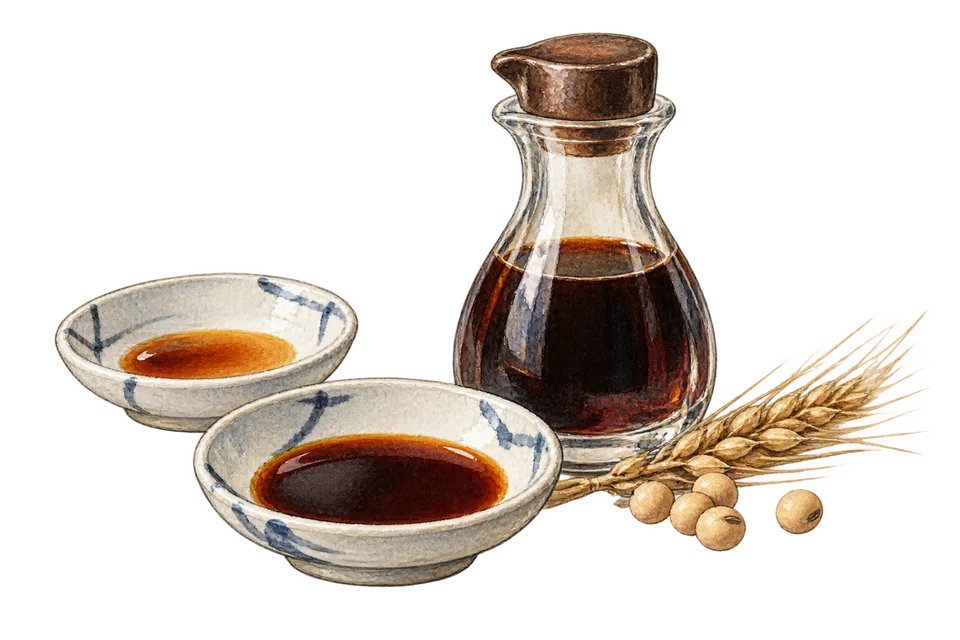
01 · SHOYU FIELD NOTES
At the table? Start here.
Ask if the dish is already seasoned.
Especially with sushi, the chef may have finished it for you. “Should I eat this without adding soy sauce?” is a helpful question, not a test of etiquette.
Use a small amount first.
Pour a little into your own dish, or follow the serving method provided. Add more only if you want it; you are looking for a balance with the food, not trying to finish the sauce.
Ingredient checks come before tasting.
If you have an allergy or dietary restriction, ask about the current sauce and the whole dish first. A colour, name or tasting suggestion in this guide cannot establish safety.
Read the ingredient and shared-tool checks →
02 · SHOYU FIELD NOTES
Five types. Five different jobs.
Japan’s standard categories describe ingredients and production as well as appearance. The pairing notes below are editorial starting points, not rules or reports of a tasting we conducted.
Do not memorise the shelf. Begin with the meal.
One useful bottle for several meals
Start with a small koikuchi ↓
It gives a practical reference for seasoning, dipping and comparing the other types.
Still read the ingredients, salt equivalent and storage directions.A pale soup, simmered vegetable or egg dish
Compare usukuchi and shiro ↓
Both can season without bringing the same depth of colour as koikuchi, but they are made differently.
Pale does not mean low-sodium; follow the recipe rather than swapping equal amounts.A rich finishing taste for a small bite
Try tamari or saishikomi ↓
Their different ingredient balance or brewing step can give a fuller impression at the table.
Use a small touch first. Neither name proves a product is wheat-free.The sweet soy sauce you noticed on a trip
Look for amakuchi and ask its intended use ↓
Sweetness may be a regional preference or a particular product recipe, not a sixth standard type.
Ask whether it is for dipping or cooking and read every ingredient.Koikuchi · the everyday reference
濃口醤油All-purpose seasoningA broadly useful Japanese soy sauce, usually brewed with soybeans and wheat in similar proportions. It gives you a reference point for the other four: savoury flavour, aroma and colour arrive together. “Dark” in an English translation describes its Japanese category; it does not automatically mean a Chinese dark soy sauce.
A way to try it
For your first bottle, think of a meal you actually cook. A little on a cooked mushroom or a spoonful measured into a sauce is a more useful test than drinking it neat. Keep some food unseasoned so you can notice what changed.
Koikuchi is a type, not a promise that every bottle has the same sweetness, salt or ingredients.
Usukuchi · colour steps back
淡口・薄口醤油Paler colour, not reduced saltUsukuchi is strongly associated with Kansai cooking. It helps season a dish without colouring it as deeply as koikuchi. This matters when the cook wants you to see a pale turnip, clear broth or the yellow of an egg custard. Ordinary usukuchi can contain more salt than ordinary koikuchi: “light” is the dangerous shortcut here.
A way to try it
Order a clear soup or a gently coloured simmered dish and notice how much flavour can sit behind a pale appearance. You cannot identify the bottle from the bowl alone, so ask which seasoning was used if the kitchen has time.
Do not replace koikuchi with an equal amount simply to cut salt. Compare the actual nutrition labels and follow the recipe.
Tamari · a concentrated finish
たまり醤油Soybean-led, often richTamari is a soybean-led style associated with central Japan. Richness and a fuller texture make it an interesting partner for tuna or grilled food. It is not merely koikuchi boiled down: the difference starts in the brewing ingredients and method. Some tamari contains wheat, including products sold in Japan.
A way to try it
If offered a choice with unseasoned sashimi, try a small touch on one edge. Notice whether the sauce carries the fish’s flavour into the finish or overwhelms it. Needing less is not a judgement about which sauce is better.
“Tamari” alone is not a gluten-free claim. Check the current bottle, maker information and preparation at the restaurant.
Saishikomi · brewed with soy sauce
再仕込醤油Depth from a different brewing stepInstead of starting the mash with salt water, this method uses unheated soy sauce. The name refers to that second brewing step, not two trips through a filter. The result is often deeply coloured and full-flavoured. Yanai’s kanro soy sauce in Yamaguchi is one regional doorway into this idea.
A way to try it
Consider a small bottle for finishing food at the table rather than a large bottle for every pan. On a plain piece of tofu, compare how long the flavour remains after swallowing. If tofu is unsuitable for you, use another food you already know is safe for your needs.
A long maturation claim does not tell you the salt content or make the sauce suitable for an allergy.
Shiro · amber, not white
白醤油Wheat-led and very paleShiro is a very pale, wheat-led soy sauce associated with Aichi. Despite the name, it is amber rather than milky white. It lets a cook add seasoning while leaving the appearance of a soup or egg dish relatively light. Its pale colour does not make it low-salt or wheat-free.
A way to try it
At a specialist shop, ask how the maker uses it in cooking. It may be a more rewarding purchase for someone who makes soups or steamed dishes than someone who wants only a dipping sauce for sushi.
Shiro shoyu is not shiro dashi. The latter is a prepared seasoning that can contain fish stock and other ingredients.
03 · SHOYU FIELD NOTES
How grains become a liquid seasoning.
This is an outline of honjozo brewing, using Kikkoman’s account as an example—not a home-fermentation recipe or the process for every soy sauce. Koji helps break down the raw materials; fermentation and maturation develop the mash before pressing. The dark liquid does not come from simply dissolving a brown powder.
- 01
Prepare
Steam soybeans; roast and crush wheat.
- 02
Koji
Cultivate koji on the prepared ingredients.
- 03
Moromi
Add brine; ferment and mature the mash.
- 04
Press
Separate the liquid from the mash.
- 05
Finish
Refine, usually heat-treat, and bottle.
The finishing step matters too. Heating and an unheated finish produce different styles; “nama” is not shorthand for superior or medicinal. At a brewery, ask which part of this sequence changes for the bottle you like. A concrete answer about ingredients or finishing tells you more than the word “traditional” alone.
04 · SHOYU FIELD NOTES
The same drops behave differently in three places.
Shoyu does more than add salt. Aroma, heat and stock each change what you notice. These are culinary effects, not food-safety or preservation guidance.
Sashimi, chilled tofu, a dipping dish
Cold food · aroma meets aroma
Soy sauce has its own complex aroma. With raw fish, that aroma and the seasoning can make an unwanted fishy impression less noticeable, which is why a tiny touch may change the experience before saltiness dominates. Smell the food plain, then smell one dressed edge. This is a sensory comparison—not evidence that the food is fresh, disinfected or safe to eat.
Yaki onigiri, grilled corn, tare-glazed food
Heat · the surface becomes another flavour
When soy sauce meets heat, amino acids and sugars—including sugar from mirin in some recipes—take part in amino-carbonyl reactions. Browning, gloss and a roasted aroma can therefore belong to the recipe rather than the raw sauce alone. Notice the border between the toasted surface and the soft centre; adding more table soy sauce cannot recreate what happened over the heat.
Soba tsuyu, clear soup, simmered dishes
Stock · two kinds of umami can reinforce each other
Glutamate associated with soy sauce and inosinate associated with bonito stock can create an umami synergy when combined. That is one reason tsuyu should be read as a composed seasoning, not “diluted soy sauce”. Taste the broth as served and ask what stock supports it. Kombu, dried fish and other ingredients vary, so the same dark colour never confirms the recipe or dietary suitability.
05 · SHOYU FIELD NOTES
Six meals to notice it in.
Use these as prompts at a meal, not instructions to change a restaurant’s finished dish. Actual ingredients and preparation vary.
Sushi · ask before dipping
A piece may already have a brushed-on nikiri seasoning or a sweet tare. Ask whether it needs soy sauce rather than adding it automatically. When a piece does need it, a small touch is usually easier to control than soaking the rice. You do not need an elaborate performance: use the way you can manage comfortably, and follow the chef’s advice.
Sashimi · leave room for the fish
If there are several sauces, ask which goes with the dish. Two similar-looking bottles may be ordinary shoyu and a sweet local style, not different quality grades. Start with one edge of one piece; add wasabi according to preference and the restaurant’s guidance, not because a universal rule requires it.
Tofu · compare a bite, not a bowl
On unseasoned tofu, put a little sauce on one portion and leave another plain. This keeps the texture and soybean flavour visible in the comparison. Spring onion, ginger and bonito flakes can change the result again. Check both tofu and toppings if you have dietary restrictions.
Yaki onigiri · smell the surface
A soy-seasoned grilled rice ball is a good way to notice what happens when the seasoning meets heat. Look at the contrast between its browned surface and soft rice inside. It is normally already seasoned: the bottle on the table is not an instruction to add more.
Soba and udon · recognise tsuyu
The dipping liquid is usually tsuyu, a prepared mixture, not straight soy sauce. Its stock, sweetness and concentration are part of the dish. Follow the serving explanation; do not dilute it or pour in table soy sauce simply because it looks dark. Bottled concentrates bought for home have their own dilution instructions.
Grilled food · tare is a recipe
A glossy yakitori skewer or eel dish may use a soy-based tare with sugar and other seasonings. “Soy sauce flavour” does not disclose the whole recipe. Enjoy the balance with plain rice, and ask about the actual sauce if ingredients matter to you.
At a sushi restaurant for the first time? Read the sushi guide →
06 · SHOYU FIELD NOTES
Follow a flavour into a place.
Soy sauce has an East Asian history, with earlier fermented seasonings linking Japan with China and the Korean peninsula. Japan’s particular styles grew through local ingredients, makers and meals. That shared background is part of the interest: you can recognise a relative of something you eat at home, then notice what changed here.
Noda · the river behind the bottle
Soybeans and wheat from the Kanto plain, waterways and the growing Edo market helped Noda’s soy sauce industry develop. A label can therefore point to transport history as well as flavour. Before a museum or factory visit, read the operator’s current booking, language and access information; this article is not a reservation.
Tatsuno and Kyoto · a pale dish has a history
Tatsuno in Hyogo is associated with the development of usukuchi, and Kyoto’s cooking offers a way to appreciate its purpose. You need not make a brewery detour to begin: look carefully at one pale simmered vegetable, then ask about its seasoning. A culinary preference can connect two places without making every household cook alike.
Aichi · pale and dark can be neighbours
Aichi’s association with both shiro shoyu and soybean-led tamari breaks an easy assumption: a region does not have only one sauce. Compare their intended jobs rather than arranging them from weak to strong. One may suit a pale soup; another may finish a piece of fish. Ask for a cooking suggestion with the bottle.
Yanai · read the words kanro and saishikomi
Kanro soy sauce is a local thread to follow in Yanai, Yamaguchi. Its brewing story offers a useful question for a shop: what does using soy sauce in the next mash change? Take the answer back to a small portion of food. The place name alone cannot tell you the precise maturation time of the bottle in your hand.
Shodoshima · make room for a brewing district
The Hishio no Sato district connects soy sauce breweries with tsukudani, food simmered in a seasoned sauce. Kagawa’s official visitor guide introduces walking routes and places to learn about wooden-vat brewing. Choose one visit and leave room for lunch rather than collecting factory stops. Check ferry or bus connections, the return journey and current visitor arrangements separately.
Kyushu · ask whether this one is sweet
Sweet soy sauces offer another flavour direction, with Fundokin in Oita providing a concrete product example. Do not turn that into “all Kyushu sauce is sweet”, or invent one historical cause for every local preference. Ask whether the bottle is intended for dipping or cooking; then decide whether that is how you want to use it at home.
07 · SHOYU FIELD NOTES
Nine words—not nine more types.
One bottle can be koikuchi, nama and marudaizu at the same time. Murasaki is a restaurant nickname, not a category. Read the type, production or ingredient claim, and any prepared seasoning separately.
- 本醸造honjozo
- A brewing method. Read it separately from the five types and from added ingredients; it does not mean “safe for every diet”.
- 生しょうゆnama shoyu
- In this reading, soy sauce finished without the usual heating step. It is not a sixth base type, nor a promise of health benefits.
- 生醤油ki-joyu
- The character 生 has another reading, ki. Do not assume it means nama; in cooking, ki-joyu can mean soy sauce not mixed with other seasonings. Ask if the label is unclear.
- 丸大豆marudaizu
- Whole soybeans describe a raw material. They do not identify the salt level, and the words do not mean the bottle contains only soybeans.
- 甘口amakuchi
- A sweet direction. Check the actual ingredients for the sweetening and any other seasoning; sweetness does not measure salt.
- 減塩gen’en
- A reduced-salt claim is different from usukuchi. Compare the stated salt equivalent on the same serving basis, not bottle colour or cap colour.
- だし醤油dashi shoyu
- A soy-based seasoning with stock ingredients. Fish can already be in the bottle. “Kombu” on the front does not prove other stock ingredients are absent.
- 白だしshiro dashi
- A pale prepared seasoning, not another name for shiro shoyu. Check its ingredients and dilution instructions for the intended dish.
- むらさきmurasaki
- A traditional restaurant nickname for soy sauce, especially familiar around sushi. The association gives several possible origins rather than one settled story, and the word does not identify a sixth type, ingredient list or salt level.
08 · SHOYU FIELD NOTES
Choose the meal before the bottle.
For your own kitchen
Name the dish you want to make. An everyday sauce for several recipes and a finishing sauce for tofu are different purchases. A small size lets you learn how quickly you use it; a large souvenir bottle is less useful if its storage needs do not fit your kitchen.
For someone else
Ask about allergies and what they cook before buying. A modest bottle with one clear serving idea can make a better gift than a prestigious name without instructions. Keep the maker’s label and give the recipient a link to the current ingredient information, not your translation alone.
For a long journey home
Check unopened and opened storage separately. Leave a gift sealed, protect the bottle against breakage and leaks, and check destination, transit and airline rules before purchasing. Airport availability is not an import guarantee. If you cannot meet the storage conditions, choose something else.
Turn the bottle around: four checks.
- 名称・原材料名
Identify the product, then read all ingredients—not just the front’s flavour word.
- アレルギー表示
Check the allergen statement and any maker advice relevant to your needs. Bring uncertainty to the maker or restaurant before eating.
- 食塩相当量
Compare the same quantity: per 15 ml and per 100 ml are not directly comparable numbers.
- 保存方法・開栓後・賞味期限
A best-before date assumes the stated unopened storage. After opening, follow the separate instructions; it is not automatically good until the printed date.
09 · SHOYU FIELD NOTES
A small comparison in your own kitchen.
If both products and the food are suitable for your needs, compare just two sauces on small portions of the same plain food. Use separate clean utensils, label the dishes and keep an unseasoned portion. Smell first, then use a few drops with the food. There is no need to drink soy sauce neat or taste every bottle in a sitting.
Write three short notes: what you smelled, what changed in the food, and which meal you would use it for. Repeat with the same food another day if you wish. A preference can change with the dish, so the useful result is “I would use this on…” rather than a winner.
This is an optional home comparison, not an invitation to experiment with shared restaurant bottles or enter a kitchen. A shop tasting has its own portions, utensils and rules; follow the staff’s explanation.
10 · SHOYU FIELD NOTES
Read the sauce. Check the whole meal.
Wheat and soy are important checks for many soy sauces. Tamari is not automatically gluten-free. Fermentation is not proof that a product is suitable for coeliac disease or a food allergy. Use the current label and manufacturer information, and follow your own clinical advice rather than experimenting with an uncertain product.
Ask about stock, marinades, glaze, toppings and shared tools or containers—not only the bottle placed on the table. Requesting no extra soy sauce cannot remove sauce already in the cooking. If the restaurant cannot confirm what you need to know, do not use this guide as permission to eat the dish.
For vegan, religious or other dietary needs, check the actual product and finished dish. Dashi seasonings may contain fish; fermented or added alcohol may also matter. An absence of the word “alcohol” on the front label is not religious certification. Ask about appropriate certification or maker information for your requirements.
11 · SHOYU FIELD NOTES
A question to show, not a safety certificate.
These phrases help start a conversation. For an allergy, show a card naming your specific allergen and required precautions; a general ingredient question is not enough.
これは、醤油をつけずに食べますか?
Should I eat this without adding soy sauce?
この料理には、どちらの醤油を使いますか?
Which soy sauce should I use for this dish?
この醤油は甘口ですか?
Is this a sweet soy sauce?
開封後は冷蔵保存が必要ですか?
Does this need refrigeration after opening?
原材料とアレルギー表示を確認させてください。
May I check the ingredients and allergen information?
だしや魚のエキスは入っていますか?
Does it contain stock or fish extracts?
12 · SHOYU FIELD NOTES
Questions before the next meal.
Which Japanese soy sauce should I buy first?
For general cooking, a small koikuchi bottle is a useful starting point. If a specific meal or dietary requirement brought you here, start with that instead. Check the ingredients and storage before choosing by region or packaging.
Is usukuchi low-sodium soy sauce?
No. Usukuchi describes a pale-coloured soy sauce type, not reduced sodium. Check the actual nutrition label; standard usukuchi may contain more salt than standard koikuchi.
Is tamari always gluten-free?
No. Some tamari products contain wheat. The current product label, manufacturer information and restaurant handling all matter. Do not use fermentation or the name tamari as proof that a product suits coeliac disease or a wheat allergy.
Is shoyu vegan?
Many plain soy sauces use plant ingredients, but prepared sauces may include fish stock or other animal-derived ingredients. Check the exact product and the full dish, including stock and toppings; the word shoyu alone is not enough.
Are shiro shoyu and shiro dashi the same?
No. Shiro shoyu is one of the five soy sauce types. Shiro dashi is a prepared seasoning that may contain fish stock, sweeteners and other ingredients. Follow the product’s cooking and dilution directions.
Can I bring soy sauce home from Japan?
Check your destination and transit rules, then the airline’s current liquid and baggage rules. Keep the original ingredient label. Buying it in Japan, or at an airport, is not by itself permission to import it. Choose a bottle whose storage needs you can meet throughout the journey.
Sources, review and limits
Sources checked and article reviewed: · Next review:
Classification and production facts draw on public authorities, the industry association and named makers. Pairing, shopping and itinerary suggestions are editorial proposals, not accounts of an on-site visit, an independent product tasting or a paid recommendation. Source links are provided beside the relevant sections. Current product labels and venue information take priority.
English and Japanese received AI language quality review; no human native-speaker review was performed. Korean and Chinese versions are not yet published for this article.
- Japan Soy Sauce Association: five types and uses (new tab)
- MAFF: soy foods and soy sauce categories (new tab)
- Kikkoman: the honjozo brewing process (new tab)
- MAFF: soy sauce production methods (new tab)
- Kikkoman: soy sauce terminology (new tab)
- Higashimaru: usukuchi questions (new tab)
- Ichibiki: tamari brewing and uses (new tab)
- Ichibiki: a tamari product containing wheat (new tab)
- Kikkoman: Noda, waterways and Edo (new tab)
- MAFF: Kyoto soy sauce and Tatsuno (new tab)
- MAFF: Yanai kanro soy sauce (new tab)
- Kagawa tourism: Shodoshima’s brewing district (new tab)
- Fundokin: an example of sweet soy sauce (new tab)
- Lee Kum Kee: Chinese light and dark soy sauces (new tab)
- Japan Soy Sauce Association: aroma, heat and umami effects (new tab)
- MAFF: soy sauce and the foods of Edo (new tab)
- MAFF: the food culture of Tokyo and Edo (new tab)
- Japan Soy Sauce Association: why shoyu is called murasaki (new tab)
- Consumer Affairs Agency: food allergy information (new tab)
- NIDDK: coeliac disease and ingredient checks (new tab)
- Consumer Affairs Agency: best-before and use-by dates (new tab)