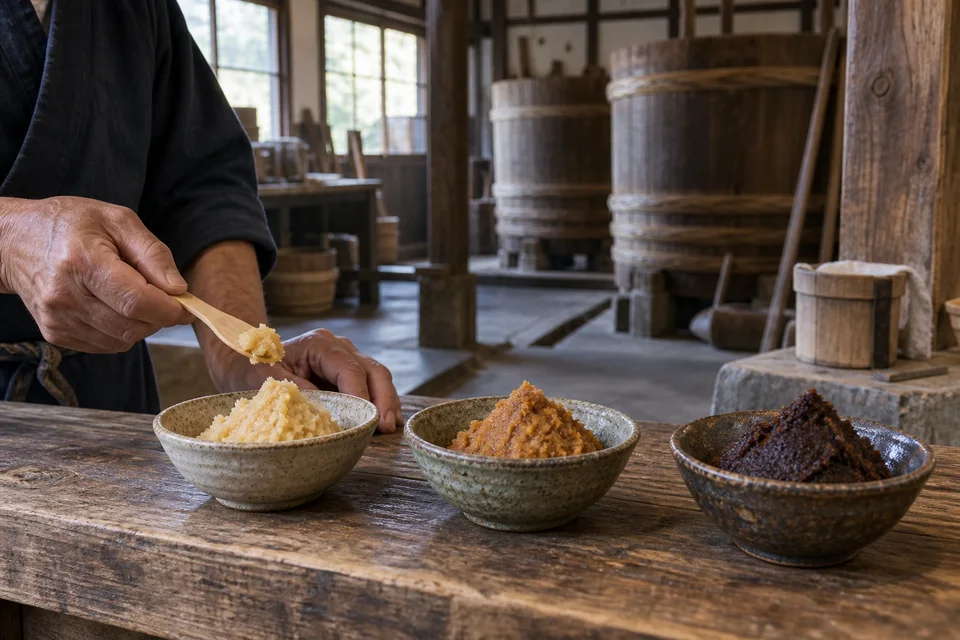
ONE SEASONING · MANY LANDSCAPES
Read soybeans, koji, place and cooking—not the colour of one bowl.
Miso does not make Japan taste the same. Some places culture koji on rice, others on barley, and the Tokai heartland works through soybean koji. Winter batches, castle-town storehouses, everyday soup and seasoning strong enough for simmering each shape a table. This atlas does not crown one “authentic” miso; it maps how to enjoy difference on the road.
- 12
- miso doorways
- 10
- dishes
- 6
- windows on place
30 SECONDS AT THE TABLE
At the bowl now? Keep only these three things.
- 01
Separate miso from miso soup
Miso is the seasoning. Stock, water, ingredients, heat and garnish make the bowl a second recipe.
- 02
Never use colour as a salt meter
Both pale and dark miso can move in sweet or savoury directions. Colour, place and saltiness are not one straight line.
- 03
Check the whole bowl for safety
Look beyond soy to stock, soy sauce, alcohol-derived seasoning, sesame and shared pots or ladles when they matter to you.
MISO IS NOT MISO SOUP
Separate the brewery’s recipe from the kitchen’s recipe.
At the brewery, soybeans, koji, salt, water, microbial conditions and time make miso. In the kitchen, the cook chooses stock, dilution, ingredients and heat. The miso label cannot describe the whole soup.
01 · THE WORD IS A DOOR, NOT A VERDICT
White, red, sweet and savoury do not belong on one axis.
One shelf mixes words for ingredients, colour, taste, finishing and product format. Separating twelve terms stops quick guesses such as “red means salty” or “mugi means wheat”.
味噌
misoA fermented seasoning usually made from cooked soybeans, koji, salt and time. The word alone does not identify the koji grain, sweetness, stock or every added ingredient.
米味噌
kome misoMiso made with rice koji. It spans pale sweet miso, light-coloured everyday miso and long-matured red expressions; it is not one flavour.
麦味噌
mugi misoMiso made with barley koji. Grain aroma can be easy to notice, and the style is deeply associated with parts of Shikoku, Kyushu and western Japan.
豆味噌
mame misoMiso in which soybeans provide the main material for both the base and koji. Tokai examples can be dark, concentrated and resilient in simmered dishes.
調合味噌
chōgō misoA blend of more than one miso category or a product in which different styles are combined. “Blended” describes composition, not inferiority.
白味噌
shiro misoA common market and culinary name for pale miso, often sweet, but not a universal legal shortcut for one recipe or salt level.
淡色味噌
tanshoku misoA light-coloured classification within rice miso. Colour is a useful description, not a complete taste or ingredient chart.
赤味噌
aka misoA broad everyday name for reddish or dark miso. Some are rice miso, some soybean miso; darkness does not prove one region or salt level.
甘味噌/辛口味噌
ama miso / karakuchi misoTerms about the balance created by salt, koji ratio and process. Karakuchi means less sweet or more savoury/salty in this context—not chilli heat.
生味噌
nama misoA label term often used when the miso has not been heat-treated after maturation. It does not guarantee live cultures in the served dish or suitability for a diet.
だし入り味噌
dashi-iri misoMiso sold with stock ingredients or extracts already mixed in. Fish or other ingredients can be present before the cook adds anything.
手前味噌
temae misoLiterally “one’s own household miso”; now also an idiom for praising one’s own work. It recalls a time when household or local batches differed visibly.
02 · BEFORE THE BOWL
Prepare the beans, choose a koji route, then entrust the mixture to time.
These five steps are a framework. Washing, cooking, ratios, vessels, temperature, maturation and post-treatment vary by maker and product.
- 01豆
Prepare the soybeans
Soybeans are washed, soaked and cooked until their structure can be worked into a paste. The exact preparation changes by maker and style.
- 02麹
Choose the koji route
Koji cultivated on rice, barley or soybeans gives the major category its name. Enzymes help break down starches and proteins during the process.
- 03塩
Mix and protect
Salt, prepared soybeans and koji are mixed. Ratio, moisture, temperature and microbial environment influence the path; no single home formula describes every miso.
- 04時
Ferment and mature
Days, months or longer may pass depending on the intended style. Time works with ingredients and conditions; a darker colour is not a stopwatch by itself.
- 05椀
Season the finished dish
The maker finishes miso; the cook then chooses dashi, dilution, heat, vegetables, proteins and garnish. The bowl is a second recipe.
03 · TWELVE DOORWAYS
Follow your appetite to the next miso.
These twelve entries include regional styles, koji ingredients, texture and product formats. They overlap: a Shinshū miso can be grainy, and an instant soup can use a blend. Start with a line that interests you and follow its links.
Flavour notes help you explore differences between products. Use current labels and venue checks for ingredients and dietary suitability.
Saikyō-style white miso
西京白味噌A soft sweetness and smooth body can support New Year ozōni, dengaku and dressings. Try a small amount first: it behaves more like a rounded seasoning than a dark soup base.
Edo sweet miso
江戸甘味噌A reddish sweet rice miso that shows why “red” cannot simply mean salty. Its colour and sweetness form a useful contrast with pale sweet miso.
Shinshū miso
信州味噌A widely recognised salty rice-miso family, often light in colour. It is a good baseline for tasting aroma and finish before comparing sweeter or darker directions.
Sendai miso
仙台味噌Often described through a firm, savoury red rice-miso direction. Let it meet root vegetables or grilled food, where depth can become structure rather than simply salt.
Tsugaru miso
津軽味噌A northern rice-miso direction associated with deeper colour and longer maturation. Taste it with the question “what food and winter did this strength have to carry?”
Echigo and visible-koji styles
越後味噌・浮き麹味噌Some northern rice miso leaves visible grains or floating koji, turning texture into part of the experience. Grain is not a defect; ask whether the product is strained or unstrained.
Setouchi barley miso
瀬戸内の麦味噌Barley aroma and a gentle sweetness can make an everyday soup feel broad rather than heavy. Taste the grain note before deciding it is simply “mild”.
Kyushu barley miso
九州の麦味噌Many travellers notice a sweeter, rounder direction than their first Tokyo bowl. Pair it with local vegetables or pork before treating sweetness as a novelty.
Tokai soybean miso
東海の豆味噌A dark, concentrated soybean-miso direction can carry long simmering without disappearing. Its bitterness, roast and savoury length become especially clear beside plain rice.
Awase miso
合わせ味噌A cook or maker can combine misos to adjust aroma, sweetness and finish. The point is not compromise: blending can be a deliberate house signature.
Grain, coarse and strained miso
粒味噌・こし味噌The same broad style can feel rustic with grains or polished after straining. This is a texture and finishing choice, not a simple quality ranking.
Dashi-added and instant miso
だし入り・即席味噌A single cup can be a useful first comparison and an easy hotel-room comfort. Convenience is a format, not proof of a simpler ingredient list.
04 · TEN WAYS MISO CHANGES ROLE
From soup to simmer, glaze and dressing.
The same miso changes when diluted, reduced, grilled or mixed with vinegar. Do not stop at soup; watch the seasoning move through ten dishes.
Miso soup
味噌汁The daily bowl is a composition of dashi, miso, water, ingredients, garnish and timing. Compare the aroma before stirring, then the final sip after the ingredients have seasoned the liquid.
Tonjiru / butajiru
豚汁Pork, roots and miso make soup into a meal. Regional naming and household contents vary; the visible pork also changes the stock, so removing pieces does not make it meat-free.
Miso-nikomi udon
味噌煮込みうどんIn Aichi, firm noodles and soybean-miso broth arrive still working in an earthen pot. Do not judge the noodle by the softness expected of another udon style; its resistance is part of the design.
Miso dengaku
味噌田楽Tofu, konnyaku, eggplant or taro becomes a surface for sweetened miso. It shows miso as glaze rather than soup; sesame, nuts or alcohol-derived seasonings may be in the paste.
Mackerel simmered in miso
さばの味噌煮Oily fish and ginger meet a miso sauce that grows glossy as it reduces. Eat a little fish, sauce and rice together; the relationship matters more than the sauce alone.
Dote-nabe
土手鍋Miso is spread around the inside of a pot and dissolves as oysters and vegetables cook. The meal changes over time; shellfish stock and concentration rise together.
Miso ramen
味噌ラーメンMiso is only one layer beside stock, aromatic oil, tare, noodles and toppings. A Sapporo-associated bowl can be rich and hot, but no one template describes every shop.
Hōba miso
朴葉味噌Miso and aromatics warm on a magnolia leaf, often beside rice in Hida. The leaf is cooking surface and aroma-bearing stage; ingredients vary by inn and set.
Miso-grilled rice ball
味噌焼きおにぎりA thin coat of seasoned miso caramelises over rice, bringing aroma before sweetness and salt. Let it cool briefly: the crust becomes easier to notice and safer to handle.
Miso-dressed vegetables
味噌和え・ぬたMiso becomes a dressing with vinegar, sugar, mustard or other accents. The quiet side dish can hide more ingredients than a plain vegetable appearance suggests.
05 · SIX WINDOWS ON PLACE
Walk from one bowl into place; do not colour the whole map.
Regional difference is not a fixed personality assigned to residents. Read these as representative windows shaped by grain, climate, preservation, trade, ceremony and neighbouring dishes.
Kyoto
A pale sweet-miso bowl can turn ozōni into a very different New Year landscape from clear soup or soy-seasoned forms elsewhere. Look for ceremonial use as well as colour.
Nagano
Shinshū miso offers a widely available reference point, while mountain vegetables and preservation keep the story tied to more than a factory label.
Sendai
The history of domain-scale preparation makes miso part of logistics and provisioning, not only home comfort. Today, compare makers rather than searching for one official taste.
Tokai
Soybean miso links bowls, stews, sauces and noodle pots across Aichi, Gifu and Mie. Repeated use is the point: one seasoning changes role with heat, dilution and fat.
Ehime and the Seto Inland Sea
Barley miso opens a story of local grain, warm climate and an everyday soup that can feel sweet without becoming dessert-like.
Kyushu and Kagoshima
Sweeter barley-miso directions meet pork, vegetables and local soups. The useful question is not “why is Kyushu miso sweet?” but “which koji, ratio and dish is in front of me?”
06 · THE YEAR IN FOUR DISHES
The same seasoning opens a different season.
New Year shapes, spring fragrance, summer coolness and winter heat: choose a dish through its ingredients, occasion and serving temperature. These are cultural seasons; individual menus and serving dates vary.
A bowl that carries a wish
A round mochi sits in pale soup. In Kyoto white-miso ozōni, the shape of the rice cake and the cut of the vegetables carry wishes for the year ahead. Once you notice that, breakfast becomes a small ceremony. Ask the host which ingredients matter in their version; family customs give the bowl its detail.
- On your trip
- Look for a current New Year menu or a specialist serving ozōni. Confirm the serving period when booking; Kyoto accommodation does not automatically include it.
- Before eating
- Check stock and toppings, including possible bonito flakes. Mochi is sticky; ask for a suitable alternative if it is difficult to chew or swallow.
White miso turns green
Kinome are young sanshō leaves. Crushed into a miso dressing for bamboo shoots, their aroma reaches you before the mild sweetness. The first contrast to notice is texture: tender bamboo still has a little resistance, while the dressing holds to its cut edges. Miso can make a seasonal ingredient easier to notice.
- On your trip
- Ask about takenoko no kinome-ae on a spring menu. Look for the words 木の芽 and たけのこ; harvest and serving dates vary.
- Before eating
- The green dressing can include egg yolk. Ask about the full dressing and any stock used for the bamboo shoots.
A cool bowl after the heat
Hiyajiru is a chilled miso mixture served over rice, often with fish, cucumber and herbs. It is associated with summer work and everyday food in Miyazaki. Watch how the crisp cucumber and soft rice meet in one spoonful. This is a different way to understand miso from the hot cup beside a set meal.
- On your trip
- Look for 冷や汁 on a local summer menu. Ask how that serving is eaten and whether the rice is plain or mixed with barley.
- Before eating
- Check fish, soy, sesame and peanuts, which appear in some versions, plus barley in the rice. A chilled vegetable appearance does not reveal the full recipe.
The forest becomes a cooking surface
Brown magnolia leaves are gathered and kept for hōba miso. In Hida’s account of the dish, a leaf by the hearth held miso and food that needed warming in a cold winter. At an inn today, the quiet bubbling and fragrance still make time visible: take a little of the cooked topping with rice as the host directs.
- On your trip
- Ask a Hida or Takayama inn whether hōba miso is on its current menu. Stored leaves allow service outside autumn, so the gathering season is not a restaurant calendar.
- Before eating
- Some versions add beef or other ingredients. Check the whole topping and follow staff guidance around the hot dish and burner.
07 · SIX MOMENTS ON YOUR TRIP
Try one small thing where you are.
Open your situation for a first step and a question to show locally. If you have a food allergy or dietary restriction, complete the checks you need before tasting. Go to safety checks ↗
01At a hotel breakfastRemember one bowl
Begin with the soup already on your tray. Notice the aroma, one ingredient and how the next bite of rice changes the taste. If breakfast has two soups, ask what they are before taking small portions. Different stock and ingredients mean you are comparing finished dishes, not measuring the miso alone.
Your first step
Write down the soup name and one detail you liked. That is enough to start a useful conversation at the next shop.
Read the bowlこの味噌汁には、何の味噌とだしを使っていますか?
What miso and stock are used in this soup?
02At a regional restaurantLet a dish explain the miso
If your first encounter was soup, choose a different role next: dengaku as a glaze, mackerel in sauce, or an udon pot. Read the whole menu description before ordering. Miso-nikomi udon and a light breakfast soup answer different appetites; neither is a better test of authenticity.
Your first step
Choose one dish that fits the meal you want, then ask how the miso is used. Confirm ingredients before ordering if you have dietary requirements.
Compare ten dishesこの料理では、味噌をどのように使っていますか?
How is the miso used in this dish?
03At a miso shop or food hallBuy for your next meal at home
Tell the seller what you plan to cook: soup for two, a vegetable dressing, or a glaze for rice. Then describe a flavour you liked. This gives them more to work with than asking for the best miso. If tasting is offered, follow their portions and serving method; do not use a shared sample spoon twice.
Your first step
Choose a small pack you can store as directed. Keep the maker and product name so you can find the same one again.
Read the pack味噌汁に使うなら、この中でどれがおすすめですか?最初はどのくらい入れるとよいですか?
Which of these would you suggest for miso soup, and how much should I start with?
04Before a brewery visitFind out what you can actually see
A shop, exhibition and working production area offer different visits. Ask which is open, whether booking is needed, the language available and the route through the building. Inside, one useful question is what the maker changes between batches: koji, water, vessel, temperature or time. Production may mean some areas cannot be shown.
Your first step
Use the maker’s current booking page for access and hygiene instructions. If the production area is closed, ask whether the shop can explain the miso on sale.
Learn the five stages first見学では製造している場所に入れますか?どの工程を見られますか?
Does the visit include the production area, and which parts of the process can we see?
05With an instant soup at the hotelRead the sachets before adding water
Paste, freeze-dried soup and separate garnish sachets are different formats. Read which packets go into the cup and the amount and temperature of water. The finished flavour depends on following that product’s directions. Use a suitable cup; do not put miso or other ingredients directly into the hotel kettle.
Your first step
Check stock and garnishes as well as the miso. Only buy opened-pack formats you can keep under the stated conditions.
Understand instant formatsこの二つの袋は両方入れますか?お湯はどのくらい入れますか?
Do I add both of these sachets? How much hot water should I use?
06Before buying a pack to take homeCheck storage, baggage and entry rules
First check whether the pack can travel under its storage instructions. Then check your airport and airline’s current rules for pastes in cabin baggage, and your destination authority’s rules for food imports. A shop can explain its product, but it cannot grant permission at airport security or the border. A sealed pack does not settle those questions.
Your first step
Keep the original ingredients and maker’s details. If you cannot establish suitable storage or entry permission, choose a different souvenir.
Read storage and ingredientsこの商品の原材料と、未開封の保存方法を見せてください。
Please show me the ingredients and storage instructions for this unopened pack.
08 · FIVE SCENES, NO SINGLE INVENTOR
Household batches grew into storehouses, towns and journeys.
Do not shrink the origin to one person or year. Follow five scenes: early records, the household, domains and towns, convenient formats and the modern brewery visit.
- 01記
Ancient records, uncertain origins
Japanese records preserve early words related to fermented soybean seasonings. Several origin stories exist; treat them as theories and textual traces, not one proved birthday for modern miso.
- 02家
Household batches and temae miso
When households or communities prepared their own batches, taste carried grain, climate, storage and family practice. The idiom temae miso still remembers pride in one’s own making.
- 03藩
Storehouses, domains and towns
Larger storehouses made miso part of provisioning, commerce and urban food. Sendai offers one vivid case, while other regions built different maker and market histories.
- 04工
Standardisation and convenient formats
Industrial production, blending, packaging, dashi-added miso and instant soup widened access. Convenience did not erase regional style; old and new methods now share the same shelf.
- 05旅
The brewery as a travel stop
A brewery visit turns an invisible process into smell, temperature, vessels and conversation. Follow hygiene rules, photography guidance and the maker’s own explanation instead of treating every vat as a stage set.
09 · READ TEN LINES BEFORE BUYING
A small pack contains flavour—and a route home.
The product name suggests the koji route; ingredients reveal hidden stock; storage instructions shape hotel and flight decisions. Printed dates assume stated unopened storage. Check destination-country import rules separately.
- 01名称meishō
- Product name/category
Start with the stated category, such as rice, barley, soybean or blended miso.
- 02原材料名genzairyō-mei
- Ingredients
Read beyond soybeans, grain and salt for stock, seasonings and alcohol-derived ingredients.
- 03大豆daizu
- Soybeans
A core ingredient. If soy is an allergen for you, do not infer safety from portion size.
- 04米みそ・麦みそ・豆みそkome / mugi / mame miso
- Koji route
The name points to the koji route. Mugi miso generally uses barley, which itself contains gluten. Wheat-free does not mean gluten-free. Read the actual ingredients and cross-contact notice.
- 05だし入りdashi-iri
- Stock already added
Bonito, dried fish or seafood extract may already be mixed into the miso.
- 06生みそnama miso
- Unheated after maturation, in common use
Do not use this word to guarantee live cultures in the bowl or dietary suitability.
- 07酒精shusei
- Alcohol
It may be used for quality control. If you avoid alcohol, ask the maker about source and residual content.
- 08保存方法hozon hōhō
- Storage
Conditions may change after opening. Consider hotel temperature and the flight home before buying.
- 09賞味期限shōmi kigen
- Best-before date
A quality date under stated unopened storage, not a new deadline that automatically applies after opening.
- 10開封後要冷蔵kaihū-go yō reizō
- Refrigerate after opening
If opening during the trip, check refrigeration and travel time first.
10 · A THREE-CUP TASTING
Compare three under the same conditions, then return each to food.
Use this in your kitchen or in a tasting arranged by the shop. Complete any allergy or dietary checks first, and follow the shop’s tasting procedure and product instructions. At breakfast, enjoy the soups as served rather than taking kitchen seasonings for an experiment.
- 01
Build a three-point flight
Choose one pale sweet rice miso, one everyday rice or barley miso and one dark soybean or red miso. Three contrasts teach more than twelve random spoonfuls.
- 02
Dilute equally
Use the same warm water and amount for the first comparison. This is a tasting experiment, not a claim about each miso’s best soup recipe.
- 03
Read aroma, middle and finish
Smell first, take a small sip, then wait. Note sweetness, grain aroma, roast, acidity, bitterness and length without forcing a score.
- 04
Return each one to food
Try the favourite with tofu or vegetables, the darkest with rice, and the sweetest as a glaze. A seasoning reveals itself through a relationship, not an isolated spoonful.
11 · ALLERGY, DIET & SHARED TOOLS
Soy alone cannot answer whether the bowl is safe for you.
If you have a food allergy or medical dietary restriction, ask the venue before eating about the current miso, stock, soy sauce, sake, mirin or alcohol, seafood or meat extracts, sesame, nuts, milk or egg, plus shared pots, ladles, strainers and work surfaces. If the information you need cannot be confirmed, do not eat it.
Soy is a core ingredient
Do not infer safety from portion or colour; check the miso and finished dish.
Separate barley from wheat
Barley itself contains gluten. Ordinary barley miso is not a gluten-free choice, and wheat-free means something different. Check ingredients and shared preparation.
Stock is another ingredient layer
Bonito, dried fish, shellfish, chicken or pork can remain in soup or dashi-added miso with no visible piece.
Ask about shared tools
A label cannot explain every shared pan, ladle, strainer, measure, container or work surface.
12 · SHOW ONE SHORT QUESTION
Keep tasting advice separate from safety checks.
For flavour advice, describe one preference. For allergies or dietary restrictions, ask about specific ingredients and preparation before ordering or tasting. Showing a sentence cannot guarantee accommodation or safety.
この味噌は、米味噌、麦味噌、豆味噌のどれですか?
Is this rice, barley or soybean miso?この味噌汁のだしは何ですか?
What stock is used in this miso soup?甘めと、うま味が強いものを少しずつ試したいです。
I would like small tastes of one sweeter and one deeply savoury miso.この料理には、だし入り味噌を使っていますか?
Does this dish use miso with stock already added?酒、みりん、酒精、酒粕は入っていますか?
Does it contain sake, mirin, alcohol or sake lees?原材料表示と、開封後の保存方法を見せてください。
Please show me the ingredients and storage instructions after opening.未開封では、どの温度で保存する必要がありますか?
At what temperature must this be stored while unopened?食物アレルギーがあります。この料理全体の原材料と、だし、調味料、共用する鍋やお玉を確認してください。確認できなければ食べません。
I have a food allergy. Please check the whole dish, including stock, seasonings and shared pots or ladles. I will not eat it if this cannot be confirmed.EIGHT QUESTIONS COLOUR CANNOT ANSWER
Sweetness, dietary needs, brewery visits and the journey home.
Is darker miso always saltier?
No. Colour is shaped by ingredients, ratios, heat and maturation, while perceived saltiness also depends on the recipe and dilution. Edo sweet miso is a useful counterexample: reddish and sweet. Read the type and taste it rather than using colour as a salt meter.
Is white miso always sweet?
Many well-known white misos are sweet, but “white miso” is used broadly in markets and kitchens. Check the maker’s description, ingredients and intended use instead of applying one recipe to every pale pack.
Is miso soup vegetarian or vegan?
Not automatically. Miso can be made from soybeans, grain and salt, while the soup may use bonito, small fish, shellfish, meat stock or dashi-added miso. Confirm the finished bowl and shared kitchen with the venue.
Is barley miso gluten-free?
Barley contains gluten, so ordinary barley miso is not a gluten-free choice. Wheat-free and gluten-free mean different things. If you need to avoid gluten, check the current product, stock, seasonings and shared preparation with the maker or venue; do not eat when the required information cannot be confirmed.
Does boiling destroy the benefit of miso?
This guide does not make probiotic or health promises. Heat changes aroma and the state of microorganisms, but a served bowl also depends on safety, storage and recipe. Enjoy the cook’s intended aroma, and use medical or nutritional advice from qualified sources for health decisions.
Can I visit a miso brewery?
Some makers offer tours, shops or tastings; others cannot admit visitors because of hygiene, production or season. Reserve through the maker’s current official information and follow rules for shoes, food, photography and fragrance.
How should I carry miso home?
Choose a sealed pack, read storage and date information, protect it from heat and leakage, and keep the ingredients visible. Rules for animal or plant ingredients differ by destination, so check your home-country authority and airline before purchase.
What is the best first miso to try?
There is no universal winner. Compare three directions: pale and sweet, grain-aromatic and everyday, dark and deeply savoury. The contrast helps you name what you want at breakfast, a shop or a brewery.
OFFICIAL SOURCES & EDITORIAL LIMITS
Go deep on culture; confirm today’s bowl every time.
Sources checked 2026-09-13; next review scheduled for 2026-12-13. Official MAFF, Consumer Affairs Agency and JNTO material was compared for types, ingredients, koji, fermentation and maturation, regional dishes and labels. Place notes are representative doorways, not one recipe imposed on every home, brewery, venue or product. Current labels, makers, venues and destination authorities prevail for ingredients, maturation, storage, dates, visits and border permission.
AI language quality review completed; no human native-speaker review was performed.
- MAFF: soy sauce, miso and other traditional seasonings
- MAFF: regional diversity of miso
- MAFF: Japanese fermented foods and miso
- MAFF: fermentation and koji
- MAFF: Miyagi food culture and Sendai miso
- MAFF: Aichi food culture
- MAFF: Aichi miso-nikomi udon
- MAFF: Ehime barley-miso soup
- MAFF: Toyama rice-koji miso
- MAFF: Kagoshima tonjiru
- JNTO: an Akita miso and soy-sauce brewery
- Consumer Affairs Agency: food allergy information
- Consumer Affairs Agency: use-by and best-before dates
- MAFF: Kyoto white-miso ozōni
- MAFF: bamboo shoots with kinome miso
- MAFF: Miyazaki hiyajiru
- MAFF: Hida and Takayama hōba miso
- NIDDK: gluten-containing grains and coeliac disease