You wore slippers onto the tatami
Step back, take them off and say a brief sorry. Ask where they belong. A small correction is enough; it need not spoil the welcome.
RYOKAN · A NIGHT IN JAPAN
The changing room, the pace of dinner, a yukata after a bath and rice at breakfast: understand the small moments that make a ryokan stay memorable.
Source facts checked
Full article quality audit
TRIP POCKET
Keep this guide on this device and prepare it for weak or missing signal.
BEFORE YOU GO
Picture leaving a station with one small bag and no attraction left to tick off that day. The pleasure begins with that decision. A dinner-included ryokan stay works best when the property itself has time in your itinerary: settling in, looking out of the window, bathing if you wish, and sitting down to a meal without watching the next train.
A ryokan is a Japanese-style inn, but the word does not promise a particular building, price or service. Some have a handful of rooms, others many floors. You may sleep on a bed, eat in a restaurant, or stay without meals. The useful question is what the selected room and plan include. A modern property is not less worthy of your attention simply because it has lifts or chairs.
For a first visit, consider a night after you have recovered from the international flight. If arrival-day travel is unavoidable, work backwards from the property’s latest dinner arrival, allowing for immigration, luggage, transfers and the final bus or pickup. Tell the inn when your plan changes. A message sent while still on the train gives the kitchen more room to respond.
Sources: Japan Ryokan Association · different kinds of inn / JNTO · Japanese ryokan
Back to contents ↑A LITTLE BACKGROUND
To understand why food and lodging sit so closely together, look beyond the room. Along the Nakasendo, the road linking Edo and Kyoto, post towns provided places to rest and stay. JNTO describes 69 of these towns along the route. The traveller’s arrival was part of the town’s working life: shelter, a meal, supplies and a departure the next morning.
That history is a lens, not a claim that every ryokan is a surviving roadside inn. Hot-spring settlements, city inns and modern resort properties have different stories. Ask what was here before the present building, or which food comes from nearby. A specific answer about one river, trade route or local craft tells you more than a vague promise of “traditional Japan”.
You can carry this way of looking into the stay. Notice the wood in a tray, the name on a small sweet, or the town written beside a vegetable on the menu. They are starting points for conversation, not a test you have to pass. Some objects will be locally made; others will be ordinary supplies. Both belong to a place people keep running every day.
Sources: JNTO · the Nakasendo and its post towns
Back to contents ↑ARRIVE
At the entrance, pause long enough to see where shoes stop. Some inns ask you to remove them at the main door, others at the room. Follow the staff and the floor rather than assuming every corridor works alike. Once on tatami, take off slippers too. Ask where to place a suitcase instead of rolling its wheels across the mats.
The change in floor matters because a room can be used close to the ground. You will sit, perhaps dine and later sleep here. Keeping outdoor grit at the entrance protects that shared surface. There is no need to perform an elaborate bow or wait for a perfectly memorised greeting. A hello, your reservation name and a willingness to ask are enough to begin.
Before the explanation ends, keep four details: dinner time and place, breakfast time, the bathing arrangement, and how to reach staff later. If floor seating is difficult, ask for a chair now. If a wheelchair is part of your travel, use the arrangements agreed with the property; do not attempt an improvised transfer simply because the floor changes.
Sources: Japan Ryokan Association · from corridor to room / JNTO · bathing and indoor customs
Back to contents ↑SETTLE IN
A tray may already be waiting, or a member of staff may prepare tea. The association’s guide describes tea and sweets as a welcome also rooted in domestic hospitality. It need not be a formal tea ceremony. Look at the cup, let the drink cool, and take a moment before opening every bag.
If there is a wrapped sweet, its label may introduce a local maker or ingredient. Keep the wrapper if you want to find it again. Do not assume a complimentary sweet is safe for an allergy: check its packaging and ask about unpackaged items before eating. The same care applies to an unfamiliar tea blend.
Our suggestion is to spend five unplanned minutes here. Look at how the window frames the garden instead of opening a map immediately. A trip often trains you to keep moving. The room gives you permission to stop, and the small welcome makes that stop feel less abrupt.
Sources: Japan Ryokan Association · tea and the welcome
Back to contents ↑LOOK AROUND
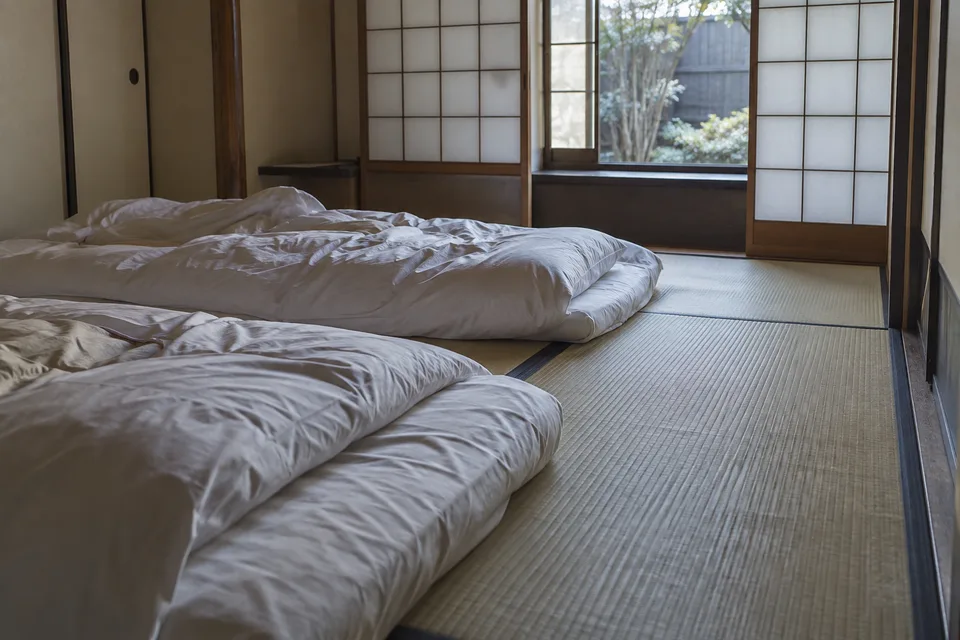
The absence of a bed can be the most surprising first impression. In a futon room, bedding is stored until it is needed, leaving space for sitting and talking. Later the table may move and bedding appear. A washitsu, or Japanese-style room, is easier to understand as a space arranged for different moments than as a bedroom missing its furniture.
Shoji filter light through paper; fusuma are opaque sliding partitions. A tokonoma is a display alcove, often holding a scroll, flowers or an object chosen for the room. It is not a luggage shelf. Let the quiet parts stay quiet: you do not need to open storage cupboards to understand the room. Ask where guests may put their belongings.
A useful way to look is to compare the room at three moments: before dinner, at bedtime and after waking. The light, visible floor and placement of objects change without a new room being built. If getting up from a low surface is uncomfortable, choose a bed and raised chair; noticing these qualities does not require sleeping on the floor.
Sources: Japan Ryokan Association · the Japanese-style room / Japan Ryokan Association · sleeping on a futon / The Japan Forum · shoji, fusuma and the tokonoma
Back to contents ↑CHANGE PACE
The cotton robe in the room is a yukata. Put the wearer’s left front panel over the right, then fasten the sash. The direction is your own left, not the left in a mirror. If it feels awkward, ask a member of staff to show you. A smaller or larger size may be available; ask rather than tying an uncomfortable fit more tightly.
The property decides where it may be worn: dinner, the lobby, the garden or outside. Some offer separate sleepwear. A haori, a short outer garment, can add a layer, but neither robe nor footwear is automatically yours to keep. For a walk, choose shoes you can use comfortably. Enjoying a town in your own clothes is just as valid.
The pleasant part is practical: fewer decisions about what to wear between bathing and dinner. Watch how the robe changes the pace of your movements. Keep sleeves away from flames and food, and use the sash firmly enough to move without having to hold the garment closed.
Sources: Japan Ryokan Association · wearing a yukata
Back to contents ↑BATH TIME
A ryokan is the accommodation; an onsen describes hot-spring water. They are not interchangeable words. A shared bath, a bookable private bath and a bath attached to your room are three different arrangements. An open-air bath describes its setting, not who else can use it. Confirm whether the exact bath you want has hot-spring water and how it is reserved.
For a conventional shared bath, undress in the changing area, wash and rinse thoroughly at the washing place, then enter the tub. Keep towels and hair out of the water. Follow the actual bathing signs: special mixed facilities or private arrangements can have different clothing rules. Leave cameras and phones out of bathing and changing areas unless the facility explicitly provides a permitted arrangement.
Ask about tattoo rules before booking; a cover sticker is not universal permission. Children, assistance, gendered facilities and changing-room privacy also deserve an exact answer from the inn. You can choose a private option or skip bathing. If you feel unwell, do not force a hot bath to complete the experience; ask staff for help when needed.
Sources: JNTO · enjoying an onsen / JNTO · bathing and indoor customs
Back to contents ↑AT THE TABLE
At a course dinner, resist the feeling that the first dishes are the whole meal. Ask how the evening is organised, then begin with what staff have served as ready to eat. Warm dishes may arrive later. A lidded bowl, a grilled fish and a chilled plate ask for different temperatures and timing; the kitchen and dining room work together to make those moments meet.
Kaiseki on a booking page usually signals a course meal, not one fixed set of dishes. The same English spelling can represent 会席, associated with a dining occasion, or 懐石, associated with tea; restaurants also use the terms with overlap. A ryokan dinner is not automatically a formal tea gathering. Ask about the actual menu rather than trying to infer every course from the name.
Look for contrast: something crisp after something soft, a clear broth beside a richer flavour, an irregular ceramic plate beside a smooth lacquer bowl. The sequence makes a small amount of food worth attention. You do not need to recognise everything to enjoy it. “What is this ingredient?” often opens a better conversation than “What is the correct way to eat?”
Drinks and extra dishes may be charged separately. Ask before adding them, and say if you would like water or an alcohol-free choice. Request a fork, spoon, earlier rice or a slower pace if that would help; the kitchen will tell you what is possible. An unfinished dish is a reason to communicate, not a reason to eat an ingredient you cannot tolerate.
Sources: Japan Ryokan Association · dinner and its timing / MAFF · the meal within a tea gathering (Japanese) / MAFF · five cooking methods
Back to contents ↑NOTICE THE DETAILS
Seasonality is more interesting than a calendar of guaranteed ingredients. A menu may introduce the beginning of a season, celebrate its height or linger on its end. Weather, supply, preservation and the cook’s choice all matter. A leaf-shaped sweet can evoke a time of year even when the main ingredient is available for longer.
Choose one detail rather than photographing every plate. Notice whether the vessel feels cool or warm to the hand, where the food leaves an empty area, or why a garnish has been cut into that shape. A garnish or leaf is not necessarily edible. Ask if you are unsure. The object may simply have been chosen because it works well with the dish; there is no hidden symbolism to solve in every bowl.
In your own notes, record one taste, one object and one sentence someone told you. It is a small souvenir that does not need luggage space. Later, a similar bowl in a shop or the same vegetable at a market may bring the evening back more vividly than another photograph of the whole room.
Sources: MAFF · seasonality in cooking (Japanese) / MAFF · tableware and presentation (Japanese)
Back to contents ↑AFTER DINNER
In Kinosaki Onsen, the visitor experience extends into public baths and streets lined with inns and shops. The town’s official tourism site explains how local businesses, farmers and fishers support that economy. Choosing a sweet or a small craft can connect your stay to people beyond the property’s front desk.
That does not make every onsen town a walkable evening village. A hillside inn may be far from other businesses; a picturesque road may have steps, traffic or little lighting. Before leaving, check where your yukata and footwear may be used, what is open, and when you must return. Keep a room key and the property’s address accessible.
A lobby chair, a book or an early night may suit you better. Leave enough freedom for that. The inn is a workplace and, in some cases, someone’s family business. Quiet corridors and permission before photographing people make it easier to share the space without turning someone else’s evening into a performance.
Sources: Visit Kinosaki · the town and its inns / Visit Kinosaki · community and tourism
Back to contents ↑TURN IN
If your plan includes futon preparation, staff may enter while you dine. Agree on the timing and put away valuables and private items first. Some inns ask guests to prepare bedding themselves. A futon here means bedding laid on the floor, including a mattress and covering, rather than necessarily the folding sofa called a futon in some countries.
Before settling down, find the light switch, the route to the toilet and the number for staff. Leave a clear walking strip beside the bedding. If the mattress or pillow is uncomfortable, ask what alternatives exist; an extra layer is a request, not an entitlement. Avoid moving heavy tables or heaters to invent a new layout.
Now compare the view with the one you saw over tea. The table no longer organises the room; the bedding does. The pleasure is not proof that one way of sleeping is better. It is discovering that a familiar room can make space for a different part of the day.
Sources: Japan Ryokan Association · sleeping on a futon / Japan Ryokan Association · what futon means
Back to contents ↑WAKE UP
Rice, miso soup, a piece of grilled fish and several small accompaniments can make a breakfast tray look like dinner to a visitor used to toast. You can alternate small mouthfuls with rice, rather than finish every side dish in sequence. A whole fish may have bones. Ask how to handle an unfamiliar item; requesting cutlery is fine.
This is a ryokan breakfast, not a claim about what every Japanese household eats every morning. Bread, coffee, quick meals and many other routines are also part of daily life. A set breakfast gives the kitchen room to offer a more deliberate start. Ask about alternatives in advance if rice, fish or the set time does not fit your needs.
Give departure its own margin. Recheck the bill, any locally collected charges and the pickup arrangement before the last minute. Leave borrowed items in the room, check outlets and the safe, and ask about storing bags if you plan to explore. A warm thank-you can be specific: the soup, the view, the patient explanation. There is no need to manufacture a grand farewell.
Sources: Japan Ryokan Association · breakfast / Japan Ryokan Association · departure
Back to contents ↑A photograph, dish name or booking-site request cannot establish whether a meal is suitable. Tell the actual property every food you must avoid. Ask the kitchen about stock, sauces, processed ingredients and unintended cross-contact through shared equipment. Ask for a specific response before buying a meal plan, and reconfirm when the food is served.
Removing a visible ingredient does not remove an allergen already in a sauce or stock. “Request received” is not acceptance. If the property cannot confirm the conditions you need, do not assume the food is suitable. Agree a workable alternative before booking; follow your clinician’s individual advice for travel with allergies.
Sources: Consumer Affairs Agency · food allergy when eating out
Step back, take them off and say a brief sorry. Ask where they belong. A small correction is enough; it need not spoil the welcome.
Contact the property as soon as you know. Give a realistic arrival estimate and ask what can still be served, any charge, and a food alternative if dinner cannot be moved. Do not promise an arrival you cannot make.
Do not eat the uncertain dish or rely on removing a topping. Ask whether an independently confirmed alternative is possible. If not, discuss an appropriate food arrangement with the property and follow your existing medical plan.
Pause and tell staff the specific difficulty. Ask about an alternative within the property, availability and any charge before moving rooms or attempting a transfer. You can still enjoy dinner, the room and the town.
Show one question and wait for a reply. For an allergy, name the actual food separately; this general sentence is not an allergy card or a confirmation of safety.
到着が遅れそうです。夕食の時間に間に合うか、相談したいです。
We may arrive late. Could we discuss whether we can still make dinner?
靴はここで脱ぎますか?荷物はどこに置けばよいですか?
Should I take my shoes off here? Where should I put my luggage?
床に座るのが難しいので、椅子を用意できますか?
It is difficult for me to sit on the floor. Could you provide a chair?
浴衣の着方を教えてもらえますか?
Could you show me how to put on the yukata?
この料理には何が入っていますか?
What ingredients are in this dish?
食物アレルギーがあります。避ける食材をお伝えするので、だしや調味料、共用器具も厨房に確認してください。
I have a food allergy. I will explain the foods I must avoid. Please check the stock, seasonings and shared equipment with the kitchen too.
この料金は何の料金か、教えてもらえますか?
Could you explain what this charge is for?
Twelve menu terms, the changing seasons and three regional dishes. Find the pleasure in dinner and breakfast, with Japanese questions to use at the table.
Read the exact room and meal plan, compare the whole-stay cost, and confirm the bath, arrival and access conditions before paying.
Understand why the floor changes how a room is used.
Put the ryokan bath into Japan’s wider bathing culture.
Sources checked and text reviewed: / Next scheduled review:
Written from the official sources below. Examples are editorial scenarios, not a property inspection or a hosted stay. Historical association pages help explain customs; they are not used to promise current prices or service. Recheck the current property and exact plan before travelling.
Language review: AI-assisted checks of meaning, natural wording, travel usability and safety consistency in English and Japanese. No human native-speaker review has been completed.