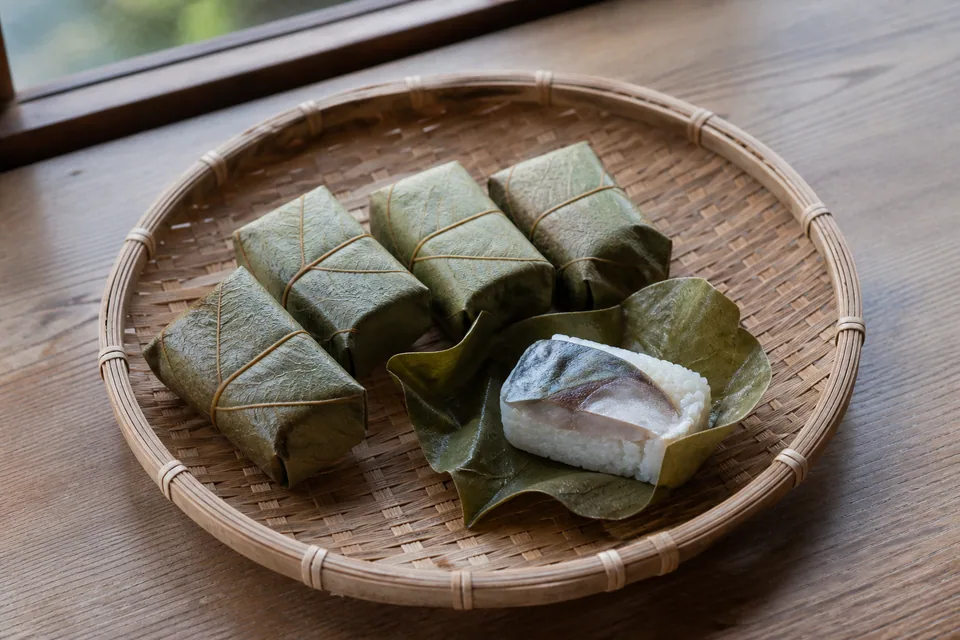
Nara kakinoha-zushi shown as leaf-wrapped pressed sushi; this editorial image does not represent a particular restaurant or today’s serving.
58 / 60
Leaf-wrapped pressed sushi
Cured fish, vinegar and leaf aroma
Compact and gently firm
Soy sauce
Usually none.
Wasabi
Not used.
WHAT IS IT?
What exactly is Nara kakinoha-zushi?
Kakinoha-zushi is cured mackerel or salmon over vinegared rice, wrapped individually in a persimmon leaf. The leaf is wrapping, not usually eaten.
CHOOSE WITH CONFIDENCE
Place Nara kakinoha-zushi beside two close relatives.
If the next question is “another flavour,” choose Osaka battera; if it is “another texture,” choose Toyama masu-zushi. Pick one while Nara kakinoha-zushi is still clear in memory.
PLACE & CONTEXT
Nara kakinoha-zushi and place
A Nara speciality linked to inland Gojo and Yoshino, commonly using mackerel or salmon.
YOUR FIRST PIECE
Build the baseline before seasoning.
Hands or chopsticks are both possible; start without extra seasoning. Taste: Cured fish, vinegar and leaf aroma. Texture: Compact and gently firm. Soy guidance: Usually none. Wasabi guidance: Not used.